


45PSI Tires MPG vs. 34PSI Tires MPG


Member
Joined: Jan 2008
Posts: 554
From: Orange County
Are we talking just the regular stock dunlops? Take a tire width of 205 and over inflate them. They'll feel like 195 witdth tires afterwards? Not really a safety hazard when overinflating 215 width tires? This is getting to vague for me now because different tires have different characteristics. Also, tires vary with alignment. If alignment is bad, tires will wear faster.
The stock fit is aligned so that the front will wear evenly between 32 to 34 PSI with 0 camber angle. The back setting is a negative camber, but I find that it wears out only the middle at 32-34 PSI. Ususally, the wear marks are noticeable after 200 miles of driving. This is also a reason why rotations are necessary to wear out the tires evenly.
The stock fit is aligned so that the front will wear evenly between 32 to 34 PSI with 0 camber angle. The back setting is a negative camber, but I find that it wears out only the middle at 32-34 PSI. Ususally, the wear marks are noticeable after 200 miles of driving. This is also a reason why rotations are necessary to wear out the tires evenly.

Member
Joined: Jul 2007
Posts: 604
From: Lexington, SC
So, I have put ~200miles on the tires at 60psig and have notice what SEEMS to be better handling around corners and a few more seconds longer at coasting. I haven't notice any decrease in braking(I don't remember what normal braking is like). The bumps and uneven ground are very noticeable but tolerable.
The Cornering is subjective - what seems to be handling better may be do to the car skidding and me not noticing since I don't hear the wheels chirp, however, it does not feel like the car is skidding or drifting it feels like it stick to the road which is contrary to what I would of thought.
I am referring to the STOCK SPORT DUNLOPS that come on the FIT.
I have to agree with mahout that the tire compound has a lot to do with traction of a car. You don't need a wider tire for better auto crossing but you do need a sticky tire which will come down to proper psig and what the tire is made of.
The Cornering is subjective - what seems to be handling better may be do to the car skidding and me not noticing since I don't hear the wheels chirp, however, it does not feel like the car is skidding or drifting it feels like it stick to the road which is contrary to what I would of thought.
I am referring to the STOCK SPORT DUNLOPS that come on the FIT.
I have to agree with mahout that the tire compound has a lot to do with traction of a car. You don't need a wider tire for better auto crossing but you do need a sticky tire which will come down to proper psig and what the tire is made of.
Last edited by pb and h; Jul 8, 2008 at 12:34 PM.

Push My Button

Joined: May 2007
Posts: 4,997
From: Calgary, Alberta
Hold on. we're talking about the changes in behavior with pressure on any given tire. There is a huge difference between not only different brands but also the lines within brands. But in general - and thats all we can do here - the maximum cornering and mpg occur near the maximum pressure 'allowed'. Tire wear is maximized near the manufacturers recommendation.
That maximum handling pressure depends on the wheel width as well as the profile. I, too, run 40 profile tires, 205/40x17 on 17x7 rims. My street pressures are 40 front and 36 rear. Whenever the rim width exceeds the bead width, as it does in this case, additional pressure is needed to just have the tread lay flat on the ground. That way I get acceptable life out of the tires while getting good handling thanks to the stiffer sidewalls.
Running 45 psi in a 55 series stiffens the sidewall to get pretty much the same handling as 40 psi in wider tires on a wider rimbut at the cost of less tire life,. (thats why SS racers increased pressure; a stiffer tire is more responsive and deforms less which is necessary for road racing.)
A quick survey here shows the 4 of us have used more than 10,000 tires in the last 40 years in both racing and street use. We all agree that for maximum performance, braking, cornering, and mpg, pressures higher than 'recommended' are better; for maximum tire life pressures a little less than recommended is better. Tire life is opposite of mpg.How much above and below 'recommended' is indeed different for each tire,
Rolling friction is not just a result of hardening or surface contact. The materials and tread design are also heavy factors. The less a tire surface deforms when it rolls is the key to lowering rolling friction. Hardening and pressure contribute but the rubber composition and tread design probably have more to contribute. A tire with no deformation would yield less rolling friction but would be a tad difficult to turn or shed water.
PS the general rule for altering pressures on tires is when the rim width exceeds the 'nominal' rim width the pressure shouldd be increased to get the tread' flat. when the rim width is less than the 'nominal' rim width the press ure br reduced to get the tread 'flat' The nominal rim width, or presumptionally the bead width, can be found in TireRacks specifications data.
That maximum handling pressure depends on the wheel width as well as the profile. I, too, run 40 profile tires, 205/40x17 on 17x7 rims. My street pressures are 40 front and 36 rear. Whenever the rim width exceeds the bead width, as it does in this case, additional pressure is needed to just have the tread lay flat on the ground. That way I get acceptable life out of the tires while getting good handling thanks to the stiffer sidewalls.
Running 45 psi in a 55 series stiffens the sidewall to get pretty much the same handling as 40 psi in wider tires on a wider rimbut at the cost of less tire life,. (thats why SS racers increased pressure; a stiffer tire is more responsive and deforms less which is necessary for road racing.)
A quick survey here shows the 4 of us have used more than 10,000 tires in the last 40 years in both racing and street use. We all agree that for maximum performance, braking, cornering, and mpg, pressures higher than 'recommended' are better; for maximum tire life pressures a little less than recommended is better. Tire life is opposite of mpg.How much above and below 'recommended' is indeed different for each tire,
Rolling friction is not just a result of hardening or surface contact. The materials and tread design are also heavy factors. The less a tire surface deforms when it rolls is the key to lowering rolling friction. Hardening and pressure contribute but the rubber composition and tread design probably have more to contribute. A tire with no deformation would yield less rolling friction but would be a tad difficult to turn or shed water.
PS the general rule for altering pressures on tires is when the rim width exceeds the 'nominal' rim width the pressure shouldd be increased to get the tread' flat. when the rim width is less than the 'nominal' rim width the press ure br reduced to get the tread 'flat' The nominal rim width, or presumptionally the bead width, can be found in TireRacks specifications data.
 Our opinions are only separated by a couple of pounds on this issue and that can be easily attributed to tire brand and car setup. With that said, am I to understand that your street pressures represent what you believe to be a happy medium between MPG and handeling? or just Handeling?
Ok, but as far as sidewall max goes that number shouldn't even be relevant other than ensuring you arn't exceeding it for safety reasons. Using a precentage of that should only be considered when refering to a specific tire.
Actually for the track I plan to use 38 front and 40 rear next time out, are you running a RSB by chance?
Last edited by Sugarphreak; Jul 8, 2008 at 12:50 PM.
Member
Joined: Jan 2008
Posts: 4,371
From: NC USA
I don't know enough about tires on road to know if a tire on normal asphalt has a constant coefficient of friction but it isn't a violation of a law of physics for an increase in tire pressure to have no effect on braking or cornering as long as the tire hasn't lost it's grip.
First, the basic friction law F=uN is for non-deforming surfaces. Rubber doesn't fall in that catagory. Think of it as a deformable surface penetrating a non-smooth surface. Depending on the tread pressure (not the tire pressure) the deformable surface squeezes into the pits in the non-smooth surface, the tentacles in the road surface creating more than 1 g of 'adhesion' more like a gear than a fruction surface. (if you want a funny time research the argunments in drag racing prior to dragsters getting over 1 g acceleration, There were many proponents that dragsters could not accelerate faster than 1 g and opposed by those who took the side of rubber deforming into the pits and literally hooking up to get g forces as much as 3 or 4 to 1.)
When that Texas dragster ran a quarter-mile in less the 9 seconds at over 156 mph the argument was settled. Indy Cars and F! as well as dragsters depend on maximizing that pentetration with strong tentacles.
Second, its a big argument now whether tire contact surface change is directly related to tire pressure. I'm on the side that is doesn't because the structure of the tire interferes. When the tire pressure or tire structure changes the contact patch is changed but not directly related. An example would be supporting the vehicle on 2x4' or 2x6's. The load doesn't change but the surface pressure changes. A tire is more flexible than a 2x4 or 2x6 so there is an effect but not directly related. Thats why making suspension changes to suit weather or track is so diificult. Its one thing to change surfaxce pressure but another to maximize tentacles into the surface that are strong enough to hold without breaking,
PS changing tire pressures is mostly used not only to affect the road surace patch (hence the tentacles) but also to change the spring on the suspension. Drives NASCAR crew chiefs wild. And Goodyear techs.
First, the basic friction law F=uN is for non-deforming surfaces. Rubber doesn't fall in that catagory. Think of it as a deformable surface penetrating a non-smooth surface. Depending on the tread pressure (not the tire pressure) the deformable surface squeezes into the pits in the non-smooth surface, the tentacles in the road surface creating more than 1 g of 'adhesion' more like a gear than a fruction surface. (if you want a funny time research the argunments in drag racing prior to dragsters getting over 1 g acceleration, There were many proponents that dragsters could not accelerate faster than 1 g and opposed by those who took the side of rubber deforming into the pits and literally hooking up to get g forces as much as 3 or 4 to 1.)
When that Texas dragster ran a quarter-mile in less the 9 seconds at over 156 mph the argument was settled. Indy Cars and F! as well as dragsters depend on maximizing that pentetration with strong tentacles.
Second, its a big argument now whether tire contact surface change is directly related to tire pressure. I'm on the side that is doesn't because the structure of the tire interferes. When the tire pressure or tire structure changes the contact patch is changed but not directly related. An example would be supporting the vehicle on 2x4' or 2x6's. The load doesn't change but the surface pressure changes. A tire is more flexible than a 2x4 or 2x6 so there is an effect but not directly related. Thats why making suspension changes to suit weather or track is so diificult. Its one thing to change surfaxce pressure but another to maximize tentacles into the surface that are strong enough to hold without breaking,
PS changing tire pressures is mostly used not only to affect the road surace patch (hence the tentacles) but also to change the spring on the suspension. Drives NASCAR crew chiefs wild. And Goodyear techs.
Last edited by mahout; Jul 8, 2008 at 12:50 PM.
Member
Joined: Feb 2008
Posts: 1,049
From: lake worth FL
I do not understand why Performance "handling" as in cornering or braking has any bearing on this at least from what I think Shawn is doing. ie 99% Eco. driven. My feeling is the performance from 30 to 60psi on these tires would ONLY show up at a track on a course with a stop watch pressing the car to it's limits. That is meaningless in a thread about Eco. In addition IMHO I would never exceed the side wall pressure without 1st hand knowledge of the real deign limits. To me if it says "maximum pressure" that may as well come from God. it's an engineering thing folks.

That said, Eco to me is total cost and I think it's wise to keep an eye on the overall cost when making changes to improve mpg performance. That is changing the tire pressure from 45 to 60 may save 1% on fuel use but may also cost you 3% more for tire use. Net savings -2%. Put that in $ of the life of the trie to get a fell for it. The cost to replace them is around $500. Figure avg use is 35k that's about $6 per tank of fuel.
That total cost concept is out of reach for many Fit users based on what I read here over and over, but one I like to understand and quantify.
have fun!
That said, Eco to me is total cost and I think it's wise to keep an eye on the overall cost when making changes to improve mpg performance. That is changing the tire pressure from 45 to 60 may save 1% on fuel use but may also cost you 3% more for tire use. Net savings -2%. Put that in $ of the life of the trie to get a fell for it. The cost to replace them is around $500. Figure avg use is 35k that's about $6 per tank of fuel.
That total cost concept is out of reach for many Fit users
based on what I read here over and over, but one I like to understand and quantify.have fun!
Member
Joined: Jul 2007
Posts: 604
From: Lexington, SC
Ok, so supposedly these tires wore the way they did using the recommend psig:
Check this out about load and psi:
http://www.geocities.com/barrystiretech/footprint.jpg
Again, as Paul has stated, "ECO" we are dealing with the ECO side here. I am trying to figure out how long we can make these tires last and what is the best psig to make that happen. Everything is within reason of course.
Errr... NO. Tires will last LONGER, not shorter.
Try Wayne's accord with 100,000+ miles on the original tires and completely even treadwear.
This is what happens when you use Toyota's recommended pressure for the Prius. I've seen similar results on my Civic at Honda's specified pressure.
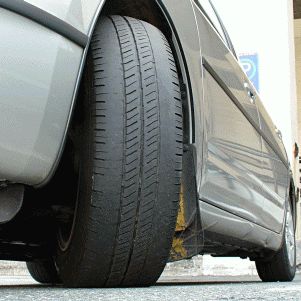
The pressure you should use is the sidewall rating: 44 psi in most cases. If you want to go higher, you can, but we don't officially recommend it.
Try Wayne's accord with 100,000+ miles on the original tires and completely even treadwear.
This is what happens when you use Toyota's recommended pressure for the Prius. I've seen similar results on my Civic at Honda's specified pressure.
The pressure you should use is the sidewall rating: 44 psi in most cases. If you want to go higher, you can, but we don't officially recommend it.
Check this out about load and psi:
http://www.geocities.com/barrystiretech/footprint.jpg
Again, as Paul has stated, "ECO" we are dealing with the ECO side here. I am trying to figure out how long we can make these tires last and what is the best psig to make that happen. Everything is within reason of course.
Push My Button
Joined: May 2007
Posts: 4,997
From: Calgary, Alberta
I do not understand why Performance "handling" as in cornering or braking has any bearing on this at least from what I think Shawn is doing. ie 99% Eco. driven. My feeling is the performance from 30 to 60psi on these tires would ONLY show up at a track on a course with a stop watch pressing the car to it's limits. That is meaningless in a thread about Eco.
Yes for eco reasons it would probably be better if we all ran the thinnest wheels availaible and drove 20mph everywhere with as slow acceleration as possible. This would be great for MPG on a closed course.
But in the real world where people and pedestrians are all around us we need to consider safety factors and be responcible. This has been my arguement the whole time.
That said, Eco to me is total cost and I think it's wise to keep an eye on the overall cost when making changes to improve mpg performance. That is changing the tire pressure from 45 to 60 may save 1% on fuel use but may also cost you 3% more for tire use. Net savings -2%. Put that in $ of the life of the trie to get a fell for it. The cost to replace them is around $500. Figure avg use is 35k that's about $6 per tank of fuel.
Seems to me that something I overlooked was sidewall size which probably plays a larger factor in tire pressures that I had originally considered.
Member
Joined: Jan 2008
Posts: 4,371
From: NC USA
Your street pressures are very close to what I would reccomend as well Our opinions are only separated by a couple of pounds on this issue and that can be easily attributed to tire brand and car setup. With that said, am I to understand that your street pressures represent what you believe to be a happy medium between MPG and handeling? or just Handeling?
Ok, but as far as sidewall max goes that number shouldn't even be relevant other than ensuring you arn't exceeding it for safety reasons. Using a precentage of that should only be considered when refering to a specific tire.
Actually for the track I plan to use 38 front and 40 rear next time out, are you running a RSB by chance?
Our opinions are only separated by a couple of pounds on this issue and that can be easily attributed to tire brand and car setup. With that said, am I to understand that your street pressures represent what you believe to be a happy medium between MPG and handeling? or just Handeling?Ok, but as far as sidewall max goes that number shouldn't even be relevant other than ensuring you arn't exceeding it for safety reasons. Using a precentage of that should only be considered when refering to a specific tire.
Actually for the track I plan to use 38 front and 40 rear next time out, are you running a RSB by chance?
Miy tire pressures are mostly for handling and whatever mpg results. A couple of psi is meaningless; as you say its the setup depends on suspension, tires, and driver. Tire life is almost immaterial.
And I don't run any antisway bar front or rear. (front's disconnected) I want to keep my inside tires on the ground for maximum cornering, Putting any antisway bar upfront [s counterproductive, the Fit just smokes the inside tire and loses speed. A RSB with the stock FSB may be nice but the Fit is so tall the weight transfer neans the inside tires lose traction earlier. My Fit with stock FSB is scarier than heck at Oak Tree, but not so without. Or anywhere else. Rotation good, cornering speed good.
PS you are using high rear pressures to generate oversteer (acheiving rotation) at the expense of cornering power. Rotation is necessary but not at the expense of cornering speed. It just takes practice.
Last edited by mahout; Jul 20, 2008 at 07:29 PM.

Member
Joined: Oct 2007
Posts: 388
From: Amish Paradise, PA
Check this out about load and psi:
http://www.geocities.com/barrystiretech/footprint.jpg
http://www.geocities.com/barrystiretech/footprint.jpg
It is still my experience that tires inflated to within a few PSI of the max rating flex less, heat up less, and wear less than those run in the 30s. I am in it for fun and eco. Just because I hypermile doesn't mean I don't enjoy a zip or two around the exit ramp, and running anything under the mid 40's won't work for either.
We have all made a great choice in driving a car consistently top-rated in low cost of ownership. In the unlikely event that running max PSI causes even a 20% reduction in tire life, we are still hundreds of dollars ahead of someone who buys even ONE performance part for a Fit, (of which there are far greater numbers on this site; power adders on a 109 hp car? Puh-leease.)
Push My Button
Joined: May 2007
Posts: 4,997
From: Calgary, Alberta
^^^ I see. I figured you were either running a RSB or had the front disconnected if you were running higher pressure in the fronts rather than the rears.
I don't know that I agree that a FSB is counterproductive. I am running a stiffer FSB in my Fit so I need to loosen off the front end pressures to comphensate. I find it rotates nicely and seems to hold better through the corner than with the stock bar. But you are correct that I am trying to induce some oversteer so I can come in quicker on the corners. I like to leave the rear a bit loose, just preference.
I don't know that I agree that a FSB is counterproductive. I am running a stiffer FSB in my Fit so I need to loosen off the front end pressures to comphensate. I find it rotates nicely and seems to hold better through the corner than with the stock bar. But you are correct that I am trying to induce some oversteer so I can come in quicker on the corners. I like to leave the rear a bit loose, just preference.
Push My Button
Joined: May 2007
Posts: 4,997
From: Calgary, Alberta
Meh, this car needs an extra 25% more power to make it fun
 If I was that concened about money I would have picked up an old diesel rabbit. Live a little RichXKU!

Member
Joined: Feb 2008
Posts: 84
From: ontario
The coefficient of expansion of nitrogen is less than that of oxygen so the pressure increase is less.
Its only significance is in racing where heat buildup is extreme (on the order of a hundred degrees or more) and critical to the tire not overpressurizing, losing valuable contact surface.
I've forgotten what the optimum tire temps for GY race tires but it seems that it was around 220 degrees F.
Using nitrogen on the street isn't much of a help in mpg.
Its only significance is in racing where heat buildup is extreme (on the order of a hundred degrees or more) and critical to the tire not overpressurizing, losing valuable contact surface.
I've forgotten what the optimum tire temps for GY race tires but it seems that it was around 220 degrees F.
Using nitrogen on the street isn't much of a help in mpg.
Member
Joined: Feb 2008
Posts: 84
From: ontario
Ok, so supposedly these tires wore the way they did using the recommend psig:
Check this out about load and psi:
http://www.geocities.com/barrystiretech/footprint.jpg
Again, as Paul has stated, "ECO" we are dealing with the ECO side here. I am trying to figure out how long we can make these tires last and what is the best psig to make that happen. Everything is within reason of course.
Check this out about load and psi:
http://www.geocities.com/barrystiretech/footprint.jpg
Again, as Paul has stated, "ECO" we are dealing with the ECO side here. I am trying to figure out how long we can make these tires last and what is the best psig to make that happen. Everything is within reason of course.

Member
Joined: Feb 2008
Posts: 84
From: ontario
So, I have put ~200miles on the tires at 60psig and have notice what SEEMS to be better handling around corners and a few more seconds longer at coasting. I haven't notice any decrease in braking(I don't remember what normal braking is like). The bumps and uneven ground are very noticeable but tolerable.
The Cornering is subjective - what seems to be handling better may be do to the car skidding and me not noticing since I don't hear the wheels chirp, however, it does not feel like the car is skidding or drifting it feels like it stick to the road which is contrary to what I would of thought.
I am referring to the STOCK SPORT DUNLOPS that come on the FIT.
I have to agree with mahout that the tire compound has a lot to do with traction of a car. You don't need a wider tire for better auto crossing but you do need a sticky tire which will come down to proper psig and what the tire is made of.
The Cornering is subjective - what seems to be handling better may be do to the car skidding and me not noticing since I don't hear the wheels chirp, however, it does not feel like the car is skidding or drifting it feels like it stick to the road which is contrary to what I would of thought.
I am referring to the STOCK SPORT DUNLOPS that come on the FIT.
I have to agree with mahout that the tire compound has a lot to do with traction of a car. You don't need a wider tire for better auto crossing but you do need a sticky tire which will come down to proper psig and what the tire is made of.
i guess u don't care about lower lap times
the width of a tire does have an EXTREME, I can't over emphasize this, EXTREME effect on handling (all things considered equal)
Member
Joined: Feb 2008
Posts: 84
From: ontario
I'm curious about tires wearing in the center as a result of the higher pressures. The hypermilers claim tires still wear evenly since steel belts keep the tire surface flat. One poster said he's seen tires inflated at higher pressures for use in races wear out faster in the middle.
Anyone have any data for tires used only in streets?
Anyone have any data for tires used only in streets?
try looking at the wheel axially, not from the front or rear of the vehicle, this is where there is significant difference in tire shape
times change, tires change from bias ply to radial, STOP listening to the dinosaurs who can't adapt to technology
try to think more like a scientist and not like old wives telling tails
Member
Joined: Jan 2008
Posts: 4,371
From: NC USA
Wonder if there's much difference between water content in compressed air vs compressed nitrogen.
Member
Joined: Feb 2008
Posts: 84
From: ontario
True, when using max tire sidewall pressure blow outs are not a concern. Also there is some safety and comfort margin in the reccomended PSI of probably a couple of pounds.
However the tire is designed to be running with more weight at that pressure as it is a intended to fit a wide variety of vehicals. A giant heavy domestic car running the same tire will probably have a higher reccomended pressure. With that amount of pressure in the tire for a vehical which only reccomends 32psi you are without question not providing enough force downward to counteract the outward deflection that would naturally occur.
When it comes right down to it there is really no other way to explain why you get better MPG using higher pressures other than you are reducing surface area. Using that logic, if you reduce the surface area the points of contact will have more weight on them and will wear faster.
In this case we are seeing roughly a 9% increase in overall efficency. If we assume this directly relates to the tires then that is a 9% reduction of contact on the flat tread (highway's don't exactly roll the tire on corners so we can dismiss any rolling resitance along the side tread). With 9% less contact your wheels we can only assume the deflecting tire is also arching out to create that affect and has an substatial increase in weight right along the center that would not normally be there. So really the wear in the center of the tire would be somwhere between 10%-20% worse than a properly infalted tire.
However the tire is designed to be running with more weight at that pressure as it is a intended to fit a wide variety of vehicals. A giant heavy domestic car running the same tire will probably have a higher reccomended pressure. With that amount of pressure in the tire for a vehical which only reccomends 32psi you are without question not providing enough force downward to counteract the outward deflection that would naturally occur.
When it comes right down to it there is really no other way to explain why you get better MPG using higher pressures other than you are reducing surface area. Using that logic, if you reduce the surface area the points of contact will have more weight on them and will wear faster.
In this case we are seeing roughly a 9% increase in overall efficency. If we assume this directly relates to the tires then that is a 9% reduction of contact on the flat tread (highway's don't exactly roll the tire on corners so we can dismiss any rolling resitance along the side tread). With 9% less contact your wheels we can only assume the deflecting tire is also arching out to create that affect and has an substatial increase in weight right along the center that would not normally be there. So really the wear in the center of the tire would be somwhere between 10%-20% worse than a properly infalted tire.
i.e. if u DOUBLE your velocity u QUADRUPLE drag!!
uneven wear? STOP thinking 2 dimensionally!!!! instead of looking at the tire from a longitudinal direction from the car's perspective (bumper to bumper) and thinking that the tire becomes less square
looking at the tire axially (reading the sidewall perspective) the tire becomes more round with increased pressure while MAINTAINING sidewall squareness
therefore in conclusion-
increasing pressure will-
- REDUCE contact patch when looking at the tire from the side, but will generally stay the same from looking at the tire in a bumper to bumper perspective.
- increase MPG
- reduce braking (increase braking distance)
- increase turning responsiveness
- will increase cornering loads ( how fast u corner) TO A POINT then will decrease cornering loads (at what psi is optimal depends on many many many more variables
the internet is great but, back in the day u had to get info from more reputable sources like text books and magazines and such (accountability is paramount to science), instead of forums where it seems like most people failed and/or didn't take any math and science classes (not to bash forums but most people in general are scientifically illiterate)
i encourage everybody to disregard everything that i and everybody else have written and GO TO A LIBRARY and do some research and get info from reputable educated sources instead of looking into forums where even a six year old can post there "OPINIONS"!!!!!
if u want to get spoon fed chances are u are not gonna get the steak u want but just a mouthful of garbage
give a man a fish and they will eat for a day, teach a man to fish and they will feast for a lifetime.....