


Vtec


Thread Starter
|
New Member
Joined: Aug 2008
Posts: 8
From: Detroit, MI
Vtec
From doing research on these boards, it seems like the VTEC kicks in around 3500 RPMs. But I'm also reading that having the car go into VTEC is "bad" from a fuel efficiency standpoint.... which is confusing me. Isn't the point of VTEC to adjust the valves to keep the engine efficient at different RPMs?


Yes,
Vtec in the L15 (Fit Motor) kicks in at 3500 rpm.
Vtec was designed to open more valves in the head resulting in more air flow = more horsepower
It's efficient but coming from an automotive standpoint if you're revving 5-6500 rpms all day it will have an effect on fuel efficiency because revving that high requires more fuel to burn.
most ppl shift @ or below 3500 rpms if they're worried about fuel efficiency
vtec is in no way harmful to the motor
-Ricky
Vtec in the L15 (Fit Motor) kicks in at 3500 rpm.
Vtec was designed to open more valves in the head resulting in more air flow = more horsepower
It's efficient but coming from an automotive standpoint if you're revving 5-6500 rpms all day it will have an effect on fuel efficiency because revving that high requires more fuel to burn.
most ppl shift @ or below 3500 rpms if they're worried about fuel efficiency
vtec is in no way harmful to the motor
-Ricky

Joined: Jul 2008
Posts: 1,316
From: Chicago, IL
The point of VTEC is to give the car more horsepower at higher RPM. This gives you the best of both worlds...good economy at lower RPM for economy driving, more power at higher RPM for fun driving (economy is not fun...teeheehee)
Think of a detroit muscle car...ever sit behind one at an intersection and smell gasoline? It's because some of them are tuned to use more fuel to give them more power for racing and whatnot and you are smelling the unburned excess gasoline pourin out of the engine...this translates into poor fuel economy overall but greater horsepower. VTEC essentially lets you sip gasoline when you need to sip it, and CHUG it when you need to smoke V8's. In my Prelude SH, I got about 24 mpg normally but about 9mpg in VTEC.
VTEC won't hurt your engine...but it'll hurt your FE
Think of a detroit muscle car...ever sit behind one at an intersection and smell gasoline? It's because some of them are tuned to use more fuel to give them more power for racing and whatnot and you are smelling the unburned excess gasoline pourin out of the engine...this translates into poor fuel economy overall but greater horsepower. VTEC essentially lets you sip gasoline when you need to sip it, and CHUG it when you need to smoke V8's. In my Prelude SH, I got about 24 mpg normally but about 9mpg in VTEC.
VTEC won't hurt your engine...but it'll hurt your FE

New Member
Joined: Jan 2006
Posts: 19
From: Hyde Park, New York, U.S.A.
Hang on guys!!
People get the miss conception that vtec always means power, well it doesn’t, vtec is Honda’s name for their version of a variable valve timing system.
I would bet money that the i-vtec in the new L15 will work the same as in R18 in the Civic's
Example, vtec in the Honda Civic Si (K20Z3) works differently then the VTEC in Regular Civics (R18A1) and Fit (L15).
vtec in the R18 and L15 engines is implemented and optimized to increase fuel economy/ efficiency, 1500 to 3500 RPMs; while vtec in the K20 engines is optimized from 5800 to 8200 RPMs.
How i-vtec works in the R18, most likely same for new L15 i-vtec:


Honda Worldwide | July 5, 2005 "Honda Develops New 1.8l i-VTEC Engine"
http://world.honda.com/HDTV/news/2005-4050705a/
People get the miss conception that vtec always means power, well it doesn’t, vtec is Honda’s name for their version of a variable valve timing system.
I would bet money that the i-vtec in the new L15 will work the same as in R18 in the Civic's
Example, vtec in the Honda Civic Si (K20Z3) works differently then the VTEC in Regular Civics (R18A1) and Fit (L15).
vtec in the R18 and L15 engines is implemented and optimized to increase fuel economy/ efficiency, 1500 to 3500 RPMs; while vtec in the K20 engines is optimized from 5800 to 8200 RPMs.
How i-vtec works in the R18, most likely same for new L15 i-vtec:
Honda Worldwide | July 5, 2005 "Honda Develops New 1.8l i-VTEC Engine"
http://world.honda.com/HDTV/news/2005-4050705a/
Last edited by Xtreme Thunder; Aug 12, 2008 at 11:37 AM.
the L15 Fit motor is a single cam motor
vtec is completely different in singe cams
VTEC - Wikipedia, the free encyclopedia
this explains how vtec works in DOHC motors and SOHC motors
the L15 has SOHC VTEC-E
it just opens more valves in the head to provide more air flow
there's no real noticiable crossover it's not a DOHC motor
it's a sliding pin that's oil pressure activate that opens 16 valves in the head instead of 12 normally running out of Vtec in the L15.
the new i-vtec L15 will just run more efficently than the current L15
-Ricky
vtec is completely different in singe cams
VTEC - Wikipedia, the free encyclopedia
this explains how vtec works in DOHC motors and SOHC motors
the L15 has SOHC VTEC-E
it just opens more valves in the head to provide more air flow
there's no real noticiable crossover it's not a DOHC motor
it's a sliding pin that's oil pressure activate that opens 16 valves in the head instead of 12 normally running out of Vtec in the L15.
the new i-vtec L15 will just run more efficently than the current L15
-Ricky
New Member
Joined: Jan 2006
Posts: 19
From: Hyde Park, New York, U.S.A.
the L15 Fit motor is a single cam motor
vtec is completely different in singe cams
VTEC - Wikipedia, the free encyclopedia
this explains how vtec works in DOHC motors and SOHC motors
the L15 has SOHC VTEC-E
it just opens more valves in the head to provide more air flow
there's no real noticiable crossover it's not a DOHC motor
it's a sliding pin that's oil pressure activate that opens 16 valves in the head instead of 12 normally running out of Vtec in the L15.
the new i-vtec L15 will just run more efficently than the current L15
-Ricky
vtec is completely different in singe cams
VTEC - Wikipedia, the free encyclopedia
this explains how vtec works in DOHC motors and SOHC motors
the L15 has SOHC VTEC-E
it just opens more valves in the head to provide more air flow
there's no real noticiable crossover it's not a DOHC motor
it's a sliding pin that's oil pressure activate that opens 16 valves in the head instead of 12 normally running out of Vtec in the L15.
the new i-vtec L15 will just run more efficently than the current L15
-Ricky
My post was more directed toward the "New L15 i-vtec" engine rather than the L15 vtec-e engine.



Member
Joined: Aug 2008
Posts: 745
From: SF/Fremont, CA
Ah nothing like a little morning education on Vtec to get the brain flowin.
So basically the Fit im driving right now has Vtec not for power, but for efficiency - which was stated to be in between the ranges of 1.5-3.5K RPMs.
Any driving outside of that RPM frequency for this particular L15 engine is not in the Vtec "range" correct?
So basically the Fit im driving right now has Vtec not for power, but for efficiency - which was stated to be in between the ranges of 1.5-3.5K RPMs.
Any driving outside of that RPM frequency for this particular L15 engine is not in the Vtec "range" correct?
No.
Wrong.
Like i said in my post before, forget about 1500 - 3500 that is where the L15 is most effecient using 12 valves (out of Vtec), when the revs climb over 3500 the pin opens up 16 valves resulting in more air flow (in Vtec).
so theoretically it works like a DOHC vtec motor without the extra cam.
so 3500 - 6500 = vtec
understand now?
-Ricky
Wrong.
Like i said in my post before, forget about 1500 - 3500 that is where the L15 is most effecient using 12 valves (out of Vtec), when the revs climb over 3500 the pin opens up 16 valves resulting in more air flow (in Vtec).
so theoretically it works like a DOHC vtec motor without the extra cam.
so 3500 - 6500 = vtec
understand now?
-Ricky
Member
Joined: Aug 2008
Posts: 745
From: SF/Fremont, CA
Thanks, but i was reading the wiki ya'll posted up and I read the VTEC-E
and I quote from Wiki:
SOHC VTEC-E
Honda's next version of VTEC, VTEC-E, was used in a slightly different way; instead of optimising performance at high RPM, it was used to increase efficiency at low RPM. At low RPM, one of the two intake valves is only allowed to open a very small amount, increasing the fuel/air atomization in the cylinder and thus allowing a leaner mixture to be used. As the engine's speed increases, both valves are needed to supply sufficient mixture. A sliding pin, which is pressured by oil, as in the regular VTEC, is used to connect both valves together and allows the full opening of the second valve.
That gave me the impression that the Vtec was for lower range. But sorry if i'm wrong. I just want to learn is all. =)
and I quote from Wiki:
SOHC VTEC-E
Honda's next version of VTEC, VTEC-E, was used in a slightly different way; instead of optimising performance at high RPM, it was used to increase efficiency at low RPM. At low RPM, one of the two intake valves is only allowed to open a very small amount, increasing the fuel/air atomization in the cylinder and thus allowing a leaner mixture to be used. As the engine's speed increases, both valves are needed to supply sufficient mixture. A sliding pin, which is pressured by oil, as in the regular VTEC, is used to connect both valves together and allows the full opening of the second valve.
That gave me the impression that the Vtec was for lower range. But sorry if i'm wrong. I just want to learn is all. =)
New Member
Joined: Jan 2006
Posts: 19
From: Hyde Park, New York, U.S.A.
VTEC-E is a twist on the regular VTEC mechanism. Whereas VTEC's purpose can be more or less summarized as: extracting high RPM performance while maintaining smooth low RPM operation, VTEC-E can be summarized as: allow extremely lean fuel-air mixture at low RPMs in order to increase fuel economy. In other words, VTEC technology is used to optimize different ends of the RPM range in the two different implementations
First, some background information. Fuel is mixed with air and then combusted in cylinders to make torque. How much torque is generated is affected directly by how much and how well the fuel and air are mixed together. Less fuel and more air is called a "lean" mixture, the opposite is called a "rich" mixture. For low RPMs, a normal engine's intake charge velocity is low enough that the fuel and air are not mixed together very well. To make up for the sub-optimal mixing effect, a slightly rich fuel/air mixture (more fuel) is needed to maintain smooth operation. VTEC-E artificially increases the intake charge velocity, which creates a swirling effect inside the cylinder. This promotes a very good mixture of the fuel and air, thus allowing a lean fuel/air mixture to be used. The result of this is great fuel economy when running at low RPMs. Indeed, the current Civic HX, a 2400lb coupe, is capable of 37cty/44hwy fuel economy from a 115hp 1.6L VTEC-E engine. Now lets see how VTEC-E works in detail.
Unlike regular VTEC mechanisms, there aren't any extra cam lobes in a VTEC-E engine. So each pair of valves works off of exactly two cam lobes. Since VTEC-E merely increases the low RPM intake charge velocity, it is a mechanism that only affects the operation of the intake valves. VTEC-E is found only in SOHC engines due to its economical intentions. All this means that we only have to look at the two intake cam lobes and the associated rocker arms and valves in order to gain a full understanding of VTEC-E.
A non-VTEC-E engine normally has one single camprofile for the intake valves. A VTEC-E engine has two different intake cam profiles. At low RPMs, each intake valve works from its own intake cam profile. One of the intake cam profiles is very normal looking. The other one, however, is almost perfectly round, with just enough profile to it so that it pushes the valve open just enough to avoid pooling of fuel above the valve lip. Therefore at low RPM, only one intake valve is opening and closing. Most of the intake fuel and air are squeezed through this one valve, resulting in a good swirling effect in the cylinder. The swirling effect optimizes the fuel/air mixture, thus allowing a very lean mixture to be used.
As the RPMs increase, the demand for more fuel/air rises as well. Once a certain RPM is reached (approximately 2500RPM for the Civic HX), the one-intake-valve configuration starts to become a significant intake restriction. At this time, a solid pin is pushed through the two intake valve rocker arms, thus binding the two rocker arms into a single unit. This causes both intake valves to open and close according to the normal cam profile, while the almost-round cam profile is no longer used.
VTEC-E is some times confused to be just another high-RPM optimizing mechanism like other VTEC variants. And there is some truth to this: since only one intake valve is used at low RPMs, the one normal camlobe is made to open that one valve slightly taller and for longer duration than if both intake valves are used. At higher RPMs, both valves follow this same cam lobe so they are both opened slightly taller and for longer duration. This results in a slight improvement in high RPM breathing compared to non-VTEC-E engines and thus slightly more power. This is evident by comparing the Civic DX and Civic HX engine. The two engines are essentially the same except for the VTEC-E in the Civic HX. But the Civic HX's VTEC-E mechanism results in 115hp, versus 106hp from the Civic DX. So the Civic HX has more power in addition to better fuel economy. But make no mistake, VTEC-E is designed with economy as the primary goal, not power output
First, some background information. Fuel is mixed with air and then combusted in cylinders to make torque. How much torque is generated is affected directly by how much and how well the fuel and air are mixed together. Less fuel and more air is called a "lean" mixture, the opposite is called a "rich" mixture. For low RPMs, a normal engine's intake charge velocity is low enough that the fuel and air are not mixed together very well. To make up for the sub-optimal mixing effect, a slightly rich fuel/air mixture (more fuel) is needed to maintain smooth operation. VTEC-E artificially increases the intake charge velocity, which creates a swirling effect inside the cylinder. This promotes a very good mixture of the fuel and air, thus allowing a lean fuel/air mixture to be used. The result of this is great fuel economy when running at low RPMs. Indeed, the current Civic HX, a 2400lb coupe, is capable of 37cty/44hwy fuel economy from a 115hp 1.6L VTEC-E engine. Now lets see how VTEC-E works in detail.
Unlike regular VTEC mechanisms, there aren't any extra cam lobes in a VTEC-E engine. So each pair of valves works off of exactly two cam lobes. Since VTEC-E merely increases the low RPM intake charge velocity, it is a mechanism that only affects the operation of the intake valves. VTEC-E is found only in SOHC engines due to its economical intentions. All this means that we only have to look at the two intake cam lobes and the associated rocker arms and valves in order to gain a full understanding of VTEC-E.
A non-VTEC-E engine normally has one single camprofile for the intake valves. A VTEC-E engine has two different intake cam profiles. At low RPMs, each intake valve works from its own intake cam profile. One of the intake cam profiles is very normal looking. The other one, however, is almost perfectly round, with just enough profile to it so that it pushes the valve open just enough to avoid pooling of fuel above the valve lip. Therefore at low RPM, only one intake valve is opening and closing. Most of the intake fuel and air are squeezed through this one valve, resulting in a good swirling effect in the cylinder. The swirling effect optimizes the fuel/air mixture, thus allowing a very lean mixture to be used.
As the RPMs increase, the demand for more fuel/air rises as well. Once a certain RPM is reached (approximately 2500RPM for the Civic HX), the one-intake-valve configuration starts to become a significant intake restriction. At this time, a solid pin is pushed through the two intake valve rocker arms, thus binding the two rocker arms into a single unit. This causes both intake valves to open and close according to the normal cam profile, while the almost-round cam profile is no longer used.
VTEC-E is some times confused to be just another high-RPM optimizing mechanism like other VTEC variants. And there is some truth to this: since only one intake valve is used at low RPMs, the one normal camlobe is made to open that one valve slightly taller and for longer duration than if both intake valves are used. At higher RPMs, both valves follow this same cam lobe so they are both opened slightly taller and for longer duration. This results in a slight improvement in high RPM breathing compared to non-VTEC-E engines and thus slightly more power. This is evident by comparing the Civic DX and Civic HX engine. The two engines are essentially the same except for the VTEC-E in the Civic HX. But the Civic HX's VTEC-E mechanism results in 115hp, versus 106hp from the Civic DX. So the Civic HX has more power in addition to better fuel economy. But make no mistake, VTEC-E is designed with economy as the primary goal, not power output

so basically to summarize what the above poster said....researching vtec-e is pointless, being that we only have regular vtec. (a la 2001-2005 civic ex.)
dunno if anyone noticed, but those got better gas mileage than thier non-vtec equipped civics. (and they made more hp too.)
vtec= better ecnomy and more power. simple as that.
dunno if anyone noticed, but those got better gas mileage than thier non-vtec equipped civics. (and they made more hp too.)
vtec= better ecnomy and more power. simple as that.
New Member
Joined: Jan 2006
Posts: 19
From: Hyde Park, New York, U.S.A.
That latter part of that statement is flawed with regard to the newer R18 engine in the Civic and most likely the 'New L15 i-vtec' in the 2009 Fit
In the R18 the engine is in VTEC at LOW LOAD conditions.
Source: Honda Worldwide : Honda Motor Co.,Ltd.
In the R18 the engine is in VTEC at LOW LOAD conditions.
Source: Honda Worldwide : Honda Motor Co.,Ltd.

Member
Joined: Jul 2007
Posts: 1,584
From: Memphis, TN

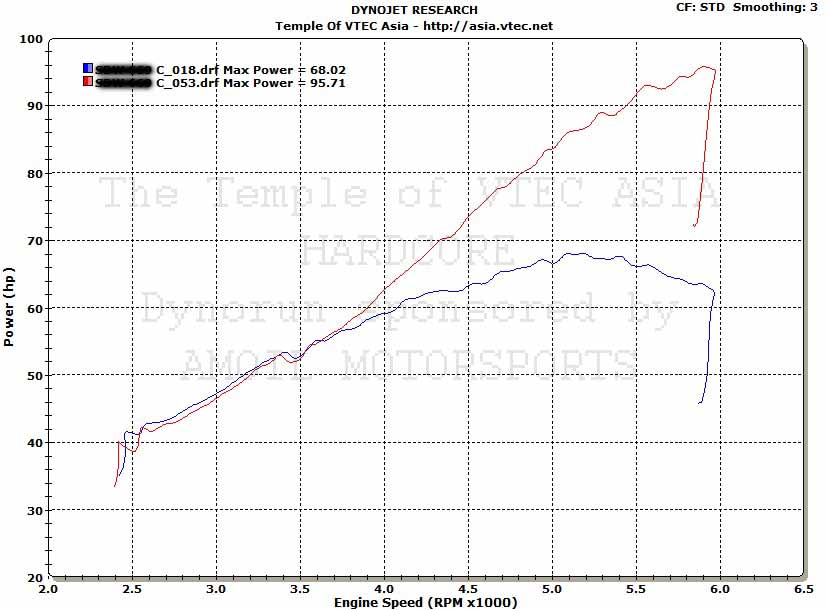

i thought that people who installed the vtec light on the fit noticed that the fit was ALWAYS in vtec under around 3krpm or so...and once you get past that rpm range its disengaged. may be this thread has just confused me...haha.
Member
Joined: Jul 2007
Posts: 1,584
From: Memphis, TN
From what I've read in the past, the Fit's VTEC is always engaged after 3,500rpm. Between 2,300rpm [?] and 3,500rpm, VTEC engagement is determined by throttle position, meaning that if you're at 2,500rpm and just cruising, then VTEC is off, but if you're at the same rpm but floor it, VTEC will engage.
At least, that's my understanding.
At least, that's my understanding.

Member
Joined: Jul 2008
Posts: 548
From: USA
R18 in vtec at low load because it's a miller cycle. Much like retarding the cam, it keeps valves open into the compression stroke reducing the vacuum in the manifold and therefore the pumping loss that comes with it.
Much like a Crane 0016 cam in a d15b7/d16a6 with cam retarded 5 degrees, capable of really good mileage if tuned right.
Much like a Crane 0016 cam in a d15b7/d16a6 with cam retarded 5 degrees, capable of really good mileage if tuned right.

Member
Joined: Jul 2008
Posts: 122
From: Lisbon, Maine, USA
