


MPG Fit Physics

Thread Starter
|
New Member
Joined: May 2009
Posts: 21
From: Carson CA
MPG Fit Physics
This week I drove from Westminster to Laguna Beach. The freeway portion was on a new tank so correcting for the guage it looked like 42.5 trip MPG with the AC on. Getting to the beach it dropped down to about 40 MPG due to some traffic lights. When I reached the summit of Alta Laguna Park (The Top of the World) it had dropped down to about 28 MPG in one just mile of hill climbing.
 What went wrong? Why does the Fit do so poorly on hills. I had to know.
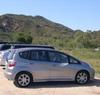
There was another Silver GE Fit at the summit, BTW.
When I got back I did some physics calculations and best case trip MPG would have been about 31 MPG to the summit not counting the stop signs. As it turns out the park is about 1036 feet above sea level. I estimate the car with two people and hiking gear to be 2900 lbs. It takes a huge amount of energy (3.9 megaJoules) to haul even a subcompact up a mere 1000 feet in one mile. The math suggests less than 7 MPG. Bottom line: any car will douse MPG with a large hill unless you can coast the backside at a safe speed without the brakes on (or have a hybrid to convert the hill into charge).
Other physics fascinations is how much gas it takes to accelerate to 65 MPH highway speeds - I estimate 0.020 gallons a shot. Doesn't seem like much but on a short trip it is costly, so coast as much as possible. There should be an optimum acceleration rate as well. Too slow wastes gas almost as much as jackrabbit. The engine has an optimum power and RPM range where it is most efficient at converting the thermal enegry of gasoline to kinetic energy (motion).
If there is interest I would like to share some physics insight into what we should expect for real MPG and how to make the best of it. It would be nice if some of you can do some experiments and we can estimate HP to cruise at various speeds with and without AC, tire specs, AT vs MT, 1.2 vs 1.3 vs 1.5, D vs S, 87 octane vs gasohol, warm-up waste, etc. It's nice to know the best you can achieve and not get frustrated. Then we can concentrate on our driving skills.
For openers, I estimate that the 2009 Sport AT (L15 i-VTEC) requires 15 HP to cruise at 65 MPH with AC on, 43 MPG steady state. This suggests the L15 is 20.3% efficient on 87 octane (it is probably better than this). Useful data from our Scanguage brethren would be gallons per minute and coastdown times such as 65 to 60 (useful for calculating real rolling HP).
A gallon of gas should contain 124,000 BTUs = 130.8 MJ = 175,400 HP-sec of energy.
Coastdown from 65 to 60 MPH is 109 HP-sec for 2900 lb. Example: 15 HP cruising would take 7.3 seconds to coast down.
Silver 2009 Sport At
Getting to the beach it dropped down to about 40 MPG due to some traffic lights. When I reached the summit of Alta Laguna Park (The Top of the World) it had dropped down to about 28 MPG in one just mile of hill climbing. What went wrong? Why does the Fit do so poorly on hills. I had to know.There was another Silver GE Fit at the summit, BTW.
When I got back I did some physics calculations and best case trip MPG would have been about 31 MPG to the summit not counting the stop signs. As it turns out the park is about 1036 feet above sea level. I estimate the car with two people and hiking gear to be 2900 lbs. It takes a huge amount of energy (3.9 megaJoules) to haul even a subcompact up a mere 1000 feet in one mile. The math suggests less than 7 MPG. Bottom line: any car will douse MPG with a large hill unless you can coast the backside at a safe speed without the brakes on (or have a hybrid to convert the hill into charge).
Other physics fascinations is how much gas it takes to accelerate to 65 MPH highway speeds - I estimate 0.020 gallons a shot. Doesn't seem like much but on a short trip it is costly, so coast as much as possible. There should be an optimum acceleration rate as well. Too slow wastes gas almost as much as jackrabbit. The engine has an optimum power and RPM range where it is most efficient at converting the thermal enegry of gasoline to kinetic energy (motion).
If there is interest I would like to share some physics insight into what we should expect for real MPG and how to make the best of it. It would be nice if some of you can do some experiments and we can estimate HP to cruise at various speeds with and without AC, tire specs, AT vs MT, 1.2 vs 1.3 vs 1.5, D vs S, 87 octane vs gasohol, warm-up waste, etc. It's nice to know the best you can achieve and not get frustrated. Then we can concentrate on our driving skills.
For openers, I estimate that the 2009 Sport AT (L15 i-VTEC) requires 15 HP to cruise at 65 MPH with AC on, 43 MPG steady state. This suggests the L15 is 20.3% efficient on 87 octane (it is probably better than this). Useful data from our Scanguage brethren would be gallons per minute and coastdown times such as 65 to 60 (useful for calculating real rolling HP).
A gallon of gas should contain 124,000 BTUs = 130.8 MJ = 175,400 HP-sec of energy.
Coastdown from 65 to 60 MPH is 109 HP-sec for 2900 lb. Example: 15 HP cruising would take 7.3 seconds to coast down.
Silver 2009 Sport At

Thread Starter
|
New Member
Joined: May 2009
Posts: 21
From: Carson CA
Hi keepitpg,
let's look at how just getting up to 65 MPH can dilute MPG. Hypothetical door to door trip with no stopping.
0 to 65 MPH requires 0.550 MJ or 738 HP-sec. Until I have better data, assume Fit takes 15 HP to run this speed and can do it at 43 MPG steady.
A 10 mile trip with hard braking at the end would take 0.02 gal to get up to speed and 0.233 gal to make the trip = 0.253 gal => 39.6 MPG. Yuk.
Now let's try and coast. Assume 7.5 HP and 30 MPH average. Convert kinetic energy to distance x force. 738 HP-sec at 7.5 HP is 98 seconds, or about 0.82 miles. Actual coastdown won't be so good so lets use 65 seconds (decelerate 1 MPH/sec). That works out to 0.59 mi, I think, maybe too optimistic, but let's do the math. Gas is only burned for 9.4 miles, so 0.02 + 0.219 gal = 0.239 gal. That is 41.9 MPG. Worth the effort.
Now let's compare to a shorter trip, 5 miles. I get 0.02 + 0.116 gal = 0.136 gal => 36.8 MPG, 40.9 with coasting.
A pattern emerges here if we look at a long trip, say 2 hours with a rest stop (how I drive to Oregon from CA). 0.02 + 3.029 gal = 3.049 gal => 42.6 MPG for 130 miles. Compare with 42.8 for the coasting case.
So a table looks like
trip distance MPG(stop) MPG(coast)
2.5 miles 32.1 39.0
5 miles 36.8 40.9
10 miles 39.6 41.9
20 miles 41.2 42.4
130 miles 42.6 42.8
Conclusions: (1) Even though the Fit can get superb gas mileage, the actual trip or tank MPG will suffer if your trips are short enough. (2) Coast to a stop if possible. (3) Expect climbing hills to cause the same dilution of MPG, coast baby coast.
Next time: AC on, idling at the stoplight, hills
let's look at how just getting up to 65 MPH can dilute MPG. Hypothetical door to door trip with no stopping.
0 to 65 MPH requires 0.550 MJ or 738 HP-sec. Until I have better data, assume Fit takes 15 HP to run this speed and can do it at 43 MPG steady.
A 10 mile trip with hard braking at the end would take 0.02 gal to get up to speed and 0.233 gal to make the trip = 0.253 gal => 39.6 MPG. Yuk.
Now let's try and coast. Assume 7.5 HP and 30 MPH average. Convert kinetic energy to distance x force. 738 HP-sec at 7.5 HP is 98 seconds, or about 0.82 miles. Actual coastdown won't be so good so lets use 65 seconds (decelerate 1 MPH/sec). That works out to 0.59 mi, I think, maybe too optimistic, but let's do the math. Gas is only burned for 9.4 miles, so 0.02 + 0.219 gal = 0.239 gal. That is 41.9 MPG. Worth the effort.
Now let's compare to a shorter trip, 5 miles. I get 0.02 + 0.116 gal = 0.136 gal => 36.8 MPG, 40.9 with coasting.
A pattern emerges here if we look at a long trip, say 2 hours with a rest stop (how I drive to Oregon from CA). 0.02 + 3.029 gal = 3.049 gal => 42.6 MPG for 130 miles. Compare with 42.8 for the coasting case.
So a table looks like
trip distance MPG(stop) MPG(coast)
2.5 miles 32.1 39.0
5 miles 36.8 40.9
10 miles 39.6 41.9
20 miles 41.2 42.4
130 miles 42.6 42.8
Conclusions: (1) Even though the Fit can get superb gas mileage, the actual trip or tank MPG will suffer if your trips are short enough. (2) Coast to a stop if possible. (3) Expect climbing hills to cause the same dilution of MPG, coast baby coast.
Next time: AC on, idling at the stoplight, hills

Thread Starter
|
New Member
Joined: May 2009
Posts: 21
From: Carson CA
More Fit Physics
asianmoomoo,
I got lots of stuff to post but seemed like a lack of interest so I calmed down. I have some data predicting wind resistance vs MPH, parasitic HP on the engine itself vs RPM, and predicted MPG vs speed. With science, you postulate, predict, measure, adjust, then do it over again until it is perfect. My original numbers have been refined.
Another discussion you might find interesting is my GE8 vs Pontiac Firebird 350 climbing a hill. My buddy says a more powerful car wins MPG up a hill and I say no way. The Fit seems terrible uphill because it can cruise at 40 plus on a good day. If you get 22 MPG cruising it seems like your car handles hills very efficiently. It really does take a lot of gas to climb a hill and the Fit is still 2604 lbs empty vs 3200 lbs for the Firebird.
Happy 4th of July 2009 in whatever nation you all live!
DoktorDreem
I got lots of stuff to post but seemed like a lack of interest so I calmed down. I have some data predicting wind resistance vs MPH, parasitic HP on the engine itself vs RPM, and predicted MPG vs speed. With science, you postulate, predict, measure, adjust, then do it over again until it is perfect. My original numbers have been refined.
Another discussion you might find interesting is my GE8 vs Pontiac Firebird 350 climbing a hill. My buddy says a more powerful car wins MPG up a hill and I say no way. The Fit seems terrible uphill because it can cruise at 40 plus on a good day. If you get 22 MPG cruising it seems like your car handles hills very efficiently. It really does take a lot of gas to climb a hill and the Fit is still 2604 lbs empty vs 3200 lbs for the Firebird.
Happy 4th of July 2009 in whatever nation you all live!
DoktorDreem
Hey Doc, I am interested. I am trying to interpret all of your equations and am sure it will all register with me at some point in time as you continue. Please don't stop now..... All of the threads are dead right now for some reason.... Dog days of summer I guess.

Even more of a good thing if you are into single speed bicycles or even a moped....The cool thing about hills is getting to go down them and in a Fit that is a lot of fun if there are some tight curves, even more so, but that is true for bicycles and even mopeds as well.

Member

Joined: May 2009
Posts: 211
From: Western NY
My Buick is lucky to get 18 mpg going up hills. Then again it's ~2.5x the engine size and 1000 lbs heavier of the Fit.
My fiancee manages ~39 mpg out of her Fit on the highway using minimal hypermiling. My Buick can get 37-39 mpg highway using a lot of neutral coasting down hills and doing ~63 mph. The ScanGauge in the Buick helps a lot.
Hills suck. Neutral coasting rocks. Isn't the AT Fit flat-towable? That means engine-off coasting if you're willing to try.
My fiancee manages ~39 mpg out of her Fit on the highway using minimal hypermiling. My Buick can get 37-39 mpg highway using a lot of neutral coasting down hills and doing ~63 mph. The ScanGauge in the Buick helps a lot.
Hills suck. Neutral coasting rocks. Isn't the AT Fit flat-towable? That means engine-off coasting if you're willing to try.
Thread Starter
|
New Member
Joined: May 2009
Posts: 21
From: Carson CA
 Fit Physics Basics part one
Part one of Fit physics from the Doc,
We are in this discussion because we want the best MPG from our Fit or understand the best we can do. For any car the MPG will be a product of
the engine and transmission: efficiency vs load and RPM
the car: rolling resistance, weight
the road: hills vs flat, curves, traffic, speed limit
the driver: acceleration rate, coasting, speed, AC on, idling vs stop, length of trip
We don't have hybrids so the game is to get the most out of a gallon of gas and do it comfortably and safely using only acceleration, cruising and coasting. Our hybrid friends get to exchange the energy of the gas and kinetic energy of the car with electrical charge.
A gallon of 87 octane contains nominally (depends who you ask) 124,000 BTUs of energy. Since we don't want to know how much steam we can generate, first convert the energy from thermal to equivalent kinetic energy, the get from point A to point B kind of answer. For these discussions I prefer the metric system.
Kinetic energy of a system is one half the mass times the speed squared. Useful units here are Joules and Horsepower (HP).
1 HP = 746 Watts
1 W = 1 Joule/second
1 kWh (kilowatt-hour) = 3413 BTUs = 3.6 megaJoules (MJ)
Therefore our 124,000 BTU = 36.33 kWh = 130.8 MJ = 48.7 HP-hours or
175,378 HP-seconds
For the sake of discussion if we have a car that takes a mere 15 HP to cruise at 55 MPH on a level road, and assume the engine is 100% efficient at converting thermal energy to kinetic energy (not possible), one gallon would last us 48.7 HP-h/15 HP = 3.247 hours of driving time. At 55 MPH that is an incredible 178.6 MPG. A car that is 30% efficient would get an impressive 53.6 MPG. But 15 HP is a rather small number for a decent size car.
How efficient is our Fit? I don't know. We will just have to measure it with some simple science experiments. We do know:
how much the car weights (per Honda 2009 AT is 2604 lbs empty)
how much we and our passengers weigh (typical 400 lbs for me and mine)
how much gas weighs (6 lbs per gallon)
how fast we are driving (assume our speedo is accurate)
how to count seconds (stop watch or "one-one-thousand")
The experiment is to count how long it takes to coast from, say 70 to 65 MPH, and calculate how much energy was lost to wind, tires and engine drag. I invite you to send me your data for AT and MT, in gear or in neutral, for a range of speeds. I recommend a 5 MPH difference as the coasting time varies drastically at higher speeds Yes, jadr09fit, the AT is towable and coasts very nicely. Next time I'll go through the equations for calculating your coastdown HP. I'll want to get three things for a level road before we take on hills and other factors:
wind resistance
tire rolling resistance
engine drag
Cheers.
We are in this discussion because we want the best MPG from our Fit or understand the best we can do. For any car the MPG will be a product of
the engine and transmission: efficiency vs load and RPM
the car: rolling resistance, weight
the road: hills vs flat, curves, traffic, speed limit
the driver: acceleration rate, coasting, speed, AC on, idling vs stop, length of trip
We don't have hybrids so the game is to get the most out of a gallon of gas and do it comfortably and safely using only acceleration, cruising and coasting. Our hybrid friends get to exchange the energy of the gas and kinetic energy of the car with electrical charge.
A gallon of 87 octane contains nominally (depends who you ask) 124,000 BTUs of energy. Since we don't want to know how much steam we can generate, first convert the energy from thermal to equivalent kinetic energy, the get from point A to point B kind of answer. For these discussions I prefer the metric system.
Kinetic energy of a system is one half the mass times the speed squared. Useful units here are Joules and Horsepower (HP).
1 HP = 746 Watts
1 W = 1 Joule/second
1 kWh (kilowatt-hour) = 3413 BTUs = 3.6 megaJoules (MJ)
Therefore our 124,000 BTU = 36.33 kWh = 130.8 MJ = 48.7 HP-hours or
175,378 HP-seconds
For the sake of discussion if we have a car that takes a mere 15 HP to cruise at 55 MPH on a level road, and assume the engine is 100% efficient at converting thermal energy to kinetic energy (not possible), one gallon would last us 48.7 HP-h/15 HP = 3.247 hours of driving time. At 55 MPH that is an incredible 178.6 MPG. A car that is 30% efficient would get an impressive 53.6 MPG. But 15 HP is a rather small number for a decent size car.
How efficient is our Fit? I don't know. We will just have to measure it with some simple science experiments. We do know:
how much the car weights (per Honda 2009 AT is 2604 lbs empty)
how much we and our passengers weigh (typical 400 lbs for me and mine)
how much gas weighs (6 lbs per gallon)
how fast we are driving (assume our speedo is accurate)
how to count seconds (stop watch or "one-one-thousand")
The experiment is to count how long it takes to coast from, say 70 to 65 MPH, and calculate how much energy was lost to wind, tires and engine drag. I invite you to send me your data for AT and MT, in gear or in neutral, for a range of speeds. I recommend a 5 MPH difference as the coasting time varies drastically at higher speeds Yes, jadr09fit, the AT is towable and coasts very nicely. Next time I'll go through the equations for calculating your coastdown HP. I'll want to get three things for a level road before we take on hills and other factors:
wind resistance
tire rolling resistance
engine drag
Cheers.
this is a good thread...but the scientific jargon is hard for me to understand. is it possible for you to just tell us what is the best and most fuel efficient way to drive the fit? hahaha. like a "how to maximize the fit's MPG for dummies" hahaha
Thread Starter
|
New Member
Joined: May 2009
Posts: 21
From: Carson CA
Doctor's Orders
asianmoomoo,
my advice will not be surprising and should work for any car. The web has lots of videos and discussions on how to get the best MPG. The physics are to find out how much difference a driving change makes and quantify it, then it is up to you. Example is to use AC or not. We are blessed with a built in, but inaccurate guage, to teach us to drive skillfully. I learned my techniques on a 1995 GTI VR6 (has MPG meter) and was able to cruise at 30 MPG on a good day.
Best MPG:
1) long trips are best to reduce the penalty of warming up. Lots of short trips together are the next best thing. I don't have any data yet how much gas is used to reach operating temperature.
2) maintain a steady speed. acceleration is costly. This can easily be quantified with my models. And don't use the brakes if you can.
3) whenever possible watch the traffic and coast whenever it is safe to do so. Coasting in neutral with engine off is just about free, neutral with engine on nearly free, and coasing in drive least economical. In one future post I intend to show at what incline threshold you fail to get most of your energy back. This requires some math.
4) hills are extremely costly, therefore take it easy, let the car slow down if you can get away with it. Downhill, coast and even let the speed go a little high if safe to do so. My rule is 5 MPH under on the climb and 5 MPH over downhill will avoid tickets and road rage. If the hill is too steep to coast at a safe speed you will waste gas braking but use the energy to run the AC if that is beneficial. I tend to discourage you all from engine off coasting since your power steering will be off and you have only a small reserve of power brake left for the stop. You don't need power steering at speed but if someone cuts you off or a deer jumps out into the road it can be very dangerous. hybrids have aux power for forced auto stop, we don't. Besides, I don't know how much life the puny starter motor has, and the flat towing feature of the AT is probably not good at 75 MPH.
5) turns use more gas. How much depends on the slip angle of the tires where turning force results in parasitic drag. Hard cornering will increase rolling resistance. However I have used "scrubbing off speed" to drive route 20 from Corvallis to Newport with minimal braking on turns. It is fun and will outrun most drivers. Don't do this is you are not skilled at it! Oregon doesn't have guard rails on many roads.
6) there will be an optimal acceleration. I don't know what it is but the Fit seems to not be terribly demanding. I have done some 6000 RPM shifting to get onto the 405 on the 270 degree uphill onramps and still gotten 34-36 MPG overall for 11 mile commutes.
7) don't use AC if you don't need it. Perhaps our brethren with Scanguages can tell us how many MPG AC costs.
8) use the best gear for the engine efficiency. The L15A17 is very forgiving between 1500 and 3000 RPM compared to a large V8. I suspect but haven't proven the AT outperforms the MT at 65 because the engine RPM is 2300 vs 3000. An LS06 Vette will accelerate hard in any gear because of the overflowing torque. For the diminutive L15, there are fewer choices for gears, especially uphill. At 65 you can downshift to 4th for more power, or it may be mandatory on a mild hill. 35 or 40 HP is all she got in 5th gear and each 1% incline will take another 5 HP. A 4% climb is about it without a downshift to grab more RPM and multiply torque.
9) Tires will run better MPG when inflated higher but care must be used to ensure they do not exceed sidewall ratings and understand that excess pressure will reduce the tire's ability to generate slip angle force (by stretching and holding the pavement) and hence permit hard cornering. I'm running 38 PSI warm right now and desire another couple of pounds. The Z-rated tires on my GTI corner very well at 45 lbs but were designed for it and easily outmanuever the Fit. The GE8 showroom cheapies surely are not made for 45 lbs, Honda says run 32. (One might think that a tire rolling down a road at 75 experiences a steady centrifugal force by the rim. That is very much not the case. Consider that a patch on the ground must come to a complete stop to hold the pavement, then accelerate to 150 MPH over the rim and then decelerate to another complete stop every revolution. Rim separation will happen during this acceleration phase where the bead can't hold the rim any longer. )
10) last but not least is speed, just slow down. 75 MPH is significantly worse than 65, and 55 is very good. I get nearly the same MPG slow and go on the 405 at 35 MPH with pulse and glide as I seem to do at 75 steady. Claims of 45 MPG at 75 don't seem physically possible. Wind resistance is measurable and very predictable. Coefficient of drag of 0.33 and 25.9 square feet lines up well with my coastdown observations.
my advice will not be surprising and should work for any car. The web has lots of videos and discussions on how to get the best MPG. The physics are to find out how much difference a driving change makes and quantify it, then it is up to you. Example is to use AC or not. We are blessed with a built in, but inaccurate guage, to teach us to drive skillfully. I learned my techniques on a 1995 GTI VR6 (has MPG meter) and was able to cruise at 30 MPG on a good day.
Best MPG:
1) long trips are best to reduce the penalty of warming up. Lots of short trips together are the next best thing. I don't have any data yet how much gas is used to reach operating temperature.
2) maintain a steady speed. acceleration is costly. This can easily be quantified with my models. And don't use the brakes if you can.
3) whenever possible watch the traffic and coast whenever it is safe to do so. Coasting in neutral with engine off is just about free, neutral with engine on nearly free, and coasing in drive least economical. In one future post I intend to show at what incline threshold you fail to get most of your energy back. This requires some math.
4) hills are extremely costly, therefore take it easy, let the car slow down if you can get away with it. Downhill, coast and even let the speed go a little high if safe to do so. My rule is 5 MPH under on the climb and 5 MPH over downhill will avoid tickets and road rage. If the hill is too steep to coast at a safe speed you will waste gas braking but use the energy to run the AC if that is beneficial. I tend to discourage you all from engine off coasting since your power steering will be off and you have only a small reserve of power brake left for the stop. You don't need power steering at speed but if someone cuts you off or a deer jumps out into the road it can be very dangerous. hybrids have aux power for forced auto stop, we don't. Besides, I don't know how much life the puny starter motor has, and the flat towing feature of the AT is probably not good at 75 MPH.
5) turns use more gas. How much depends on the slip angle of the tires where turning force results in parasitic drag. Hard cornering will increase rolling resistance. However I have used "scrubbing off speed" to drive route 20 from Corvallis to Newport with minimal braking on turns. It is fun and will outrun most drivers. Don't do this is you are not skilled at it! Oregon doesn't have guard rails on many roads.
6) there will be an optimal acceleration. I don't know what it is but the Fit seems to not be terribly demanding. I have done some 6000 RPM shifting to get onto the 405 on the 270 degree uphill onramps and still gotten 34-36 MPG overall for 11 mile commutes.
7) don't use AC if you don't need it. Perhaps our brethren with Scanguages can tell us how many MPG AC costs.
8) use the best gear for the engine efficiency. The L15A17 is very forgiving between 1500 and 3000 RPM compared to a large V8. I suspect but haven't proven the AT outperforms the MT at 65 because the engine RPM is 2300 vs 3000. An LS06 Vette will accelerate hard in any gear because of the overflowing torque. For the diminutive L15, there are fewer choices for gears, especially uphill. At 65 you can downshift to 4th for more power, or it may be mandatory on a mild hill. 35 or 40 HP is all she got in 5th gear and each 1% incline will take another 5 HP. A 4% climb is about it without a downshift to grab more RPM and multiply torque.
9) Tires will run better MPG when inflated higher but care must be used to ensure they do not exceed sidewall ratings and understand that excess pressure will reduce the tire's ability to generate slip angle force (by stretching and holding the pavement) and hence permit hard cornering. I'm running 38 PSI warm right now and desire another couple of pounds. The Z-rated tires on my GTI corner very well at 45 lbs but were designed for it and easily outmanuever the Fit. The GE8 showroom cheapies surely are not made for 45 lbs, Honda says run 32. (One might think that a tire rolling down a road at 75 experiences a steady centrifugal force by the rim. That is very much not the case. Consider that a patch on the ground must come to a complete stop to hold the pavement, then accelerate to 150 MPH over the rim and then decelerate to another complete stop every revolution. Rim separation will happen during this acceleration phase where the bead can't hold the rim any longer. )
10) last but not least is speed, just slow down. 75 MPH is significantly worse than 65, and 55 is very good. I get nearly the same MPG slow and go on the 405 at 35 MPH with pulse and glide as I seem to do at 75 steady. Claims of 45 MPG at 75 don't seem physically possible. Wind resistance is measurable and very predictable. Coefficient of drag of 0.33 and 25.9 square feet lines up well with my coastdown observations.

You know Dok, you'd probably have better luck if you took a little time to read up on the topic. Even a bright guy like yourself might be able to learn from people who have posted extensively in the past on this topic.
There are several very good threads here on techinques to save gas, and several of those techniques directly contradict your advice. Generalized advice only goes so far. Nobody who has experience squeezing an extra mile out of each gallon in a Fit is going to take you seriously until you get up to speed on our cars.
There are several very good threads here on techinques to save gas, and several of those techniques directly contradict your advice. Generalized advice only goes so far. Nobody who has experience squeezing an extra mile out of each gallon in a Fit is going to take you seriously until you get up to speed on our cars.
Last edited by wdb; Jul 5, 2009 at 09:05 PM.

Member
Joined: May 2009
Posts: 225
From: Shreveport, LA

I have a Scangauge but haven't hooked it up to the Fit. I've kept it in my CR-V since it doesn't have any sort of MPG readout. I've tried watching the effect of a/c on mpg with the stock instant gauge but it's too inprecise. I've had discussions with an a/c specialist who said in most systems there actually is a benefit to keeping low fan speeds vs. using high beyond the electric load. He said that the compressor stays off on cycles longer b/c there's less effort required to keep the temp at 33 f degrees?
Member
Joined: Jan 2008
Posts: 4,371
From: NC USA
This week I drove from Westminster to Laguna Beach. The freeway portion was on a new tank so correcting for the guage it looked like 42.5 trip MPG with the AC on. Getting to the beach it dropped down to about 40 MPG due to some traffic lights. When I reached the summit of Alta Laguna Park (The Top of the World) it had dropped down to about 28 MPG in one just mile of hill climbing. What went wrong? Why does the Fit do so poorly on hills. I had to know.
There was another Silver GE Fit at the summit, BTW.
When I got back I did some physics calculations and best case trip MPG would have been about 31 MPG to the summit not counting the stop signs. As it turns out the park is about 1036 feet above sea level. I estimate the car with two people and hiking gear to be 2900 lbs. It takes a huge amount of energy (3.9 megaJoules) to haul even a subcompact up a mere 1000 feet in one mile. The math suggests less than 7 MPG. Bottom line: any car will douse MPG with a large hill unless you can coast the backside at a safe speed without the brakes on (or have a hybrid to convert the hill into charge).
Other physics fascinations is how much gas it takes to accelerate to 65 MPH highway speeds - I estimate 0.020 gallons a shot. Doesn't seem like much but on a short trip it is costly, so coast as much as possible. There should be an optimum acceleration rate as well. Too slow wastes gas almost as much as jackrabbit. The engine has an optimum power and RPM range where it is most efficient at converting the thermal enegry of gasoline to kinetic energy (motion).
If there is interest I would like to share some physics insight into what we should expect for real MPG and how to make the best of it. It would be nice if some of you can do some experiments and we can estimate HP to cruise at various speeds with and without AC, tire specs, AT vs MT, 1.2 vs 1.3 vs 1.5, D vs S, 87 octane vs gasohol, warm-up waste, etc. It's nice to know the best you can achieve and not get frustrated. Then we can concentrate on our driving skills.
For openers, I estimate that the 2009 Sport AT (L15 i-VTEC) requires 15 HP to cruise at 65 MPH with AC on, 43 MPG steady state. This suggests the L15 is 20.3% efficient on 87 octane (it is probably better than this). Useful data from our Scanguage brethren would be gallons per minute and coastdown times such as 65 to 60 (useful for calculating real rolling HP).
A gallon of gas should contain 124,000 BTUs = 130.8 MJ = 175,400 HP-sec of energy.
Coastdown from 65 to 60 MPH is 109 HP-sec for 2900 lb. Example: 15 HP cruising would take 7.3 seconds to coast down.
Silver 2009 Sport At
Getting to the beach it dropped down to about 40 MPG due to some traffic lights. When I reached the summit of Alta Laguna Park (The Top of the World) it had dropped down to about 28 MPG in one just mile of hill climbing. What went wrong? Why does the Fit do so poorly on hills. I had to know.There was another Silver GE Fit at the summit, BTW.
When I got back I did some physics calculations and best case trip MPG would have been about 31 MPG to the summit not counting the stop signs. As it turns out the park is about 1036 feet above sea level. I estimate the car with two people and hiking gear to be 2900 lbs. It takes a huge amount of energy (3.9 megaJoules) to haul even a subcompact up a mere 1000 feet in one mile. The math suggests less than 7 MPG. Bottom line: any car will douse MPG with a large hill unless you can coast the backside at a safe speed without the brakes on (or have a hybrid to convert the hill into charge).
Other physics fascinations is how much gas it takes to accelerate to 65 MPH highway speeds - I estimate 0.020 gallons a shot. Doesn't seem like much but on a short trip it is costly, so coast as much as possible. There should be an optimum acceleration rate as well. Too slow wastes gas almost as much as jackrabbit. The engine has an optimum power and RPM range where it is most efficient at converting the thermal enegry of gasoline to kinetic energy (motion).
If there is interest I would like to share some physics insight into what we should expect for real MPG and how to make the best of it. It would be nice if some of you can do some experiments and we can estimate HP to cruise at various speeds with and without AC, tire specs, AT vs MT, 1.2 vs 1.3 vs 1.5, D vs S, 87 octane vs gasohol, warm-up waste, etc. It's nice to know the best you can achieve and not get frustrated. Then we can concentrate on our driving skills.
For openers, I estimate that the 2009 Sport AT (L15 i-VTEC) requires 15 HP to cruise at 65 MPH with AC on, 43 MPG steady state. This suggests the L15 is 20.3% efficient on 87 octane (it is probably better than this). Useful data from our Scanguage brethren would be gallons per minute and coastdown times such as 65 to 60 (useful for calculating real rolling HP).
A gallon of gas should contain 124,000 BTUs = 130.8 MJ = 175,400 HP-sec of energy.
Coastdown from 65 to 60 MPH is 109 HP-sec for 2900 lb. Example: 15 HP cruising would take 7.3 seconds to coast down.
Silver 2009 Sport At
Sounds a lot like the global warming debacle - lots of calculations based on 'estimates'.

Member
Joined: Jul 2008
Posts: 548
From: USA
 . Difference here is the repeatable and verifiable results that can be checked and retested by unbiased independent parties.
Personally I find this whole thread very interesting indeed!
I don't see that ~20% estimation to be that far off. An engine in cruise conditions is rarely near its peak BSFC, and even at that point is rarely over 35%.

New Member
Joined: Jan 2010
Posts: 17
From: above and beyond
This week I drove from Westminster to Laguna Beach. The freeway portion was on a new tank so correcting for the guage it looked like 42.5 trip MPG with the AC on. Getting to the beach it dropped down to about 40 MPG due to some traffic lights. When I reached the summit of Alta Laguna Park (The Top of the World) it had dropped down to about 28 MPG in one just mile of hill climbing. What went wrong? Why does the Fit do so poorly on hills. I had to know.
There was another Silver GE Fit at the summit, BTW.
When I got back I did some physics calculations and best case trip MPG would have been about 31 MPG to the summit not counting the stop signs. As it turns out the park is about 1036 feet above sea level. I estimate the car with two people and hiking gear to be 2900 lbs. It takes a huge amount of energy (3.9 megaJoules) to haul even a subcompact up a mere 1000 feet in one mile. The math suggests less than 7 MPG. Bottom line: any car will douse MPG with a large hill unless you can coast the backside at a safe speed without the brakes on (or have a hybrid to convert the hill into charge).
Other physics fascinations is how much gas it takes to accelerate to 65 MPH highway speeds - I estimate 0.020 gallons a shot. Doesn't seem like much but on a short trip it is costly, so coast as much as possible. There should be an optimum acceleration rate as well. Too slow wastes gas almost as much as jackrabbit. The engine has an optimum power and RPM range where it is most efficient at converting the thermal enegry of gasoline to kinetic energy (motion).
If there is interest I would like to share some physics insight into what we should expect for real MPG and how to make the best of it. It would be nice if some of you can do some experiments and we can estimate HP to cruise at various speeds with and without AC, tire specs, AT vs MT, 1.2 vs 1.3 vs 1.5, D vs S, 87 octane vs gasohol, warm-up waste, etc. It's nice to know the best you can achieve and not get frustrated. Then we can concentrate on our driving skills.
For openers, I estimate that the 2009 Sport AT (L15 i-VTEC) requires 15 HP to cruise at 65 MPH with AC on, 43 MPG steady state. This suggests the L15 is 20.3% efficient on 87 octane (it is probably better than this). Useful data from our Scanguage brethren would be gallons per minute and coastdown times such as 65 to 60 (useful for calculating real rolling HP).
A gallon of gas should contain 124,000 BTUs = 130.8 MJ = 175,400 HP-sec of energy.
Coastdown from 65 to 60 MPH is 109 HP-sec for 2900 lb. Example: 15 HP cruising would take 7.3 seconds to coast down.
Silver 2009 Sport At
Getting to the beach it dropped down to about 40 MPG due to some traffic lights. When I reached the summit of Alta Laguna Park (The Top of the World) it had dropped down to about 28 MPG in one just mile of hill climbing. What went wrong? Why does the Fit do so poorly on hills. I had to know.There was another Silver GE Fit at the summit, BTW.
When I got back I did some physics calculations and best case trip MPG would have been about 31 MPG to the summit not counting the stop signs. As it turns out the park is about 1036 feet above sea level. I estimate the car with two people and hiking gear to be 2900 lbs. It takes a huge amount of energy (3.9 megaJoules) to haul even a subcompact up a mere 1000 feet in one mile. The math suggests less than 7 MPG. Bottom line: any car will douse MPG with a large hill unless you can coast the backside at a safe speed without the brakes on (or have a hybrid to convert the hill into charge).
Other physics fascinations is how much gas it takes to accelerate to 65 MPH highway speeds - I estimate 0.020 gallons a shot. Doesn't seem like much but on a short trip it is costly, so coast as much as possible. There should be an optimum acceleration rate as well. Too slow wastes gas almost as much as jackrabbit. The engine has an optimum power and RPM range where it is most efficient at converting the thermal enegry of gasoline to kinetic energy (motion).
If there is interest I would like to share some physics insight into what we should expect for real MPG and how to make the best of it. It would be nice if some of you can do some experiments and we can estimate HP to cruise at various speeds with and without AC, tire specs, AT vs MT, 1.2 vs 1.3 vs 1.5, D vs S, 87 octane vs gasohol, warm-up waste, etc. It's nice to know the best you can achieve and not get frustrated. Then we can concentrate on our driving skills.
For openers, I estimate that the 2009 Sport AT (L15 i-VTEC) requires 15 HP to cruise at 65 MPH with AC on, 43 MPG steady state. This suggests the L15 is 20.3% efficient on 87 octane (it is probably better than this). Useful data from our Scanguage brethren would be gallons per minute and coastdown times such as 65 to 60 (useful for calculating real rolling HP).
A gallon of gas should contain 124,000 BTUs = 130.8 MJ = 175,400 HP-sec of energy.
Coastdown from 65 to 60 MPH is 109 HP-sec for 2900 lb. Example: 15 HP cruising would take 7.3 seconds to coast down.
Silver 2009 Sport At
New Member
Joined: Jan 2010
Posts: 17
From: above and beyond
asianmoomoo,
I got lots of stuff to post but seemed like a lack of interest so I calmed down. I have some data predicting wind resistance vs MPH, parasitic HP on the engine itself vs RPM, and predicted MPG vs speed. With science, you postulate, predict, measure, adjust, then do it over again until it is perfect. My original numbers have been refined.
Another discussion you might find interesting is my GE8 vs Pontiac Firebird 350 climbing a hill. My buddy says a more powerful car wins MPG up a hill and I say no way. The Fit seems terrible uphill because it can cruise at 40 plus on a good day. If you get 22 MPG cruising it seems like your car handles hills very efficiently. It really does take a lot of gas to climb a hill and the Fit is still 2604 lbs empty vs 3200 lbs for the Firebird.
Happy 4th of July 2009 in whatever nation you all live!
DoktorDreem
I got lots of stuff to post but seemed like a lack of interest so I calmed down. I have some data predicting wind resistance vs MPH, parasitic HP on the engine itself vs RPM, and predicted MPG vs speed. With science, you postulate, predict, measure, adjust, then do it over again until it is perfect. My original numbers have been refined.
Another discussion you might find interesting is my GE8 vs Pontiac Firebird 350 climbing a hill. My buddy says a more powerful car wins MPG up a hill and I say no way. The Fit seems terrible uphill because it can cruise at 40 plus on a good day. If you get 22 MPG cruising it seems like your car handles hills very efficiently. It really does take a lot of gas to climb a hill and the Fit is still 2604 lbs empty vs 3200 lbs for the Firebird.
Happy 4th of July 2009 in whatever nation you all live!
DoktorDreem
more people here know who paris hilton is compared to niels bohr

New Member
Joined: Jan 2010
Posts: 17
From: above and beyond
look up hypermiling
quick synopsis
- accelerate as slow as possible
- top speed as low as possible in the highest gear without lugging the engine
- as much coasting as possible (engine off if u can handle it)
- drive like u have no brakes
- keep the car in-tune and as empty and clean (no bike racks, flags on antenna etc) as possible