


AC level and AC blower level vs. fuel economy


Thread Starter
|
Member
Joined: Jul 2010
Posts: 59
From: USA

AC level and AC blower level vs. fuel economy
I noticed the Fit does not use that much more fuel to power the AC, but in general how do AC level (more blue vs less blue) and blower level affect fuel economy? What about recirculation? I noticed switching off recirculation actually made the AC cooler? Does recirculation keep carbon monoxide in the car (bad for your health)?
Member
Joined: Aug 2009
Posts: 3,661
From: Georgia
The temperature knob doesn't change the amount the A/C runs, it just increases heat from the heater core mixing this with cold air from the A/C core. No effect on fuel efficiency.
The fan control will reduce the amount of time the A/C compressor runs on lower speeds. I don't know how much fuel this would save, but it might be measurable.
For the same reason, using recirculation will reduce the amount of time the compressor runs, as it's not cooling hotter outside air. I wouldn't worry about bad air in the car unless someone passes gas; enough outside air still enters to stay healthy. Depending on the outside temperature, bringing in outside air (not using recirculate) might make the A/C cooled air colder, as the compressor is working more. But when it get's really hot this is less likely.
The fan control will reduce the amount of time the A/C compressor runs on lower speeds. I don't know how much fuel this would save, but it might be measurable.
For the same reason, using recirculation will reduce the amount of time the compressor runs, as it's not cooling hotter outside air. I wouldn't worry about bad air in the car unless someone passes gas; enough outside air still enters to stay healthy. Depending on the outside temperature, bringing in outside air (not using recirculate) might make the A/C cooled air colder, as the compressor is working more. But when it get's really hot this is less likely.

Good answer Steve. I use recirculate most often, I like to block out as much exhaust and other smells from outside the car as possible. Once free of traffic/out on the open road I definitely let some fresh air in the car by switching over for a bit.
Wish we could find a cabin filter with a carbon activated layer, this would really help catch the odors. I thought they had one over in Japan for the GE8 since they have so many smog issues, but never did come across one for purchase. I may try to stick a thin sheet of carbon in there with my filter sometime and see if that helps.
Wish we could find a cabin filter with a carbon activated layer, this would really help catch the odors. I thought they had one over in Japan for the GE8 since they have so many smog issues, but never did come across one for purchase. I may try to stick a thin sheet of carbon in there with my filter sometime and see if that helps.
Last edited by reako; Sep 2, 2010 at 11:25 AM.

Member
Joined: Jan 2009
Posts: 1,888
From: Parañaque City, Philippines
Over here in Manila we don't have heater controls so all we get is cooling (which makes more sense).
Your A/C compressor has a magnetic clutch on the outside of its pulley (which is driven by the engine via a belt). How long and how often it engages determines how hard it's working to cool your car via the A/C - and by extension how much the engine is burning fuel driving it mechanically.
On a low setting (less blue), the compressor clutch engages in fairly short durations. On a high setting (more blue), the clutch engages for noticeably longer amounts of time.
You'll notice it just by listening to the way the engine's noise changes, and at night, how often the headlights flicker. Every time the headlights flicker, or when the engine noise gets an added soft whine, that's usually when the A/C clutch engages.
By comparison, the blower doesn't add all that much load on the engine since it's electrical.
HTH
Your A/C compressor has a magnetic clutch on the outside of its pulley (which is driven by the engine via a belt). How long and how often it engages determines how hard it's working to cool your car via the A/C - and by extension how much the engine is burning fuel driving it mechanically.
On a low setting (less blue), the compressor clutch engages in fairly short durations. On a high setting (more blue), the clutch engages for noticeably longer amounts of time.
You'll notice it just by listening to the way the engine's noise changes, and at night, how often the headlights flicker. Every time the headlights flicker, or when the engine noise gets an added soft whine, that's usually when the A/C clutch engages.
By comparison, the blower doesn't add all that much load on the engine since it's electrical.
HTH
Last edited by Type 100; Sep 2, 2010 at 11:33 AM.

Member
Joined: Jun 2009
Posts: 70
From: Miami, Fl. USA
[quote=fitowner10;905401]I noticed the Fit does not use that much more fuel to power the AC,
Are you serious? My Fit looses 4 MPG in the summer here in Miami, I get 30 MPG now and in the winter without running the AC I get 34 MPG

Are you serious? My Fit looses 4 MPG in the summer here in Miami, I get 30 MPG now and in the winter without running the AC I get 34 MPG
Member
Joined: Aug 2009
Posts: 3,661
From: Georgia
Interesting how many heat-A/C configurations Honda stuffs in this car. I don't think the USDM shortens the compressor cycles to vary temperature. This would disable the A/C at cold temps when you want heat but still want dehumidified air. The A/C core stays at a constant temp above freezing controlled by cycling the compressor. The temp knob on USDM just varies the amount of heat output. Sometimes I wish there was a separate temperature control for the A/C as this would be more efficient in terms of fuel (but less efficient in terms of dehumidifying).
[quote=MIAMIFIT;905577]ditto on this, i get 43-44mpg all winter and cannot do better than 39mpg with the A/C in the summer.

Member

Joined: Aug 2009
Posts: 2,462
From: Vermont
Over here in Manila we don't have heater controls so all we get is cooling (which makes more sense).
Your A/C compressor has a magnetic clutch on the outside of its pulley (which is driven by the engine via a belt). How long and how often it engages determines how hard it's working to cool your car via the A/C - and by extension how much the engine is burning fuel driving it mechanically.
On a low setting (less blue), the compressor clutch engages in fairly short durations. On a high setting (more blue), the clutch engages for noticeably longer amounts of time.
You'll notice it just by listening to the way the engine's noise changes, and at night, how often the headlights flicker. Every time the headlights flicker, or when the engine noise gets an added soft whine, that's usually when the A/C clutch engages.
By comparison, the blower doesn't add all that much load on the engine since it's electrical.
HTH
Your A/C compressor has a magnetic clutch on the outside of its pulley (which is driven by the engine via a belt). How long and how often it engages determines how hard it's working to cool your car via the A/C - and by extension how much the engine is burning fuel driving it mechanically.
On a low setting (less blue), the compressor clutch engages in fairly short durations. On a high setting (more blue), the clutch engages for noticeably longer amounts of time.
You'll notice it just by listening to the way the engine's noise changes, and at night, how often the headlights flicker. Every time the headlights flicker, or when the engine noise gets an added soft whine, that's usually when the A/C clutch engages.
By comparison, the blower doesn't add all that much load on the engine since it's electrical.
HTH
In short, the AC is always running when turned on, and only generates ONE temperature level.... Cold. The rest is done by the Heater Core and temperature modulation.
If the AC kicked on and off like a home system, you'd feel little jerks while driving. Less power when the AC compressor kicks in, and more when it doesn't. This would be nothing if not annoying. Try doing this manually and you'll see what I mean. Put the car on cruise and press the AC button, Press it again and you'll feel it. imagine having that happen all of the time as the car attempts to maintain optimal temperature. You'd have whiplash.
~SB
Last edited by specboy; Sep 2, 2010 at 10:31 PM. Reason: Damn Grammar... To, Two, Too...
Member
Joined: Aug 2009
Posts: 3,661
From: Georgia
Neither is wrong. Type100 is describing the Fit's A/C in the Philippines where Honda deletes the heater. Since there is no heated air to mix with the cold to vary the output air temperature this requires controlling the temperature by cycling the A/C compressor on and off. This is how aftermarket A/C works everywhere since it's not integrated with a heater.
The USDM Fit's A/C compressor cycles on and off, but only to maintain a constant temperature above freezing regardless of input air temperature. This air is then mixed with warm air from the heater core when warmer temperatures are dialed in with the temp knob (but the function of the A/C continues unchanged). This provides the added advantage of being able to provide warm dehumidified air.
The USDM Fit's A/C compressor cycles on and off, but only to maintain a constant temperature above freezing regardless of input air temperature. This air is then mixed with warm air from the heater core when warmer temperatures are dialed in with the temp knob (but the function of the A/C continues unchanged). This provides the added advantage of being able to provide warm dehumidified air.

Would this mean the a/c should run more efficiently in "recirculate" mode in hot weather therefore giving you better mpg, than in fresh air" mode?
In what conditons would it be more effective to use the A/C in fresh air mode?
In what conditons would it be more effective to use the A/C in fresh air mode?
Member
Joined: Aug 2009
Posts: 3,661
From: Georgia
Now in winter the windows will fog up easily if you leave it on recirculate without running the A/C.

Member
Joined: May 2010
Posts: 3,417
From: Capital Distric New York
Truthfully the best reason to use recirculate is when driving past a dairy barn or riding behind a spewing bus. I've just tested it out driving by a local dairy farm. Stink city big time - but with the Fit's air flow buttoned up not a whiff gets in the car.
I might use it to boost the cooling - or possibly heating, but I'm approaching my first winter with my FIT so I'm not sure if it will be needed. I've learned in the winter to not turn on the heat till the engine is hot_
I really don't care for the cabin air quality when running on recirculate for any extended time.
I also use the AC in the winter in my cars as well as the summer for the benefit of dehumidified air.
I might use it to boost the cooling - or possibly heating, but I'm approaching my first winter with my FIT so I'm not sure if it will be needed. I've learned in the winter to not turn on the heat till the engine is hot_
I really don't care for the cabin air quality when running on recirculate for any extended time.
I also use the AC in the winter in my cars as well as the summer for the benefit of dehumidified air.

Member
Joined: Aug 2009
Posts: 953
From: NY
[quote=MIAMIFIT;905577]
Winter here means a 4mpg drop and summer, even with AC, is a 4mpg gain. Just opposite from you is all. Reason being, more extreme cold and difficult road conditions. But there was no doing without the AC this summer, that's for sure!
Dan
Dan
Last edited by Shockwave199; Sep 3, 2010 at 03:18 AM.
I know that the guys up north get better mileage during the summer but everyone I have asked down here says they get better mileage when it is cool (cold) and their cars also run faster and smoother as well.

[quote=BakedCookies;905669]
Shit man, I haven't been able to get better than 34 since the summer heat started. I don't waste much time getting wherever I'm going though, either. But even on interstate trips, I'm not getting anymore than 34. 
Member
Joined: Jan 2009
Posts: 1,888
From: Parañaque City, Philippines
If the AC kicked on and off like a home system, you'd feel little jerks while driving. Less power when the AC compressor kicks in, and more when it doesn't. This would be nothing if not annoying. Try doing this manually and you'll see what I mean. Put the car on cruise and press the AC button, Press it again and you'll feel it. imagine having that happen all of the time as the car attempts to maintain optimal temperature. You'd have whiplash.
~SB
~SB
All that gives it away are the telltale slight flicker of the headlights and the overlying hum of the A/C compressor, like I mentioned.
The A/C works like this on all our Hondas - an SX8 City, my GD1 and my mom's FD1 Civic.
Anyway I'm learning a lot here...never had a car with a heater.
Member
Joined: Aug 2009
Posts: 3,661
From: Georgia
This may be true on expensive vehicles or home Air Conditioners where temperature is controlled by a thermostat, but in the US, the fit AC has two options: Always on, and always off(and that is only controlled by the push of a button - or rotating the Dial to Defogger). As Steve said, all the knob does is Add heat to the air which is being circulated. The more you turn towards the RED, the more Hot air is added to the Cold air being generated by the AC. This gives you more temperate air from the vents. The more you turn towards the blue, the Less Heat is added to the Cold Air from the AC.
In short, the AC is always running when turned on, and only generates ONE temperature level.... Cold. The rest is done by the Heater Core and temperature modulation.
If the AC kicked on and off like a home system, you'd feel little jerks while driving. Less power when the AC compressor kicks in, and more when it doesn't. This would be nothing if not annoying. Try doing this manually and you'll see what I mean. Put the car on cruise and press the AC button, Press it again and you'll feel it. imagine having that happen all of the time as the car attempts to maintain optimal temperature. You'd have whiplash.
~SB
In short, the AC is always running when turned on, and only generates ONE temperature level.... Cold. The rest is done by the Heater Core and temperature modulation.
If the AC kicked on and off like a home system, you'd feel little jerks while driving. Less power when the AC compressor kicks in, and more when it doesn't. This would be nothing if not annoying. Try doing this manually and you'll see what I mean. Put the car on cruise and press the AC button, Press it again and you'll feel it. imagine having that happen all of the time as the car attempts to maintain optimal temperature. You'd have whiplash.
~SB
It's barely noticeable while driving, but it's there. Every few seconds on a mild day.
Member
Joined: Jan 2009
Posts: 1,888
From: Parañaque City, Philippines
Except as Type 100 describes, the Fit's A/C compressor cycles all the time, even on USDM cars. Listen for it outside the car with the A/C blower on low. radiator fans start and stop at the same time. If it doesn't then the thermistor on the A/C coil may be faulty (or it's just really hot out). It's just that the temp knob on USDM fits doesn't effect this function.
It's barely noticeable while driving, but it's there. Every few seconds on a mild day.
It's barely noticeable while driving, but it's there. Every few seconds on a mild day.
Borrowing JPD36's image:
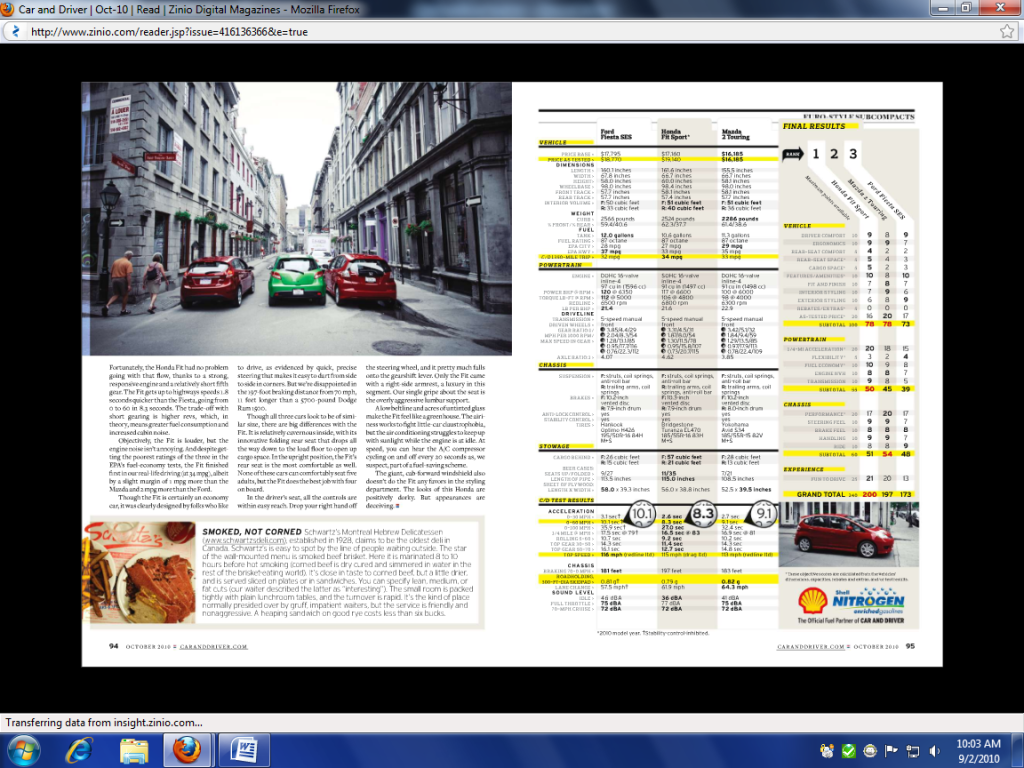
You could zoom in using this link:
Car and Driver | Oct-10 | Inside | Zinio Digital Magazines
The sentence I'm referring to is on page 94 - the one opposite the chart on the photo.


Member
Joined: Feb 2009
Posts: 124
From: RTP, NC
I agree with C&D, I think that they cycle the AC on a timer or something similar as part of a fuel-saving technique, aka better mileage rating for the car, much like the "shift" lights that cars used to have. When it's 100F here, there is no way that the AC coil is ever getting close to freezing on it's own in a properly-charged system, otherwise it would be much better at cooling the car in the first place. It simply isn't that efficient a unit. It's also annoying as hell when it kicks out and starts blowing warm air.
On a 117 HP car, the AC represents a significant additional load. It is very obvious in the difference in acceleration on my MT when the AC is engaged .v not-engaged/on.
On a 117 HP car, the AC represents a significant additional load. It is very obvious in the difference in acceleration on my MT when the AC is engaged .v not-engaged/on.