


Turbo Calculation


Thread Starter
|
Member
Joined: Apr 2006
Posts: 66
From: Far N. Dallas, TX
Turbo Calculation
Since I don't have access to my computer right now (Typing near a closed Starbucks on the iPod at the airport... thumbs will be hurting!!!)... This only applies to gassers, so no one using diesels should apply this methodology
I'm going to start off by saying:
1) I don't like ricers (specifically people who modify their cars solely for looks)
2) I've been an engineer for a few years
3) I decided to start a thread on turbo sizes
-------------------------------------------------------------------------------------
(Engine RPM)(Engine CID)/3456 = Volume
This volume is originally calculated for naturally aspirated engines, and is the main determination on where the turbo will spool, where the turbo will build boost, and how long you will be in usable boost. Thus turbo size. Now there's a little more easy math to do...
So for the fit, this would be...
(6000*91.2915)/3456 for 6000 RPM = Peak efficiency = 158.49
(2000*91.2915)/3456 for 2000 RPM = Minimum surge = 52.83
-------------------------------------------------------------------------------------
Now we get to plug our numbers into the ideal gas law. The ideal gas law relates volume, pressure, temperature and mass of air. see wikipedia (isn't it supposed to be spelled wikipaedia???) for more information... trust me on this... I went to lots of classes to learn this and simplify it for you.
PV = nRT
Where
P = absolute pressure (14.7 a.k.a sea level)
V = volume in CFM (the previous section)
n is the number of moles of gas (jokes anyone?)
R is a constant of 10.73 (technically, it's ft^3 psi·*R^-1 lb-mol^-1 which means it just keeps going... and instead of filling up this much space with the actual calculation, I decided to write in English instead... hooray for me!)
T is the post intercooled air temperature in Rankine (Rankine is Fahrenheit plus 460... let's just say it's 150*F, so... 610*R).
Now what's n? I get to do *real* math! yeah! Well that's why God (or was it the Muslims???) created Algebra...
n = PV/TR
Wow... that was hard...
Let's throw in another variable PSI... yes you guessed it... PSI is the amount of pressure above sea level everyone here seems to love (it is the forced induction page after all), it's added to the absolute pressure then that quantity is multiplied by the volume we created above...
let's plug in our values...
n = (14.7 + PSI)(V)/TR
and let's say we want 8 pounds of boost...
n = ((14.7 + 8)(V))/((10.73)(610))
simplify...
n= ((22.7)(V))/6545.3
simplify further...
2000 RPM
n= (34,777)/6545.3
6000 RPM
n= (104,334)/6545.3
and solve...
2000 RPM
Pounds per minute = 5.313
6000 RPM
Pounds per minute = 15.94
-------------------------------------------------------------------------------------
Now that I know it's a very tiny turbo we're dealing with...
The above assumes we have 100% VE. we all know VTEC is great, but I'm Guessing it's going to be closer to 80% at 2,000 RPM and 90% at 6,000 RPM (someone correct me that has the actual stock VE tables from the ECU).
2000 RPM
5.313 * 80% = 4.25 PPM
6000 RPM
15.94 * 90% = 14.346 PPM
-------------------------------------------------------------------------------------
Now we need the pressure ratio
that's easy... it's just the ratio between absolute pressure and the boost we're adding
so we take (14.7 + 8)/14.7
so the ratio is: 1.544
-------------------------------------------------------------------------------------
Now we have two (three if you count the minimum surge) numbers to look at on a compressor map...
we're going to take the 6,000 RPM one first
PR = 1.544
n = 14.346 PPM and 5.313 PPM
now since i'm on the iPod... I can't copy and paste (damn you Apple!!!) so the compressor map will have to wait...
basically it's the normal x and y deal with a dot where the x and y meet.
Usually you have PPM at the x axis of the map, and PR at the y axis.
You will notice the "topography" of the turbocharger and their pressure efficiencies. generally a turbo is effective at 60%, and the closer you get to 100% the better the turbo will be for your application.
now where to find these maps... Google image search your favorite turbo... it's probably there.
My favorite for this application? t25 55 trim .48 AR (look for a SAAB turbo... forgot which one...)
Second Favorite for this application? T3 45 trim
Third Favorite for this application? T3 40 trim
-------------------------------------------------------------------------------------
What about the minimum surge?
if you see a turbocharger map, it's got a surge line... that's where the turbocharger really starts to kick in. usually you take idle +1000 RPM (just say 2,000 RPM is where the power should really kick in) for where the surge limit would start at a maximum (ideally you would use idle, but it doesn't work like you would expect. theory is nothing like practice...).
-------------------------------------------------------------------------------------
Have fun... sorry I don't post more often...
thumbs - are - in - pain - AAAAAAAH!!!!
we'll get into A/R later... or someone else can post that...
I'm going to start off by saying:
1) I don't like ricers (specifically people who modify their cars solely for looks)
2) I've been an engineer for a few years
3) I decided to start a thread on turbo sizes
-------------------------------------------------------------------------------------
(Engine RPM)(Engine CID)/3456 = Volume
This volume is originally calculated for naturally aspirated engines, and is the main determination on where the turbo will spool, where the turbo will build boost, and how long you will be in usable boost. Thus turbo size. Now there's a little more easy math to do...
So for the fit, this would be...
(6000*91.2915)/3456 for 6000 RPM = Peak efficiency = 158.49
(2000*91.2915)/3456 for 2000 RPM = Minimum surge = 52.83
-------------------------------------------------------------------------------------
Now we get to plug our numbers into the ideal gas law. The ideal gas law relates volume, pressure, temperature and mass of air. see wikipedia (isn't it supposed to be spelled wikipaedia???) for more information... trust me on this... I went to lots of classes to learn this and simplify it for you.
PV = nRT
Where
P = absolute pressure (14.7 a.k.a sea level)
V = volume in CFM (the previous section)
n is the number of moles of gas (jokes anyone?)
R is a constant of 10.73 (technically, it's ft^3 psi·*R^-1 lb-mol^-1 which means it just keeps going... and instead of filling up this much space with the actual calculation, I decided to write in English instead... hooray for me!)
T is the post intercooled air temperature in Rankine (Rankine is Fahrenheit plus 460... let's just say it's 150*F, so... 610*R).
Now what's n? I get to do *real* math! yeah! Well that's why God (or was it the Muslims???) created Algebra...
n = PV/TR
Wow... that was hard...
Let's throw in another variable PSI... yes you guessed it... PSI is the amount of pressure above sea level everyone here seems to love (it is the forced induction page after all), it's added to the absolute pressure then that quantity is multiplied by the volume we created above...
let's plug in our values...
n = (14.7 + PSI)(V)/TR
and let's say we want 8 pounds of boost...
n = ((14.7 + 8)(V))/((10.73)(610))
simplify...
n= ((22.7)(V))/6545.3
simplify further...
2000 RPM
n= (34,777)/6545.3
6000 RPM
n= (104,334)/6545.3
and solve...
2000 RPM
Pounds per minute = 5.313
6000 RPM
Pounds per minute = 15.94
-------------------------------------------------------------------------------------
Now that I know it's a very tiny turbo we're dealing with...
The above assumes we have 100% VE. we all know VTEC is great, but I'm Guessing it's going to be closer to 80% at 2,000 RPM and 90% at 6,000 RPM (someone correct me that has the actual stock VE tables from the ECU).
2000 RPM
5.313 * 80% = 4.25 PPM
6000 RPM
15.94 * 90% = 14.346 PPM
-------------------------------------------------------------------------------------
Now we need the pressure ratio
that's easy... it's just the ratio between absolute pressure and the boost we're adding
so we take (14.7 + 8)/14.7
so the ratio is: 1.544
-------------------------------------------------------------------------------------
Now we have two (three if you count the minimum surge) numbers to look at on a compressor map...
we're going to take the 6,000 RPM one first
PR = 1.544
n = 14.346 PPM and 5.313 PPM
now since i'm on the iPod... I can't copy and paste (damn you Apple!!!) so the compressor map will have to wait...
basically it's the normal x and y deal with a dot where the x and y meet.
Usually you have PPM at the x axis of the map, and PR at the y axis.
You will notice the "topography" of the turbocharger and their pressure efficiencies. generally a turbo is effective at 60%, and the closer you get to 100% the better the turbo will be for your application.
now where to find these maps... Google image search your favorite turbo... it's probably there.
My favorite for this application? t25 55 trim .48 AR (look for a SAAB turbo... forgot which one...)
Second Favorite for this application? T3 45 trim
Third Favorite for this application? T3 40 trim
-------------------------------------------------------------------------------------
What about the minimum surge?
if you see a turbocharger map, it's got a surge line... that's where the turbocharger really starts to kick in. usually you take idle +1000 RPM (just say 2,000 RPM is where the power should really kick in) for where the surge limit would start at a maximum (ideally you would use idle, but it doesn't work like you would expect. theory is nothing like practice...).
-------------------------------------------------------------------------------------
Have fun... sorry I don't post more often...
thumbs - are - in - pain - AAAAAAAH!!!!
we'll get into A/R later... or someone else can post that...
Last edited by alphaseinor; Apr 4, 2008 at 12:54 PM.

 working to be a mech engineer in the next few years

Member
Joined: Jul 2006
Posts: 667
From: california
lol PV=nRT for physics is approached a little differently from chemistry, but all the same. good stuff, i understood all the PV=nRT stuff but the other stuff, i would have to re-read it for it to make more sense. rep to you!
Thread Starter
|
Member
Joined: Apr 2006
Posts: 66
From: Far N. Dallas, TX
I've been working on heat exchangers... specifically shell and tube... mechanical engineer...
most of this you will learn in a standard physics class... lots of ways of doing ideal gas law...
I'm pretty sure I'm correct on the above, there's a couple of things I had to correct after I posted it, and I need to update the formula since I screwed up and forgot to add a conversion factor for the volume.
most of this you will learn in a standard physics class... lots of ways of doing ideal gas law...
I'm pretty sure I'm correct on the above, there's a couple of things I had to correct after I posted it, and I need to update the formula since I screwed up and forgot to add a conversion factor for the volume.


Thread Starter
|
Member
Joined: Apr 2006
Posts: 66
From: Far N. Dallas, TX
I'm sure there is friction... don't think it's worth calculating tho... Anyone know the actual temp post IC (yes... more variables... just need an approximate real world number)?
Oh and here's a couple of maps with the above data and my analysis
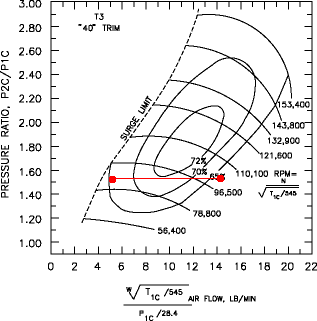
Ahh a T3 40... would make really great low end power, and technically would work out fine...
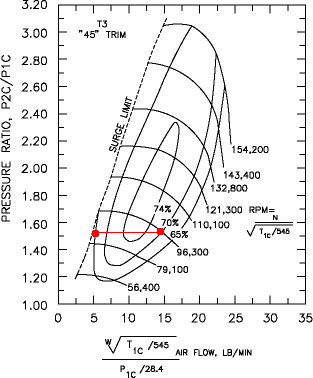
T3 45 would do better than a 40... note the 74% efficiency of the turbo, the low RPMs with this will probably help with any boost spikes under 2,000 RPMs (note the surge limit... anything to the left of that line is dangerous!).
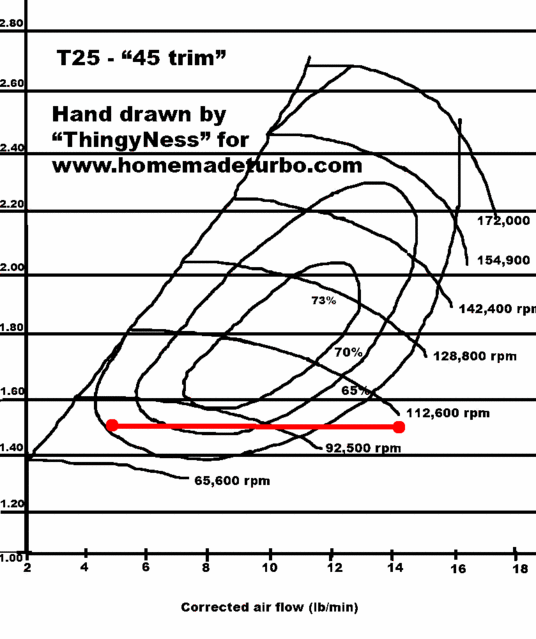
Sorry about the giant pic above... the T25 45 wouldn't be a good candidate, it runs out of steam before redline.
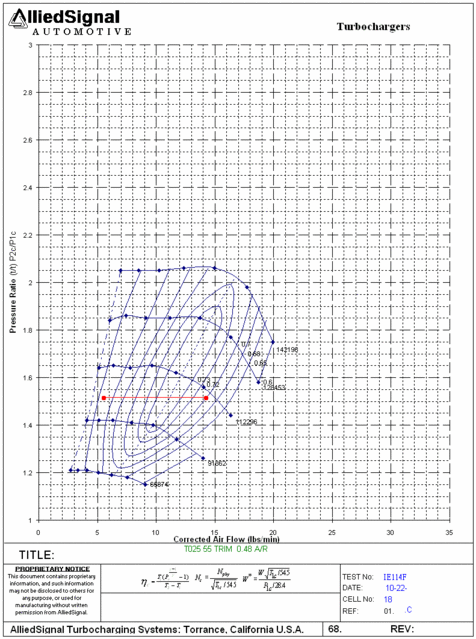
Here's a T25 55 trim... Probably my personal favorite you'd probably have boost off idle, and all the way through redline. I'd also wager you could go boosting up higher if the engine could handle it. fast spool, but with a wonderful pull to redline... in theory...
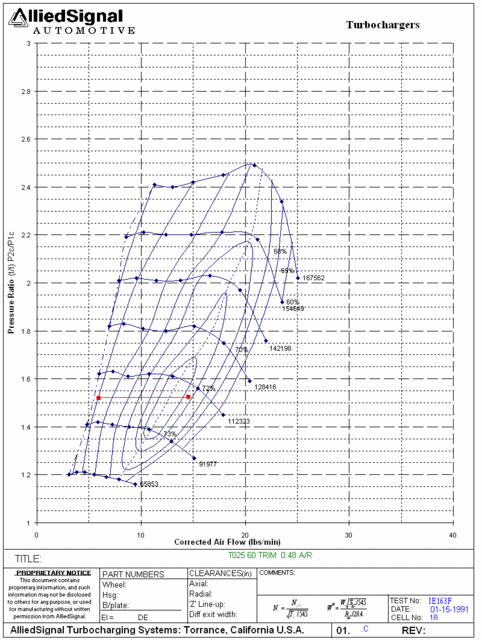
Same thing with the T25 60 trim, very nice all around! peak efficiency is right near redline. this one probably would do better on a dyno or a strip, where the 55 trim would be better suited for the track.
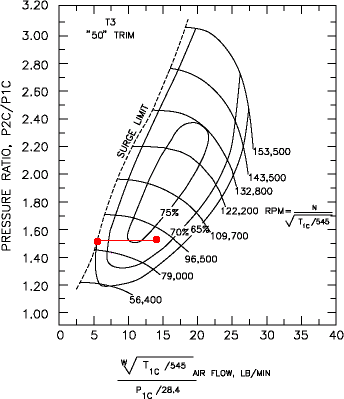
Now as for the T3 50 trim (note, I pushed it back from earlier) it would give that turbo push feel, and still make good power... coming a little too close for comfort on the surge limit, but hey... it would feel like a kick in the pants! Probably better suited for a strip with a MT. The track you'd probably end up popping it. This is where bigger is probably better, but possibly the largest turbo you "should" run from an engineering standpoint.
Oh and here's a couple of maps with the above data and my analysis
Ahh a T3 40... would make really great low end power, and technically would work out fine...
T3 45 would do better than a 40... note the 74% efficiency of the turbo, the low RPMs with this will probably help with any boost spikes under 2,000 RPMs (note the surge limit... anything to the left of that line is dangerous!).
Sorry about the giant pic above... the T25 45 wouldn't be a good candidate, it runs out of steam before redline.
Here's a T25 55 trim... Probably my personal favorite you'd probably have boost off idle, and all the way through redline. I'd also wager you could go boosting up higher if the engine could handle it. fast spool, but with a wonderful pull to redline... in theory...
Same thing with the T25 60 trim, very nice all around! peak efficiency is right near redline. this one probably would do better on a dyno or a strip, where the 55 trim would be better suited for the track.
Now as for the T3 50 trim (note, I pushed it back from earlier) it would give that turbo push feel, and still make good power... coming a little too close for comfort on the surge limit, but hey... it would feel like a kick in the pants! Probably better suited for a strip with a MT. The track you'd probably end up popping it. This is where bigger is probably better, but possibly the largest turbo you "should" run from an engineering standpoint.
Last edited by alphaseinor; Apr 4, 2008 at 01:34 PM.
Thread Starter
|
Member
Joined: Apr 2006
Posts: 66
From: Far N. Dallas, TX
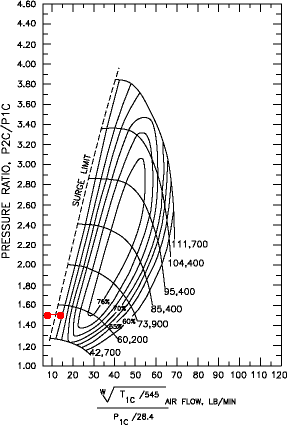
Now we're just being silly... This is a T61 you wouldn't be making any usable boost until higher RPMs (probably close to 4,000 RPMs) and it would probably (eventually) break the turbo if you punched it at from a standstill.
Last edited by alphaseinor; Apr 6, 2008 at 01:53 PM.


Thread Starter
|
Member
Joined: Apr 2006
Posts: 66
From: Far N. Dallas, TX
I did all of the calculations for you... the graphs show different types of turbos and their characteristics. I then put on a beginning and an ending point on the graph and connected the dots.
basically you want to have a turbo that peaks (second dot) as close to "center" of the pressure areas on the x axis as you can. You also want one that won't begin boosting to the left of the surge limit, or you can over-rev the turbo and make it pop.
basically you want to have a turbo that peaks (second dot) as close to "center" of the pressure areas on the x axis as you can. You also want one that won't begin boosting to the left of the surge limit, or you can over-rev the turbo and make it pop.


ahh good old adiabatic efficency. well looking at your numbers helps assure me that my choice should work out well. I plan on running a 15g compressor on my turbo setup here in the future. you can see the maps here Stealth 316 Home looks like i'll be in the sweet spot but right on the surge line(doubt i'll be at full boost by 2k. would be nice but we'll see. I also have a 13g compressor wheel and housing if it comes down to that. thanks for punching the numbers.


Member

Joined: Nov 2006
Posts: 472
From: Brandon, MS/ Memphis, TN
That is what i thought haha..... and i am used to R being 0.0821(L-atm/mol-k) or the other r with deals with m/s2 but i forgot the numbers off the top of my head stupid chem hahaha.

Member
Joined: Feb 2008
Posts: 124
From: Ar-Kansas
Since I don't have access to my computer right now (Typing near a closed Starbucks on the iPod at the airport... thumbs will be hurting!!!)... This only applies to gassers, so no one using diesels should apply this methodology
I'm going to start off by saying:
1) I don't like ricers (specifically people who modify their cars solely for looks)
2) I've been an engineer for a few years
3) I decided to start a thread on turbo sizes
-------------------------------------------------------------------------------------
(Engine RPM)(Engine CID)/3456 = Volume
This volume is originally calculated for naturally aspirated engines, and is the main determination on where the turbo will spool, where the turbo will build boost, and how long you will be in usable boost. Thus turbo size. Now there's a little more easy math to do...
So for the fit, this would be...
(6000*91.2915)/3456 for 6000 RPM = Peak efficiency = 158.49
(2000*91.2915)/3456 for 2000 RPM = Minimum surge = 52.83
-------------------------------------------------------------------------------------
Now we get to plug our numbers into the ideal gas law. The ideal gas law relates volume, pressure, temperature and mass of air. see wikipedia (isn't it supposed to be spelled wikipaedia???) for more information... trust me on this... I went to lots of classes to learn this and simplify it for you.
PV = nRT
Where
P = absolute pressure (14.7 a.k.a sea level)
V = volume in CFM (the previous section)
n is the number of moles of gas (jokes anyone?)
R is a constant of 10.73 (technically, it's ft^3 psi·*R^-1 lb-mol^-1 which means it just keeps going... and instead of filling up this much space with the actual calculation, I decided to write in English instead... hooray for me!)
T is the post intercooled air temperature in Rankine (Rankine is Fahrenheit plus 460... let's just say it's 150*F, so... 610*R).
Now what's n? I get to do *real* math! yeah! Well that's why God (or was it the Muslims???) created Algebra...
n = PV/TR
Wow... that was hard...
Let's throw in another variable PSI... yes you guessed it... PSI is the amount of pressure above sea level everyone here seems to love (it is the forced induction page after all), it's added to the absolute pressure then that quantity is multiplied by the volume we created above...
let's plug in our values...
n = (14.7 + PSI)(V)/TR
and let's say we want 8 pounds of boost...
n = ((14.7 + 8)(V))/((10.73)(610))
simplify...
n= ((22.7)(V))/6545.3
simplify further...
2000 RPM
n= (34,777)/6545.3
6000 RPM
n= (104,334)/6545.3
and solve...
2000 RPM
Pounds per minute = 5.313
6000 RPM
Pounds per minute = 15.94
-------------------------------------------------------------------------------------
Now that I know it's a very tiny turbo we're dealing with...
The above assumes we have 100% VE. we all know VTEC is great, but I'm Guessing it's going to be closer to 80% at 2,000 RPM and 90% at 6,000 RPM (someone correct me that has the actual stock VE tables from the ECU).
2000 RPM
5.313 * 80% = 4.25 PPM
6000 RPM
15.94 * 90% = 14.346 PPM
-------------------------------------------------------------------------------------
Now we need the pressure ratio
that's easy... it's just the ratio between absolute pressure and the boost we're adding
so we take (14.7 + 8)/14.7
so the ratio is: 1.544
-------------------------------------------------------------------------------------
Now we have two (three if you count the minimum surge) numbers to look at on a compressor map...
we're going to take the 6,000 RPM one first
PR = 1.544
n = 14.346 PPM and 5.313 PPM
now since i'm on the iPod... I can't copy and paste (damn you Apple!!!) so the compressor map will have to wait...
basically it's the normal x and y deal with a dot where the x and y meet.
Usually you have PPM at the x axis of the map, and PR at the y axis.
You will notice the "topography" of the turbocharger and their pressure efficiencies. generally a turbo is effective at 60%, and the closer you get to 100% the better the turbo will be for your application.
now where to find these maps... Google image search your favorite turbo... it's probably there.
My favorite for this application? t25 55 trim .48 AR (look for a SAAB turbo... forgot which one...)
Second Favorite for this application? T3 45 trim
Third Favorite for this application? T3 40 trim
-------------------------------------------------------------------------------------
What about the minimum surge?
if you see a turbocharger map, it's got a surge line... that's where the turbocharger really starts to kick in. usually you take idle +1000 RPM (just say 2,000 RPM is where the power should really kick in) for where the surge limit would start at a maximum (ideally you would use idle, but it doesn't work like you would expect. theory is nothing like practice...).
-------------------------------------------------------------------------------------
Have fun... sorry I don't post more often...
thumbs - are - in - pain - AAAAAAAH!!!!
we'll get into A/R later... or someone else can post that...
I'm going to start off by saying:
1) I don't like ricers (specifically people who modify their cars solely for looks)
2) I've been an engineer for a few years
3) I decided to start a thread on turbo sizes
-------------------------------------------------------------------------------------
(Engine RPM)(Engine CID)/3456 = Volume
This volume is originally calculated for naturally aspirated engines, and is the main determination on where the turbo will spool, where the turbo will build boost, and how long you will be in usable boost. Thus turbo size. Now there's a little more easy math to do...
So for the fit, this would be...
(6000*91.2915)/3456 for 6000 RPM = Peak efficiency = 158.49
(2000*91.2915)/3456 for 2000 RPM = Minimum surge = 52.83
-------------------------------------------------------------------------------------
Now we get to plug our numbers into the ideal gas law. The ideal gas law relates volume, pressure, temperature and mass of air. see wikipedia (isn't it supposed to be spelled wikipaedia???) for more information... trust me on this... I went to lots of classes to learn this and simplify it for you.
PV = nRT
Where
P = absolute pressure (14.7 a.k.a sea level)
V = volume in CFM (the previous section)
n is the number of moles of gas (jokes anyone?)
R is a constant of 10.73 (technically, it's ft^3 psi·*R^-1 lb-mol^-1 which means it just keeps going... and instead of filling up this much space with the actual calculation, I decided to write in English instead... hooray for me!)
T is the post intercooled air temperature in Rankine (Rankine is Fahrenheit plus 460... let's just say it's 150*F, so... 610*R).
Now what's n? I get to do *real* math! yeah! Well that's why God (or was it the Muslims???) created Algebra...
n = PV/TR
Wow... that was hard...
Let's throw in another variable PSI... yes you guessed it... PSI is the amount of pressure above sea level everyone here seems to love (it is the forced induction page after all), it's added to the absolute pressure then that quantity is multiplied by the volume we created above...
let's plug in our values...
n = (14.7 + PSI)(V)/TR
and let's say we want 8 pounds of boost...
n = ((14.7 + 8)(V))/((10.73)(610))
simplify...
n= ((22.7)(V))/6545.3
simplify further...
2000 RPM
n= (34,777)/6545.3
6000 RPM
n= (104,334)/6545.3
and solve...
2000 RPM
Pounds per minute = 5.313
6000 RPM
Pounds per minute = 15.94
-------------------------------------------------------------------------------------
Now that I know it's a very tiny turbo we're dealing with...
The above assumes we have 100% VE. we all know VTEC is great, but I'm Guessing it's going to be closer to 80% at 2,000 RPM and 90% at 6,000 RPM (someone correct me that has the actual stock VE tables from the ECU).
2000 RPM
5.313 * 80% = 4.25 PPM
6000 RPM
15.94 * 90% = 14.346 PPM
-------------------------------------------------------------------------------------
Now we need the pressure ratio
that's easy... it's just the ratio between absolute pressure and the boost we're adding
so we take (14.7 + 8)/14.7
so the ratio is: 1.544
-------------------------------------------------------------------------------------
Now we have two (three if you count the minimum surge) numbers to look at on a compressor map...
we're going to take the 6,000 RPM one first
PR = 1.544
n = 14.346 PPM and 5.313 PPM
now since i'm on the iPod... I can't copy and paste (damn you Apple!!!) so the compressor map will have to wait...
basically it's the normal x and y deal with a dot where the x and y meet.
Usually you have PPM at the x axis of the map, and PR at the y axis.
You will notice the "topography" of the turbocharger and their pressure efficiencies. generally a turbo is effective at 60%, and the closer you get to 100% the better the turbo will be for your application.
now where to find these maps... Google image search your favorite turbo... it's probably there.
My favorite for this application? t25 55 trim .48 AR (look for a SAAB turbo... forgot which one...)
Second Favorite for this application? T3 45 trim
Third Favorite for this application? T3 40 trim
-------------------------------------------------------------------------------------
What about the minimum surge?
if you see a turbocharger map, it's got a surge line... that's where the turbocharger really starts to kick in. usually you take idle +1000 RPM (just say 2,000 RPM is where the power should really kick in) for where the surge limit would start at a maximum (ideally you would use idle, but it doesn't work like you would expect. theory is nothing like practice...).
-------------------------------------------------------------------------------------
Have fun... sorry I don't post more often...
thumbs - are - in - pain - AAAAAAAH!!!!
we'll get into A/R later... or someone else can post that...
thats assuming 90% VE correct? I've seen as high as 150%VE on honda's with lower boost levels, oviously not too sure about the l15a. but seeing that approx 145whp is being acheived at 6psi and factoring in a theoretical 17% drivetrain loss were at roughly 170bhp. also one thing I didn't see in you notes (which isn't a big deal really) is inlet pressure drop for corrected Pressure Ratio. an average loss on the pre turbo inlet is 1psi. and for those who live in higher elevations you really need to factor in the PR.