


Clarification - there is no vtc on l series

![Lyon[Nightroad]'s Avatar](https://www.fitfreak.net/forums/customavatars/avatar31469_2.gif)
Clarification - there is no vtc on l series
Just needed to clarify and make a retraction. In the past I've stated that this engine features VTC as a part of I-vtec. I just wanted to clear up that this is impossible. You can't put vtc on a SOHC engine. When I was taking apart my head I kept asking myself where the vtc mechanism was... and then I quickly slapped myself in my own head You can't (well, you could, but...) change the valve timing when one camshaft has both the intake and exhaust lobes... herp derp.

Of course this begs the question why call it I-vtec at all. Just because it has 4 rocker arms instead of 5? (the L design of the 4 rocker arm setup is just a coincidence)
Of course this begs the question why call it I-vtec at all. Just because it has 4 rocker arms instead of 5? (the L design of the 4 rocker arm setup is just a coincidence)
Last edited by Lyon[Nightroad]; May 11, 2011 at 07:12 AM.

Member

Joined: Aug 2009
Posts: 2,462
From: Vermont
I think the definition from wikipedia might help a little:
~SB
Originally Posted by wikipedia.com
Valve lift and duration are still limited to distinct low- and high-RPM profiles, but the intake camshaft is now capable of advancing between 25 and 50 degrees (depending upon engine configuration) during operation. Phase changes are implemented by a computer controlled, oil driven adjustable cam gear. Phasing is determined by a combination of engine load and rpm, ranging from fully retarded at idle to somewhat advanced at full throttle and low RPM. The effect is further optimization of torque output, especially at low and midrange RPM.
~SB


Member
Joined: Oct 2009
Posts: 4,295
From: Wandering around.

Just needed to clarify and make a retraction. In the past I've stated that this engine features VTC as a part of I-vtec. I just wanted to clear up that this is impossible. You can't put vtc on a SOHC engine. When I was taking apart my head I kept asking myself where the vtc mechanism was... and then I quickly slapped myself in my own head You can't change the valve timing when one camshaft has both the intake and exhaust lobes... herp derp.
Of course this begs the question why call it I-vtec at all. Just because it has 4 rocker arms instead of 5? (the L design of the 4 rocker arm setup is just a coincidence)
Of course this begs the question why call it I-vtec at all. Just because it has 4 rocker arms instead of 5? (the L design of the 4 rocker arm setup is just a coincidence)
I think the definition from wikipedia might help a little:
~SB
Originally Posted by wikipedia.com
Valve lift and duration are still limited to distinct low- and high-RPM profiles, but the intake camshaft is now capable of advancing between 25 and 50 degrees (depending upon engine configuration) during operation. Phase changes are implemented by a computer controlled, oil driven adjustable cam gear. Phasing is determined by a combination of engine load and rpm, ranging from fully retarded at idle to somewhat advanced at full throttle and low RPM. The effect is further optimization of torque output, especially at low and midrange RPM.
Valve lift and duration are still limited to distinct low- and high-RPM profiles, but the intake camshaft is now capable of advancing between 25 and 50 degrees (depending upon engine configuration) during operation. Phase changes are implemented by a computer controlled, oil driven adjustable cam gear. Phasing is determined by a combination of engine load and rpm, ranging from fully retarded at idle to somewhat advanced at full throttle and low RPM. The effect is further optimization of torque output, especially at low and midrange RPM.
re: Lyon... What if... Honda decided to allow the exhaust timing to change with the intake timing?
For a moment, I was about to doubt myself, because thought it made an overall phasing of the whole engine, basically negating itself. But then I remembered the crankshaft isn't phased, therefore the pistons aren't phased.
So yeah, maybe VTC in the L15A7 is all about phasing intake AND exhaust vs the crank.
You can't put a SEPARATE intake vs exhaust VTC in a SOHC engine.
re SB, Lyon does bring up an interesting contradiction to the Wiki definition... it lists an intake cam, as if it's part of a DOHC (1 intake, 1 exhaust)... We have a SOHC... just one cam for both.
re: Lyon... What if... Honda decided to allow the exhaust timing to change with the intake timing?
For a moment, I was about to doubt myself, because thought it made an overall phasing of the whole engine, basically negating itself. But then I remembered the crankshaft isn't phased, therefore the pistons aren't phased.
So yeah, maybe VTC in the L15A7 is all about phasing intake AND exhaust vs the crank.
You can't put a SEPARATE intake vs exhaust VTC in a SOHC engine.
re: Lyon... What if... Honda decided to allow the exhaust timing to change with the intake timing?
For a moment, I was about to doubt myself, because thought it made an overall phasing of the whole engine, basically negating itself. But then I remembered the crankshaft isn't phased, therefore the pistons aren't phased.
So yeah, maybe VTC in the L15A7 is all about phasing intake AND exhaust vs the crank.
You can't put a SEPARATE intake vs exhaust VTC in a SOHC engine.
There is no variable timing on the camshaft at all. We do not have vtc. I have two l15a7 engines, one is on a stand and I can disassemble it freely since I have the whole thing just held hand tight. We have a fixed cam gear. This is from when I was removing my old engine.
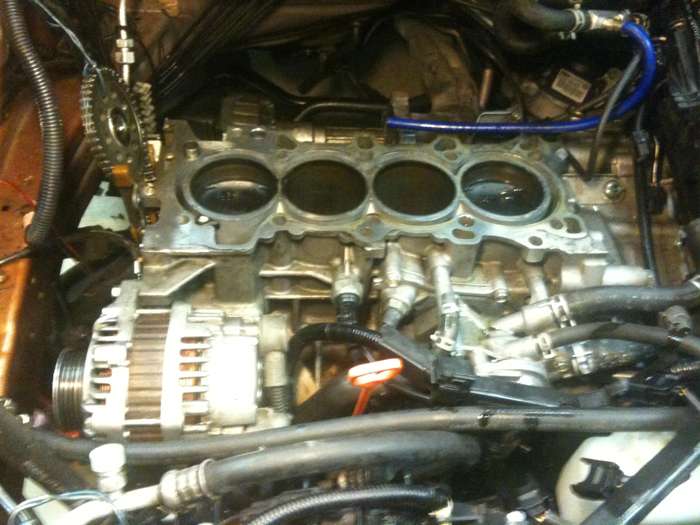
On the left there, you can see my cam gear. Its solid.
A vtc cam gear looks like this:

Which brings me back to, Why is it called i-vtec when our vtec is (with the exception of only using 4 lobes instead of 5) the same vtec as the b/d series. just marketing I guess.
Last edited by Lyon[Nightroad]; May 11, 2011 at 07:16 AM.

right but our l15a7 is marketed as an I-vtec engine. This usually refers to VTC+VTEC. However, we have no VTC, So why call it I-Vtec, why not just vtec. Our vtec is no more intelligent than that on the b/d series.
Yep, thats what, foolishly I admit, I used to think we had on our I-vtec L15a7 too, never really stopped to think about it.
Member
Joined: Oct 2009
Posts: 4,295
From: Wandering around.
There is no variable timing on the camshaft at all. We do not have vtc. I have two l15a7 engines, one is on a stand and I can disassemble it freely since I have the whole thing just held hand tight. We have a fixed cam gear.
On the left there, you can see my cam gear. Its solid.
A vtc cam gear looks like this:
Which brings me back to, Why is it called i-vtec when our vtec is (with the exception of only using 4 lobes instead of 5) the same vtec as the b/d series. just marketing I guess.
On the left there, you can see my cam gear. Its solid.
A vtc cam gear looks like this:
Which brings me back to, Why is it called i-vtec when our vtec is (with the exception of only using 4 lobes instead of 5) the same vtec as the b/d series. just marketing I guess.
In any case, wiki does mention on one page about VVT... VTEC - Wikipedia, the free encyclopedia
In the SOHC section for R series engines...
With the continued introduction of vastly different i-VTEC systems, one may assume that the term is now a catch-all for creative valve control technologies from Honda.
That sir... is a different conversation. VTEC in our engines involves a rocker arm which lifts the valve further and longer. VTC is more of timing. Imagine it opens at 1/4 of a cycle, closes at 3/4... a VTC phase would be like, opening at 3/16 and closing at 11/16 (a shift of 1/16). Where VTEC would opening at 3/16 and closing at 13/16 (a WIDENING of 1/8). This is an oversimplification of it... but should give an idea.

Tuning wasn't so bad for VTC, at least I didn't think it was difficult. When I had my 5R down on Okinawa (miss it so damn much). Easiest way is you lock all the cells to whatever angle, do some runs, move to next angle...repeat until you have done each angle and then compare data logs of all the runs and you can see where the cam likes to be at any given rpm. Plus with the preloaded maps from Hondata, it made it even easier, though I had to do a shit ton of change with mine, compression was slightly raised on top of already being .5:1 higher than the RSX-S, the much improved fuel in Japan had me able to alter the timing so damn much.

Member
Joined: Mar 2011
Posts: 501
From: Brunswick Ohio
Tuning wasn't so bad for VTC, at least I didn't think it was difficult. When I had my 5R down on Okinawa (miss it so damn much). Easiest way is you lock all the cells to whatever angle, do some runs, move to next angle...repeat until you have done each angle and then compare data logs of all the runs and you can see where the cam likes to be at any given rpm. Plus with the preloaded maps from Hondata, it made it even easier, though I had to do a shit ton of change with mine, compression was slightly raised on top of already being .5:1 higher than the RSX-S, the much improved fuel in Japan had me able to alter the timing so damn much.


I had been wondering as an engine builder how the hell Honda put VTC on a SOHC engine- I guess they just didn't, and wanted to keep the iVTEC moniker because in moron (the language of hybrid and wanna-be green car drivers), i means green and great fuel economy- thanks for bringing this to light! Mark W.
Lol, now I have to figure out what this bizarre lean hiccup is at 4000 rpms. It's so short only the span of about 200rpms. I had always blamed it on vtc and called it vtc gremlins, but now I'm determined to find out what it is.

Member
Joined: Mar 2011
Posts: 115
From: Vienna, WV
Just noticed this thread while scrolling down......yes the Fit does have vtec, depending on your exact definition of "variable". Look at the shop manual page 6-35 after reading this if you need.
There are 4 cam lobes for each cylinder. The two for the exhausts have identical profiles and operate the valves identically via conventional roller rocker arms. The two cam lobes for the intakes, however, have different profiles. One of them (primary) operates BOTH valves up until 4000+ rpm, then the other (secondary) takes over from there. The switch from one lobe to the other being in control of the intake valves is accomplished with a small piston between the two rocker arms. It's those 4 LMS that keep the secondary intake rocker arm following the secondary intake cam lobe until it takes over at higher rpm.
So "variable" means you have one set of intake valve timing, lift, and duration at low rpm and another at high rpm.
Clear as mud? A look at the two intake rockers on page 6-35 will either help a lot or make ya want a couple beers.
geo
There are 4 cam lobes for each cylinder. The two for the exhausts have identical profiles and operate the valves identically via conventional roller rocker arms. The two cam lobes for the intakes, however, have different profiles. One of them (primary) operates BOTH valves up until 4000+ rpm, then the other (secondary) takes over from there. The switch from one lobe to the other being in control of the intake valves is accomplished with a small piston between the two rocker arms. It's those 4 LMS that keep the secondary intake rocker arm following the secondary intake cam lobe until it takes over at higher rpm.
So "variable" means you have one set of intake valve timing, lift, and duration at low rpm and another at high rpm.
Clear as mud? A look at the two intake rockers on page 6-35 will either help a lot or make ya want a couple beers.
geo

You are referring to the 0.010" centerline of the "high-rpm" lobe being advanced?
Last edited by DiamondStarMonsters; May 22, 2011 at 10:46 PM.

Member
Joined: Oct 2007
Posts: 2,304
From: Illinois
Just an observation the ivtec is in the rockers and that could explain some of the problems. Honda L-Series SOHC i-VTEC Engines for the new GD Honda Fit/Jazz. Look at the rockers for the 1.5.

