3rd Generation (2015+) Say hello to the newest member of the Fit family. 3rd Generation specific talk and questions here.

6MT Shifting Recommendations for best fuel economy: Eco Assist or Honda Manual

Thread Tools
 
Search this Thread
 
Old Nov 11, 2015 | 11:23 AM
  #21  
Fit Charlie's Avatar
Member
Joined: Feb 2014
Posts: 850
From: The 603
5 Year Member
Average mpg is what you want it to be. If you reset the average every time you fill the tank, it's a tank average. Tank mpg and short trip mpg work together to show what you're doing now and how it affects the tank.
 
Old Nov 13, 2015 | 10:42 AM
  #22  
veazer's Avatar
Member
Joined: Mar 2015
Posts: 50
From: Richmond, VA
5 Year Member
Originally Posted by TorontoBoy
The Fit engine redlines at 6,800 rpm. It seems to me that shifting at only 2k rpm is really not in the engine's power band. Peak torque of 114lb occurs at 4,600 rpm, and the max 130hp occurs at 6,600 rpm.
This just means that if you're racing, you keep the engine in the 4K+ range to get you the most power. It does not mean the engine is getting good mileage in that range. To keep your car moving at a consistent speed at 45ish MPH, you need something like 2-5 hp to keep that speed depending on car shape, weight, wind speed, etc. Which your engine would give you in about 8th gear at 1.2K rpm... like you said here:

Originally Posted by TorontoBoy
By following the green Eco light I can cruise in 6th at 37mph/60kph, 2k rpm, without engine stumble, and the car does not complain at all. Left to my own choice I'd probably be in 4th gear at around 3,500 rpm.
being in 6th and going at a consistent speed at 37 is how you maximize fuel economy. Trying to accelerate in 6th from 37 though, is a bad idea. Accelerate closer to the power band, coast/maintain constant speed in the highest gear you can manage.


Originally Posted by TorontoBoy
If I shift into neutral, for example on a decline, the blue LEDs turn on. Only when I get back into a gear that has the engine at 2k rpm does the green LED appear.
This is because in 6th gear going downhill with no throttle, the fuel injectors shut off and you burn no gas, despite the engine turning because the wheels are pushing the engine. If you're in neutral, you're burning about 0.2gal/hr or something to keep the engine spinning. It's minor, but if the hill is steep enough that you can maintain speed or barely have to blip the throttle, staying in gear is better.

(Hypermiling would be to shift to neutral while turning the engine off, so you don't have the extra resistance from being in gear but you're also not burning gas to keep the engine idling. Most people view this as excessively dangerous and not worth the fuel savings, which I agree with, but it's not the point of this reply, so i don't propose it as an option 3 above.)

Originally Posted by TorontoBoy
Do the Eco Assist shift recommendations or the Honda Fit manual shift recommendations make more sense for fuel economy? ... Any advice?
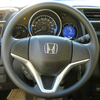
The shifting dummy lights are kinda dumb, but some of what they do is actually correct. If you accelerate at less than 2K rpm, it goes blue to tell you that you'll get better mileage by downshifting to accelerate. If you utilize engine braking, they turn green. If you're going 35 in 2nd, they'll be blue to tell you to shift. If you coast in neutral, they turn blue because you'd get better fuel economy in 6th. When you're stopped, they're blue because you're getting 0 MPG.

It all comes down to knowing why you're doing what you're doing.
 
Old Nov 15, 2015 | 11:04 AM
  #23  
TorontoBoy's Avatar
Thread Starter
|
Member
Joined: May 2015
Posts: 938
From: Toronto, ON, Canada
5 Year Member
Originally Posted by veazer
Originally Posted by TorontoBoy
... If I shift into neutral, for example on a decline, the blue LEDs turn on. Only when I get back into a gear that has the engine at 2k rpm does the green LED appear...
This is because in 6th gear going downhill with no throttle, the fuel injectors shut off and you burn no gas, despite the engine turning because the wheels are pushing the engine. If you're in neutral, you're burning about 0.2gal/hr or something to keep the engine spinning. It's minor, but if the hill is steep enough that you can maintain speed or barely have to blip the throttle, staying in gear is better...

It all comes down to knowing why you're doing what you're doing.
Thanks for the hints and tips. I do appreciate them as I learn. It has taken me a couple of days to think about your comments.

Originally Posted by GoBucky
Originally Posted by 2015FIT
I have an MT and try to glide on neutral when going downhill to increase mpg, however, this advice from someone who posted on Fuelly Fuel Saving Tips suggests differently. What are your thoughts, neutral or highest gear when going downhill?? Is it different between MT and CVT??

"While going downhill, don't drive in Neutral gear. Instead drive in the highest gear and don't put your foot on gas. This will prevent the vehicle from speeding and at the same time reduce fuel consumption as compared to the case when you drive on neutral and the fuel is constantly being fed to the motor for idling. This will reduce the braking as well."
To answer your question directly, not taking into concern the valid points mentioned above, you will definitely get better fuel efficiency coasting in neutral than coasting in gear. Coasting in neutral will allow you to maintain or even increase your speed downhill while coasting in gear will cause a slowdown in speed (except on the steepest of hills), resulting in multiple "back on the accelerator" episodes. You should be able to coast in neutral 2-4 times the distance you can coast in gear, which more than offsets the time you're actually coasting in DFCO (deceleration Fuel Cutoff). With that said, I don't neutral coast on freeways but I will neutral coast to stop signs, stop lights, on residential streets, etc.
I am interpreting this as it is better to be in gear if your car is on a flat stretch, or on a decline and you do not want to accelerate due to gravity. If your car is on a steep decline and will accelerate you will increase fuel economy by coasting. Coasting uses gas as the car is in idle, but will allow you to accelerate on a decline, burning up idle gas but naturally increasing forward momentum, saving more than the idle gas. Being in gear but off the gas will not use gas (DFCO) but will not let you accelerate due to a decline.

If (on flat or slight decline) or (on a steep decline and you do not want to accelerate)
---stay in gear, DFCO will save you idle gas;
elseif (on a decline that will accelerate car above current speed)
---coast. You will waste idle gas but increase forward momentum;
endif

I guess it really does depend on your situation. Every little bit helps though, so I'm paying attention to these little details.
 
Old Nov 15, 2015 | 01:09 PM
  #24  
Fit Charlie's Avatar
Member
Joined: Feb 2014
Posts: 850
From: The 603
5 Year Member
Coasting in gear is engine braking. If braking is appropriate, that's the way to go. If braking is not appropriate, the bit you burn idling is still better than braking.

Idling at 60 mph, my Fit gets around 270 mpg. I could make that number look higher by engine braking, but it's just a stunt that would make me burn more gas over the whole trip. Braking in any form is best avoided whenever possible.
 
Related Topics
Thread
Thread Starter
Forum
Replies
Last Post
haudoodles
3rd Generation (2015+)
4
Dec 12, 2014 10:23 AM
spookyneo
2nd Generation (GE 08-13)
45
Mar 18, 2013 12:14 PM
Fluxmerc
Fit DIY: Repair & Maintenance
0
Sep 22, 2012 02:40 AM
wsalopek
General Fit Talk
20
Apr 12, 2006 12:18 AM
CarDemon
General Fit Talk
1
Feb 19, 2006 04:20 PM


All times are GMT -4. The time now is 12:13 AM.