


So I dyno'd my Fit


Being curious I dynoed my car today. I made 87whp and 91tq on a Dynopack
WR SW intake
WR Street Header
Aspec Bpipe
Aspec Axle Back
Sorta blows but hey its a 1.5
WR SW intake
WR Street Header
Aspec Bpipe
Aspec Axle Back
Sorta blows but hey its a 1.5
Last edited by petwhookie; Nov 5, 2008 at 10:26 PM.



epic fail. Backpressure is BAD. Always. backpressure is NEVER GOOD.
What you want is to optimize exhaust size in order to maintain velocity of the gases escaping. Go as big as you can while maintaining the velocity. If the velocity slows, step the size back down. But regardless, you NEVER WANT BACKPRESSURE.
I think the big problem is, in order to take advantage of all those mods, you need a tune, via a SAFC or piggyback ecu.
But for the Fit, it's not worth the money to me to bother modding it n/a like that. Obviously 86whp is pathetic. Anyways, GL with the turbo kit.
What you want is to optimize exhaust size in order to maintain velocity of the gases escaping. Go as big as you can while maintaining the velocity. If the velocity slows, step the size back down. But regardless, you NEVER WANT BACKPRESSURE.
I think the big problem is, in order to take advantage of all those mods, you need a tune, via a SAFC or piggyback ecu.
But for the Fit, it's not worth the money to me to bother modding it n/a like that. Obviously 86whp is pathetic. Anyways, GL with the turbo kit.

epic fail. Backpressure is BAD. Always. backpressure is NEVER GOOD.
What you want is to optimize exhaust size in order to maintain velocity of the gases escaping. Go as big as you can while maintaining the velocity. If the velocity slows, step the size back down. But regardless, you NEVER WANT BACKPRESSURE.
I think the big problem is, in order to take advantage of all those mods, you need a tune, via a SAFC or piggyback ecu.
But for the Fit, it's not worth the money to me to bother modding it n/a like that. Obviously 86whp is pathetic. Anyways, GL with the turbo kit.
What you want is to optimize exhaust size in order to maintain velocity of the gases escaping. Go as big as you can while maintaining the velocity. If the velocity slows, step the size back down. But regardless, you NEVER WANT BACKPRESSURE.
I think the big problem is, in order to take advantage of all those mods, you need a tune, via a SAFC or piggyback ecu.
But for the Fit, it's not worth the money to me to bother modding it n/a like that. Obviously 86whp is pathetic. Anyways, GL with the turbo kit.
a little confused here.....
so the engine will always have the same amount of air flowing into it and out of it unless you increase the displacement or force more in (turbocharge or supercharge). that means that without making either of these modifications the volumetric flow rate out of the engine will always be the same. so if you are trying to maintain the stock exhaust velocity you would want to keep the stock exhaust size...
unless i am confused by what you said.
He saying you do not want back pressure. Back pressure has nothing to do with it. Your not trying to maintain stock exhaust velocity, your trying to increase it. You increase the velocity and increase the scavenging your going to make more power. When you go to big with the exhaust your going to lose the velocity which means your going to lose the scavenging ability, which means your going to lose power. The back pressure does nothing except restrict flow.

He saying you do not want back pressure. Back pressure has nothing to do with it. Your not trying to maintain stock exhaust velocity, your trying to increase it. You increase the velocity and increase the scavenging your going to make more power. When you go to big with the exhaust your going to lose the velocity which means your going to lose the scavenging ability, which means your going to lose power. The back pressure does nothing except restrict flow.
I'm not arguing with that at all. I agree that they are basically a waste. I don't agree that it has anything to do with back pressure and that post your quoting was to clarify for the guy asking who posted before me.
He saying you do not want back pressure. Back pressure has nothing to do with it. Your not trying to maintain stock exhaust velocity, your trying to increase it. You increase the velocity and increase the scavenging your going to make more power. When you go to big with the exhaust your going to lose the velocity which means your going to lose the scavenging ability, which means your going to lose power. The back pressure does nothing except restrict flow.
in order to increase the exhaust velocity with bolt ons you would need to DECREASE the exhaust size...
Not completely true but there lies the problem, there is no perfect size, ideally a pipe that changes with diameter with RPM as needed would be perfect but that's not gonna happen. Smaller diameter with keep velocity up at low rpm, but high rpms will suffer when the engine has to work against itself to push the exhaust out. And bigger piping will do the opposite, it will help out high rpm velocity and scavenging but hurt the low end velocity. But in the end the point is its not about back pressure.

Member
Joined: Oct 2008
Posts: 117
From: Parrish, FL
That's not true. You've got to remember that exhaust gases aren't just the flow of gases, but as the gases expand by cooling, that maintains and sometimes increases velocity.
The idea is to make sure the piping isn't too large to allow the expansion and cooling of the exhaust gases to happen too soon after the exhaust ports, but it can't be too small that the flow/expansion is restricted and causing backflow into the combustion chamber when the valves open.
Another thing to consider is that the exhaust doesn't enter from the header as a constant flow. Stock exhaust manifolds rarely are sized to accomodate the firing order of the cylinders, i.e. to size each runner according to the firing order so that the exhaust pulses reach the collector at the same time, making a constant flow out through the exhaust.
This is another thing that can make a big difference in turbo manifolds. Everyone says tubular is better. Tubular is good. Equal length is good, but pulse-converter style turbo manifolds will spool a turbo faster and maintain good solid flow at high rpm, because they convert the individual pulses of each cylinder into one full-displacement "pulse" into the collector and then turbo.
I'm no engineer, and my terminology is probably off, but this is what I've understood after reading a lot and experiencing a bit over the past 8 years or so that I've been modding cars.

Member
Joined: Jul 2008
Posts: 548
From: USA
Well for one gases contract when they cool and expand when they heat.
That's why cylinder pressure after combustion is higher than before, why hot air balloons float, and thunderclouds top 40,000 feet. PV=nRT is your friend.
Tubing should get smaller the farther away from the engine it is. That's why in your stock fit the tailpipe size is nearly the size of any ONE exhaust port on the head. Between the contracting (and slowing) gases, combined with the collector/cat/stock muffler removing the extra volume needed when the pulses are stronger (read: noisier, and when it's quiet the flow rate more or less averages out, so the size doesn't need to accomodate the extra volume of the peak of the pressure waves), the shrinking pipe sizes actually maintain the flow rate.
Thus if your exhaust velocity is too slow, you need to decrease the pipe size like slow-as-heck said.
I bet what you're thinking of is density, which gases gain as they cool (same molecules, less volume, more dense). Unfortunately this is what kills power with too big a pipe. With each exhaust pulse there is an inverted pulse from the tailpipe end that will work against the exhaust gases. Towards the rear of the exhaust system where the gases have cooled and lost their momentum by filling the pipe, the inverted pulse can cause severe exhaust reversion. That effectively makes the exhaust gas ITSELF a restriction.
For good measure, for those not inclined towards physics--- picture the gas as a cylinder in the pipe.
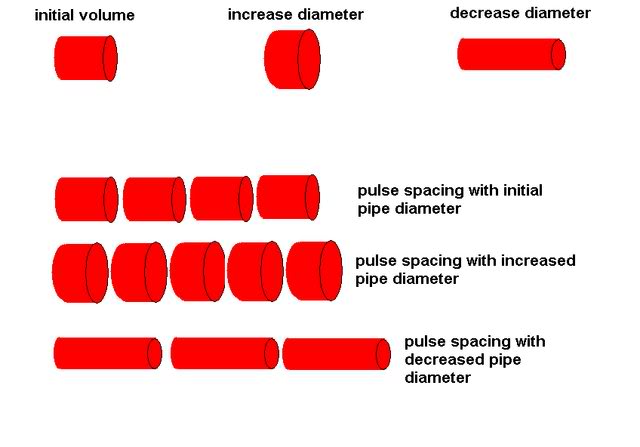
If the pipe is smaller, the number of pulses that can fit in the exhaust pipe is less. But, the engine is turning at the same speed, putting out the same number of pulses per second. Guess what-- if not as many will fit, they will be booking out of there!
That's why cylinder pressure after combustion is higher than before, why hot air balloons float, and thunderclouds top 40,000 feet. PV=nRT is your friend.
Tubing should get smaller the farther away from the engine it is. That's why in your stock fit the tailpipe size is nearly the size of any ONE exhaust port on the head. Between the contracting (and slowing) gases, combined with the collector/cat/stock muffler removing the extra volume needed when the pulses are stronger (read: noisier, and when it's quiet the flow rate more or less averages out, so the size doesn't need to accomodate the extra volume of the peak of the pressure waves), the shrinking pipe sizes actually maintain the flow rate.
Thus if your exhaust velocity is too slow, you need to decrease the pipe size like slow-as-heck said.
I bet what you're thinking of is density, which gases gain as they cool (same molecules, less volume, more dense). Unfortunately this is what kills power with too big a pipe. With each exhaust pulse there is an inverted pulse from the tailpipe end that will work against the exhaust gases. Towards the rear of the exhaust system where the gases have cooled and lost their momentum by filling the pipe, the inverted pulse can cause severe exhaust reversion. That effectively makes the exhaust gas ITSELF a restriction.
For good measure, for those not inclined towards physics--- picture the gas as a cylinder in the pipe.
If the pipe is smaller, the number of pulses that can fit in the exhaust pipe is less. But, the engine is turning at the same speed, putting out the same number of pulses per second. Guess what-- if not as many will fit, they will be booking out of there!

Well, this dynoplot doesnt mean anything because you don't have the base line dynoplot to compare. Plus Mustang dyno numbers are usually lower.

Member
Joined: Jul 2008
Posts: 160
From: Maricopa, Arizona
Sad numbers for sure, and a waste of $1000. More proof that bolt on's are pointless on this car, unless a tuning option becomes avaliable. Otherwise save the money and go F/I.

New Member
Joined: Feb 2008
Posts: 1
From: MO
What I'm basically getting from this is the stock exhaust size is matched pretty good for the engine and removing the restrictions will give a few horsepower. The big restrictions are the cat and the muffler. So I'm thinking doing just those mods should yeild the most power instead of a header back exhaust.


why is everyone complaining that mustang dynos run lower?
whatever dyno you use, your car isn't going to be suddenly faster because one dyno said you made more power than the other.
i will say that it sounds low, but like aj racing said, it would have been cool to see the baseline numbers.
i think sugarphreak and another member did this, and with all his bolt ons, sugarphreak was making less power too. sucks.
any modded fit requires f.i. i guess.
whatever dyno you use, your car isn't going to be suddenly faster because one dyno said you made more power than the other.
i will say that it sounds low, but like aj racing said, it would have been cool to see the baseline numbers.
i think sugarphreak and another member did this, and with all his bolt ons, sugarphreak was making less power too. sucks.
any modded fit requires f.i. i guess.

Member

Joined: Dec 2007
Posts: 482
From: Virginia
There have been dseries who have made over 550whp boosted, and 200whp all motor. A waste of money taking it that far, IMO, but still not bad at all.

Not bad for this car on a mustang dyno. They always read lower. But its only a number what matters is the time slip and how it feels to u when u drive it. Like when i use to race my evo i only had 316AWHP on my first dyno was not alot for a Evo around where i was at. But i use to eat up twin turboed 350Z that put down 400hp. I loved how fun it was to drive it felt good still was a good DD and a blast to drive. Evos in my book are some of the best cars i only put about $2000 in performace mods and the end i was pushing around 330AWHP but did not get a final dyno on it. One day i will get another one for just a weekend car and keep the fit for my DD.