


Snapshot


Thread Starter
|
Member
Joined: May 2012
Posts: 1,671
From: Boston, MA

Snapshot
So I was curious about a certain insurance company's device, which plugs into your OBDII port and measures your driving habits. The idea is, if you are a good driver, then they'll give you a break on your insurance. Thought I would give a report. I did this because I was curious; I'm not going to switch insurance because of it.
It makes sense, because currently, insurance companies try to predict how safe you will drive based on certain characteristics, but of course this is only a prediction and not for you individually. Now, the insurance company knows how well you drive. Clearly, there's some self-selection -- if I think I'm better than average, I'm more likely to sign up for the device than if I'm a real yobbo.
Anyway, how it works is this. The company is concerned about privacy backlash, so they DON"T collect location data. They tell you all this detail, of course; you don't have to dig to find out what is and isn't used. All they collect is:
Miles driven
Hard acceleration (# of events)
Hard braking (#)
Time of day you drive.
Makes sense, right? If you drive between 1 and 4AM frequently, this maaay not be as safe as 1 and 4pm. If you drive a lot of miles, you're just plain more likely to have someone run into you than if you leave your car in the driveway all month. It turns out that despite being a very conservative driver, I did have a few hard braking events. Probably people cutting in front of me, or just appearing they would. -7mph/second is how they define it.
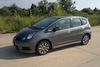
What's somewhat amusing is, the Honda Fit is NOT CAPABLE of accelerating faster than 7mph/second. So already ahead of the game there! Hehehe. Although I might say, a Corvette at 1/3 throttle is probably faster than a Fit at full throttle, but to me I would say the Fit doing that is a less safe driver. But whatever.
In any case, you track progress online. 28% discount! Yay! But this bothers me, because, who knows what base I'm getting the discount off of? Tell me in $ please? Of course, they can't do that, because that discount is layered on top of the very complicated standard factor model. From my point of view, though, this is annoying. Great, 30% max off. 30% off of $500 or $1500?
In any case, interesting experience. There's a bunch of insurers offering this, so I make no recommendation. Safe drivers, worth checking this out. Unsafe drivers, actually still worth it - it's free to test out and you will learn something, and there's no penalty if you decide not to buy insurance because you find out you get 0% discount :P
It makes sense, because currently, insurance companies try to predict how safe you will drive based on certain characteristics, but of course this is only a prediction and not for you individually. Now, the insurance company knows how well you drive. Clearly, there's some self-selection -- if I think I'm better than average, I'm more likely to sign up for the device than if I'm a real yobbo.
Anyway, how it works is this. The company is concerned about privacy backlash, so they DON"T collect location data. They tell you all this detail, of course; you don't have to dig to find out what is and isn't used. All they collect is:
Miles driven
Hard acceleration (# of events)
Hard braking (#)
Time of day you drive.
Makes sense, right? If you drive between 1 and 4AM frequently, this maaay not be as safe as 1 and 4pm. If you drive a lot of miles, you're just plain more likely to have someone run into you than if you leave your car in the driveway all month. It turns out that despite being a very conservative driver, I did have a few hard braking events. Probably people cutting in front of me, or just appearing they would. -7mph/second is how they define it.
What's somewhat amusing is, the Honda Fit is NOT CAPABLE of accelerating faster than 7mph/second. So already ahead of the game there! Hehehe. Although I might say, a Corvette at 1/3 throttle is probably faster than a Fit at full throttle, but to me I would say the Fit doing that is a less safe driver. But whatever.
In any case, you track progress online. 28% discount! Yay! But this bothers me, because, who knows what base I'm getting the discount off of? Tell me in $ please? Of course, they can't do that, because that discount is layered on top of the very complicated standard factor model. From my point of view, though, this is annoying. Great, 30% max off. 30% off of $500 or $1500?
In any case, interesting experience. There's a bunch of insurers offering this, so I make no recommendation. Safe drivers, worth checking this out. Unsafe drivers, actually still worth it - it's free to test out and you will learn something, and there's no penalty if you decide not to buy insurance because you find out you get 0% discount :P
Member
Joined: Aug 2012
Posts: 73
From: nyc
There was a stink about something similar to this with on-star equipped cars tracking your driving habits without consent. I wouldn't be surprised if other manufacturers already have similar things already in existing cars. Personally I would not do this as I don't feel comfortable with someone monitoring how I drive and possibly where I go.
btw, units of acceleration are usually m/s^2 or ft/s^2. Did you mean 7 ft/s^2?
btw, units of acceleration are usually m/s^2 or ft/s^2. Did you mean 7 ft/s^2?
Thread Starter
|
Member
Joined: May 2012
Posts: 1,671
From: Boston, MA
I meant what I said. I'm pretty sure they just wanted it to be comprehensible in real-world terms. I have no idea what 10ft/sec^2 feels like. You're right, it's not a common way to express acceleration.

This would to be better for someone who does not drive a lot or obeys the speed limits closely and gets charged higher premiums based on the area they live in rather then their driving habits.
Are you really rewarded for good driving?
Progressive claims that its Snapshot program rewards "good drivers" by offering discounts of up to 30%. But a closer look at the driving behaviors they track shows that is not strictly true.
After it's been installed in your car, the Snapshot device collects data about miles driven, the time of day one drives, and braking patterns. While this information may reveal a great deal about the degree of risk a driver imposes on an insurance company, it does not say much about whether someone is a good driver.
To see how this is the case, let's take a closer look at how Progressive uses this data to rank customers as high-, medium-, or low-risk.
Are you really rewarded for good driving?
Progressive claims that its Snapshot program rewards "good drivers" by offering discounts of up to 30%. But a closer look at the driving behaviors they track shows that is not strictly true.
After it's been installed in your car, the Snapshot device collects data about miles driven, the time of day one drives, and braking patterns. While this information may reveal a great deal about the degree of risk a driver imposes on an insurance company, it does not say much about whether someone is a good driver.
To see how this is the case, let's take a closer look at how Progressive uses this data to rank customers as high-, medium-, or low-risk.
- Miles driven: Progressive recommends that drivers not drive more than an average of 30 miles per day (about 11,000 miles annually) if they want to receive a discount. Driving a greater number of miles makes people greater insurance risks. After all, the more people drive, the more likely they are to get into accidents. But mileage alone doesn't make someone a bad driver.
- Driving times: Progressive rewards drivers who are on the road during times that pose lower risks for accidents. For example, it is more likely to reduce rates on customers who do most of their driving in the middle of the day than customers who regularly drive in rush hour traffic. The company is also less likely to decrease rates on those between midnight and 4 a.m. Prospective customers should note, though, that while information about the times of day people drive may indicate their level of risk for accidents, it does not indicate their driving ability.
- Brake patterns: Progressive also rewards drivers who have fewer "hard brakes," (i.e., fewer instances in which they decrease their speed by more than 7 miles per second). While this information can indicate bad driving habits, such as tailgating, braking patterns often have a lot to do with the driving conditions.

Thread
Thread Starter
Forum
Replies
Last Post
