


First look at stock camber...


I just got my bolts yesterday and I'll be installing them tomorrow. They're pretty unimpressive. The diameter difference is very small, but I guess we have to take whatever adjustability we can get. It took my dealer several weeks to get all 4 in stock. Apparently Honda hasn't stocked up on these bolts because people haven't crashed enough Fits yet!
Apparently so. Could it be that the Civic didn't come with a factory crash bolt at all? Hard to believe. In any case, what I hear from the rule gods is that you must use the factory pn on a crash bolt if one is specified -- aftermarket crash bolts are a no-no.
So I installed the crash bolts and did an alignment on my Fit yesterday. The bolts were really easy to install. I just did them one at a time so I didn't have the whole suspension fall apart on me. Then I levered the suspension to get max camber before tightening the bolts. I then measured the camber with a cheap camber gauge I have, and found that I had way more camber on the passenger side than the driver side. So I removed one of the bolts from the passenger side, and ended up with -3/4 degree on the driver side and -1 degree on the passenger side. I tried levering the top of the driver's side strut to get more camber, but it basically sits inside a cone at the top of the bodywork, so there's no adjustability there.
Then I set the toe using a string box, as shown in the photos below. The procedure is time consuming but simple, and it gives good results. Basically you tie string around a set of jackstands set up at each corner of the car. Raise the stands so the string is at hub height, then make the string exactly the same length at each end of the car. Then position the string so you have equal measurements from the hubs at each end of the car. It's good to use a tape measure that reads in 32nds of an inch for accuracy. This gives you a precise box around the car. Then by measuring from the front and rear rim of each wheel to the string, you get a toe measurement, and you can then measure how the toe changes as you turn the tie rods. I set the front toe at zero -- or at least as close to zero as my eyes and the tape measure could get.
I used some linoleum flooring squares to level the surface that the car sits on. Then each front wheel also sits on two flooring squares with grease smeared between them to create a turning plate, so when you turn the tie rods to adjust toe, the wheel can turn freely.
The results came out good. The car drives great and already seems to have more grip, though I haven't taken a ton of twisties with it yet. A seasoned eye can tell just by looking that the car has a lot more camber than stock.
I also found that properly simulating the driver's weight makes a big difference. I used an extra set of tires and wheels and a big water jug for the weight. At first I put some of the weight in the back seat footwell. But when I moved it all into the driver's seat, that alone changed the camber on the driver's side front wheel by 1/8 degree.
BTW, the photos show the car with the Saturn wheels and Kumho v710 R-comp tires that I'll be autocrossing with. I used these to do the alignment because I figure the firmer tires would give more exact readings.
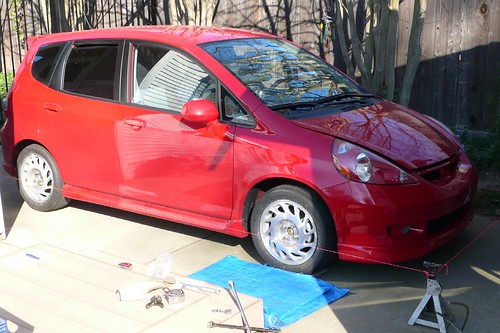
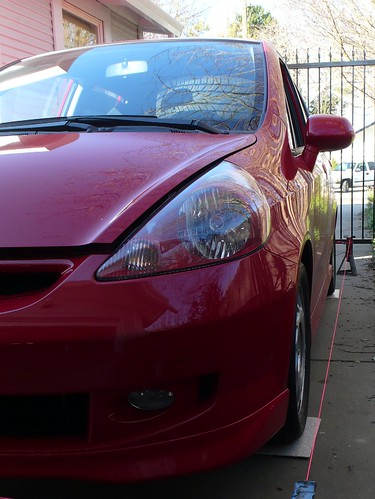
Then I set the toe using a string box, as shown in the photos below. The procedure is time consuming but simple, and it gives good results. Basically you tie string around a set of jackstands set up at each corner of the car. Raise the stands so the string is at hub height, then make the string exactly the same length at each end of the car. Then position the string so you have equal measurements from the hubs at each end of the car. It's good to use a tape measure that reads in 32nds of an inch for accuracy. This gives you a precise box around the car. Then by measuring from the front and rear rim of each wheel to the string, you get a toe measurement, and you can then measure how the toe changes as you turn the tie rods. I set the front toe at zero -- or at least as close to zero as my eyes and the tape measure could get.
I used some linoleum flooring squares to level the surface that the car sits on. Then each front wheel also sits on two flooring squares with grease smeared between them to create a turning plate, so when you turn the tie rods to adjust toe, the wheel can turn freely.
The results came out good. The car drives great and already seems to have more grip, though I haven't taken a ton of twisties with it yet. A seasoned eye can tell just by looking that the car has a lot more camber than stock.
I also found that properly simulating the driver's weight makes a big difference. I used an extra set of tires and wheels and a big water jug for the weight. At first I put some of the weight in the back seat footwell. But when I moved it all into the driver's seat, that alone changed the camber on the driver's side front wheel by 1/8 degree.
BTW, the photos show the car with the Saturn wheels and Kumho v710 R-comp tires that I'll be autocrossing with. I used these to do the alignment because I figure the firmer tires would give more exact readings.
Last edited by Skimmer; Feb 17, 2008 at 07:44 PM.

Member

Joined: Sep 2007
Posts: 91
From: North Jersey
Skimmer,
I'm really starting to hate you, lol. You have the wheels and tires I want to run...just can't find those Saturn wheels anywhere right now. I also plan on ordering the camber bolts tomorrow...can you please post the part#s for them?
Thanks!
Thanks!

Member
Joined: Oct 2007
Posts: 266
From: DFW, TX
Ditto to what Skimmer said... the wheels are out there. There were approx. 3 sets at the local 'yard I found mine, and I was able to pick the best of them to make a set for $100. They don't look as nice as Skimmer's set seems to, the sun here in TX just nukes the crap out of anything that isn't super-well maintained. Since I got my set, I've seen a dozen other sets... running down the road on S-cars. There must be a ton of them out there just waiting to be found.
I think it would be worth some research to see what the other styles of S-car wheels actually weigh. I know the Saturn guys seem to believe the sawtooth wheels are the lightest, but by how much? Any might be enough, but 15# for the "good" wheels vs. 15.2# for the ones you can find everywhere in MINT shape may not be worth the hassle. At least it probably wouldn't be for me until I get more seat time...
HF
I think it would be worth some research to see what the other styles of S-car wheels actually weigh. I know the Saturn guys seem to believe the sawtooth wheels are the lightest, but by how much? Any might be enough, but 15# for the "good" wheels vs. 15.2# for the ones you can find everywhere in MINT shape may not be worth the hassle. At least it probably wouldn't be for me until I get more seat time...
HF


Member
Joined: Jan 2008
Posts: 4,371
From: NC USA
I figure this will only interest the hard-core autocrossers out there, but anyway...
Over the weekend I made some quick camber measurements on my stock Fit and got some surprising results. FYI ... I used this style of camber/caster gauge -- cheap and crude but effective:
Caster/Camber Gauges - RPW Caster-Camber Gauge
Results:
LF -1/2 degree
RF +1/4 degree
LR -2 1/2 degree
RR -1 3/8 degree
A couple observations. Big differences from side to side, obviously, which isn't good for consistency in different kinds of turns (I did not simulate the driver's weight in the car, however, which might change things a bit). The difference in front can be fixed with the factory "crash bolts" which will also allow you to dial in more negative camber, and still remain legal for stock class. This will help, but probably not more than 8/10ths of a degree total change (according to the factory repair manual).
The difference between the rear wheels is surprisingly large and not adjustable. Aftermarket shims are available, yes, but not legal in stock class. I'm surprised there is so much negative camber in the rear. That's good. But it will make good alignment settings in the front even more critical to minimize understeer (i.e. that much negative camber in the rear will make it even more difficult to get any oversteer out of the car).
I have not checked the factory toe-in setting on my car yet, but that's next.
Over the weekend I made some quick camber measurements on my stock Fit and got some surprising results. FYI ... I used this style of camber/caster gauge -- cheap and crude but effective:
Caster/Camber Gauges - RPW Caster-Camber Gauge
Results:
LF -1/2 degree
RF +1/4 degree
LR -2 1/2 degree
RR -1 3/8 degree
A couple observations. Big differences from side to side, obviously, which isn't good for consistency in different kinds of turns (I did not simulate the driver's weight in the car, however, which might change things a bit). The difference in front can be fixed with the factory "crash bolts" which will also allow you to dial in more negative camber, and still remain legal for stock class. This will help, but probably not more than 8/10ths of a degree total change (according to the factory repair manual).
The difference between the rear wheels is surprisingly large and not adjustable. Aftermarket shims are available, yes, but not legal in stock class. I'm surprised there is so much negative camber in the rear. That's good. But it will make good alignment settings in the front even more critical to minimize understeer (i.e. that much negative camber in the rear will make it even more difficult to get any oversteer out of the car).
I have not checked the factory toe-in setting on my car yet, but that's next.
As for the rear differences, is your axle squared up with the chassis?
And did you weigh the vehicle at all four corners to compensate for different ride heights effects on your spindles. (the spindle accurately sets the camber)
Just measuring is not always accurate..
If you want to minimize understeer disconnect the antisway bar. Excessive straight ahead camber isn't the way to do it. Follow the camber as the wheel turns due to caster.

All toe and camber readings should be done with a person in the driver's seat with helmet if autocrossing or the equivalent weight.
Usually fluids filled (gas, etc).
Although there can be slight differences in right and left that example seems a bit more than usual. Checking on a level surface is good.
Another suggestion would be to cross check with another shop to reread alignment.
Usually fluids filled (gas, etc).
Although there can be slight differences in right and left that example seems a bit more than usual. Checking on a level surface is good.
Another suggestion would be to cross check with another shop to reread alignment.
Just FYI...The numbers quoted by Mahout were taken: 1) before I had touched anything on the suspection; 2) without leveling the chassis; and 3) without simulating the driver's weight. It was meant simply as a quick check.
I later found out when I did a more precise alignment (post #24 above) that simulating the driver's weight makes a big difference in the measurements. I did the alignment after leveling the chassis and simulating driver weight. But I did not corner-weight the car.
I later found out when I did a more precise alignment (post #24 above) that simulating the driver's weight makes a big difference in the measurements. I did the alignment after leveling the chassis and simulating driver weight. But I did not corner-weight the car.
Member
Joined: Jan 2008
Posts: 4,371
From: NC USA
Just FYI...The numbers quoted by Mahout were taken: 1) before I had touched anything on the suspection; 2) without leveling the chassis; and 3) without simulating the driver's weight. It was meant simply as a quick check.
I later found out when I did a more precise alignment (post #24 above) that simulating the driver's weight makes a big difference in the measurements. I did the alignment after leveling the chassis and simulating driver weight. But I did not corner-weight the car.
I later found out when I did a more precise alignment (post #24 above) that simulating the driver's weight makes a big difference in the measurements. I did the alignment after leveling the chassis and simulating driver weight. But I did not corner-weight the car.
Let me add that because we work with racers so much, we find that corner weights are invaluable; all springs do nt have exactly the same spring rates nor free length so fitting the springs to matchthe weight is best. Generally we find the feree length is about as good as measuring the actual spring rate so installing the taller on the driver side is pretty close. Its still not as precise as measuring the length at the matching corner weight. And yes adding spring shims to raise the height when the driver is onboard is even more accurate.

Thread
Thread Starter
Forum
Replies
Last Post
whitefitsport
2nd Generation GE8 Specific Suspension & Brakes Sub-Forum
4
Oct 2, 2018 10:54 PM
ciref8
2nd Generation GE8 Specific Suspension & Brakes Sub-Forum
10
Oct 17, 2014 12:31 AM
FELIXY69
Fit Suspension & Brake Modifications
10
Jul 21, 2009 10:38 AM
