


what grade of gas do you give to your fit?

Member
Joined: Aug 2009
Posts: 3,661
From: Georgia

My 96Deville was rated to burn premium fuel. Questions rose as to the use of regular. It was clearly determined that w/ the technology of the knock sensor that vintage of NorthStar engine would run perfectly fine on regular by adjusting the timing, however, a slight decrease in performance would be noted. This info is provided by GM, however, it was also confirmed on dyno by some serious motor heads.
Jump to my 2010 Fit. It is rated to run on regular fuel. With the technology of the knock sensor and the ECU it will adjust the timing to accommodate a higher rated fuel. With regular fuel being the bottom line, anything less and engine performance will suffer because timing will be out of the 'ideal' range - ECU cannot adjust, it's not been mapped.
So, when using a higher octane the engine will bump the timing to take advantage of the timing advance requirements of the fuel.
Question remains as to if this will result in more power to the drive wheels and/or if this will result in a more economical engine, i.e. better MPG's.
Am I getting this right????
BTW a quick peek at CadillacOwners will show you what a serious car forum looks like - NOT TO SAY we are not being serious, simply saying it is an excellent forum covering every aspect of Cadillac Ownership and extremely well organized.
Not bashing anything or anyone.
I love being a fitfreak_
Jump to my 2010 Fit. It is rated to run on regular fuel. With the technology of the knock sensor and the ECU it will adjust the timing to accommodate a higher rated fuel. With regular fuel being the bottom line, anything less and engine performance will suffer because timing will be out of the 'ideal' range - ECU cannot adjust, it's not been mapped.
So, when using a higher octane the engine will bump the timing to take advantage of the timing advance requirements of the fuel.
Question remains as to if this will result in more power to the drive wheels and/or if this will result in a more economical engine, i.e. better MPG's.
Am I getting this right????
BTW a quick peek at CadillacOwners will show you what a serious car forum looks like - NOT TO SAY we are not being serious, simply saying it is an excellent forum covering every aspect of Cadillac Ownership and extremely well organized.
Not bashing anything or anyone.
I love being a fitfreak_
 )
)

Member
Joined: Oct 2007
Posts: 2,304
From: Illinois
Knock it off bullet; the density difference between regular and premium is not significant. Chemical energy is not a function of density but the bonds between the molecules.
Ive been more than patient with you, Ive explained it and showed sources and have been trying to be respectful to you. You can feel the difference and if you think your gonna grab 10-15 horsepower your wrong but as your car detunes your problems will just start. Spending a few dollar a tank is cheaper than fuel injection cleaner every 3000 miles and adjusting the valves because they come loose because of knock you cant hear. I dont have money to waste on regular so I will enjoy my car with premium.
Nice article. What's your point? That we should heavily modify our GE8s?
Ive been more than patient with you, Ive explained it and showed sources and have been trying to be respectful to you. You can feel the difference and if you think your gonna grab 10-15 horsepower your wrong but as your car detunes your problems will just start. Spending a few dollar a tank is cheaper than fuel injection cleaner every 3000 miles and adjusting the valves because they come loose because of knock you cant hear. I dont have money to waste on regular so I will enjoy my car with premium.
Nice article. What's your point? That we should heavily modify our GE8s?
Member
Joined: Aug 2009
Posts: 3,661
From: Georgia
Ive been more than patient with you, Ive explained it and showed sources and have been trying to be respectful to you. You can feel the difference and if you think your gonna grab 10-15 horsepower your wrong but as your car detunes your problems will just start. Spending a few dollar a tank is cheaper than fuel injection cleaner every 3000 miles and adjusting the valves because they come loose because of knock you cant hear. I dont have money to waste on regular so I will enjoy my car with premium.
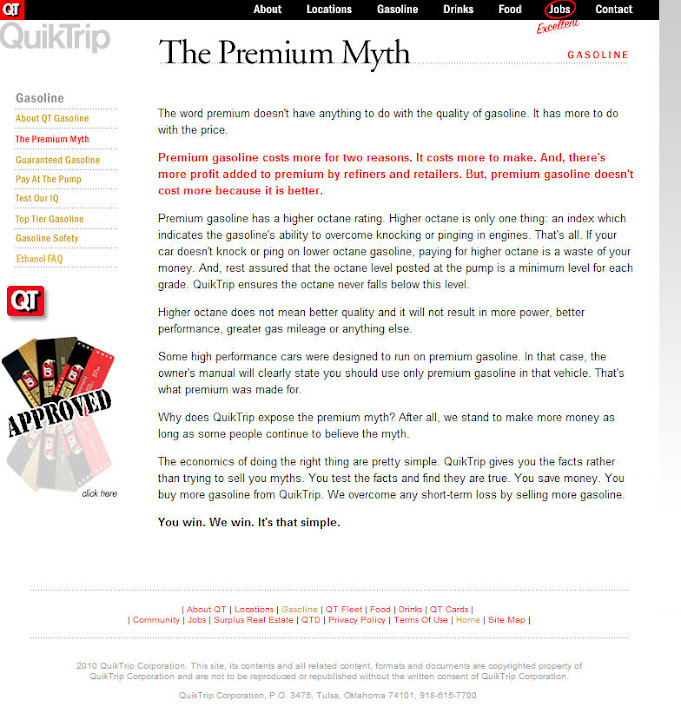
In the meantime here's my favorite QT quote again:
link
Member
Joined: Oct 2007
Posts: 2,304
From: Illinois
Ive seen big returns in power as far as passing and getting on the Highway and I didn't have to put the pedal to the floor. I am getting 40 mpg in mixed driving below 70 mph. 60-64 seems to be my sweet spot. Regular in the tank I was getting 36-38 mpg. Winter is here and mileage will go down. Ive seen the torque curve with the scan gauge and mileage difference. If you enjoy the extra torque too much you mileage will go down but driving it economically I get 2-3 mpg better per gallon.
Member
Joined: Aug 2009
Posts: 3,661
From: Georgia
For my part it's answered. I don't see a hypothesis worth testing by putting the Fit on a dyno with premium, or even switching to premium for a few tanks (this would be too subjective to have significance, especially for me). Your posts have given me more confidence in this. Thanks for your even-tempered posts.
Member
Joined: Oct 2007
Posts: 2,304
From: Illinois
Knock it off bullet; the density difference between regular and premium is not significant. Chemical energy is not a function of density but the bonds between the molecules.
That's interesting. But I bet when someone comes up with a mass produced forced induction system for the GE8 this changes.
Nice article. What's your point? That we should heavily modify our GE8s?
That's interesting. But I bet when someone comes up with a mass produced forced induction system for the GE8 this changes.
Nice article. What's your point? That we should heavily modify our GE8s?
uh, you included your comments in my quote. Here they are again:
I'm sorry. I'll respect your opinion. But until you post some data (i.e. dyno charts, track runs by a professional) that show an advantage to burning premium fuel in an economy car, your opinion will not sway mine.
In the meantime here's my favorite QT quote again:
link
I'm sorry. I'll respect your opinion. But until you post some data (i.e. dyno charts, track runs by a professional) that show an advantage to burning premium fuel in an economy car, your opinion will not sway mine.
In the meantime here's my favorite QT quote again:
link
Member
Joined: Aug 2009
Posts: 3,661
From: Georgia
Thats fine. I want to know why they are pushing regular so much? If you have a knock sensor its not gonna knock but mileage will suffer and so is power which add to the problem, so maybe they want you to buy more regular because they are getting rid of the left overs byproducts they cant use. As shown in the high carbon C9-C15 in the regular fingerprint article I posted.
Now if you are autocrossing the Fit, you're hitting those boundaries frequently. I can see where premium fuel could be an advantage. Not for daily driving regardless how heavy your foot may be.
As far as the economics, read the ad. It's good. Made me buy a tank of regular there yesterday instead of Shell, in spite of QT's involvement with creation of "top tier." See: even I'm subject to marketing influence.
Why are we arguing with someone who doesn't even know what knock retard feels like? 
He hasn't read the EnergyLab .pdf, he definitely didn't download ECMLink and look around inside, or understand the implications of the Hondata article, and his own sources conflict or prove him wrong, save for a blurb from a gas station website that was not written by a ChemE and not too mention oversimplified and inaccurate in several regards.
Also, taking a road trip and alternating tanks of 93 and 87 will not yield reproduceable or even controllable results.
Everything from pavement surface temperature, to baro pressure to coolant temp and load will be all over the place. As mentioned above it will take the ECU time to adjust, depending on how you drive this can be a week, a few days or a month. There is just too much to account for in that sort of experiment, not that I don't appreciate your efforts, Klasse.
But, again it will not yield reproduceable or accurate results. The best you could do is datalog the whole trip with a pocketlogger and then compare like data between different tanks. Though painstaking, that would produce at least some real world info.
He hasn't read the EnergyLab .pdf, he definitely didn't download ECMLink and look around inside, or understand the implications of the Hondata article, and his own sources conflict or prove him wrong, save for a blurb from a gas station website that was not written by a ChemE and not too mention oversimplified and inaccurate in several regards.
Also, taking a road trip and alternating tanks of 93 and 87 will not yield reproduceable or even controllable results.
Everything from pavement surface temperature, to baro pressure to coolant temp and load will be all over the place. As mentioned above it will take the ECU time to adjust, depending on how you drive this can be a week, a few days or a month. There is just too much to account for in that sort of experiment, not that I don't appreciate your efforts, Klasse.
But, again it will not yield reproduceable or accurate results. The best you could do is datalog the whole trip with a pocketlogger and then compare like data between different tanks. Though painstaking, that would produce at least some real world info.
Member
Joined: Oct 2007
Posts: 2,304
From: Illinois
The thing is if you ran regular its gonna take time for the maps to more and the car to take advantage of premium. The short fuel trim will adjust right away but not until its in the long term trim will it be consistent. It only gonna average between the two. Thats why Bp says 5 tanks because that how long it take to move the ecu up to a more constant map.

Member
Joined: May 2010
Posts: 3,417
From: Capital Distric New York
Well to me the proof has always been in the pudding. The flavor of the pudding has a lot to do with my tasting it in the first place.
At this point in this informative diatribe I'm needing to taste the flavor and dyno's aren't to my liking, though they are way cool machines.
My first run through on reg/prem was without the insight I've gained here - might just try it again to get my own flavor back ;-)
We all see the world through our own eyes - I never stop looking around - not for the answer I want but to get closer to my truth.
Part of my life and my design back ground - allow all the criteria/requirements to direct you to the solution without leading it.
Oil and fuel discussions rarely lead to consensus of any sort. Understanding is a fine objective.
For me it's a switch back to premium and watch the numbers.
I can view the timing and see my MPG and feel my little FIT power on - seat of the pants has gotten many a warrior through and out of the fog.
At this point in this informative diatribe I'm needing to taste the flavor and dyno's aren't to my liking, though they are way cool machines.
My first run through on reg/prem was without the insight I've gained here - might just try it again to get my own flavor back ;-)
We all see the world through our own eyes - I never stop looking around - not for the answer I want but to get closer to my truth.
Part of my life and my design back ground - allow all the criteria/requirements to direct you to the solution without leading it.
Oil and fuel discussions rarely lead to consensus of any sort. Understanding is a fine objective.
For me it's a switch back to premium and watch the numbers.
I can view the timing and see my MPG and feel my little FIT power on - seat of the pants has gotten many a warrior through and out of the fog.
Member
Joined: Aug 2009
Posts: 3,661
From: Georgia
He hasn't read the EnergyLab .pdf, he definitely didn't download ECMLink and look around inside, or understand the implications of the Hondata article, and his own sources conflict or prove him wrong, save for a blurb from a gas station website that was not written by a ChemE and not too mention oversimplified and inaccurate in several regards.
Here's a rerun from a chemical engineer employed by Honda:
"I go back and forth, and I'm hard-pressed to notice" whether there's regular or premium in the tank, says Jeff Jetter, principal chemist at Honda Research and Development Americas. He drives an Acura designed for premium.
Also, taking a road trip and alternating tanks of 93 and 87 will not yield reproduceable or even controllable results.
Everything from pavement surface temperature, to baro pressure to coolant temp and load will be all over the place. As mentioned above it will take the ECU time to adjust, depending on how you drive this can be a week, a few days or a month. There is just too much to account for in that sort of experiment, not that I don't appreciate your efforts, Klasse.
But, again it will not yield reproduceable or accurate results. The best you could do is datalog the whole trip with a pocketlogger and then compare like data between different tanks. Though painstaking, that would produce at least some real world info.
Everything from pavement surface temperature, to baro pressure to coolant temp and load will be all over the place. As mentioned above it will take the ECU time to adjust, depending on how you drive this can be a week, a few days or a month. There is just too much to account for in that sort of experiment, not that I don't appreciate your efforts, Klasse.
But, again it will not yield reproduceable or accurate results. The best you could do is datalog the whole trip with a pocketlogger and then compare like data between different tanks. Though painstaking, that would produce at least some real world info.
Member
Joined: Aug 2009
Posts: 3,661
From: Georgia
He hasn't read the EnergyLab .pdf, he definitely didn't download ECMLink and look around inside, or understand the implications of the Hondata article, and his own sources conflict or prove him wrong, save for a blurb from a gas station website that was not written by a ChemE and not too mention oversimplified and inaccurate in several regards.
Originally Posted by William Green, a chemist at the Massachusetts Institute of Technology
for standard cars on the road today, purchasing premium gasoline is simply paying a premium for a fuel that delivers no added benefits. "If you think you need it," Green says, "you're being very eccentric."
I've given you quotes from chemical engineers. You haven't given any that support your point of view.
Here's a rerun from a chemical engineer employed by Honda:
As for the rest of your references, they have nothing to indicate more power from higher octane in a car designed for regular (without mods).
agreed.
Here's a rerun from a chemical engineer employed by Honda:
As for the rest of your references, they have nothing to indicate more power from higher octane in a car designed for regular (without mods).
agreed.
This is the only exception I am making to my decision to not acknowledge you till you read the links posted for you and download the ECMLink app and play around, take the tutorials etc.
I think your confusion comes in because when I am talking about increase in mileage or power, it is not necessarily (dependent on conditions) more than what the engine is rated for.
I am talking about being able to create more torque across the rev range in real world conditions between fuels. Not with respect to the SAE rating.
Some very simple examples not necessarily even an L15A, but any NA 1.5l of comparable specific output with a modern ecu:
Scenario #1
Controls (arbitrary but for the sake of demonstration):
Baro 100kPa
AIT 95F
Humidity 85%
Coolant temp 190F
A common situation in the summer around here.
On 87, under high load, approaching 100kPa (little to no vacuum, WOT) the ECU might have to pull a few degrees of timing, richen the mixture, resulting in less power, lets say 75lb-ft peak instead of rated 90lb-ft and similar effects down to idle.
On 93, under high load (WOT) the ECU might still have to pull atleast a degree of timing to get rid of any counts of knock, but will be able to leave the mixture at the tables target AFRs. So you might see a couple more lb-ft, lets say, 76-77lb-ft vs 75lb-f instead of rated 90-lb-ft under ideal conditions.
Like before the effects will be similar throughout the power curve.
So, though you only gained 1 or 2lb-ft, the effective area under the curve has been raised across the board.
Now in some areas of the VE table, like VTEC switchover, it could be more pronounced because, just like in other cars with a dramatic shift in VE at a specific point, simply because of a change in port velocity to say above 0.6 mach where there is less charge turbulence than say ~.5mach or lower where cylinder filling, atomization, and "swirl" is less efficient. Not too mention the delta in the fuel that puddles on the walls of the runners and mouth of the ports/bowls before entering the combustion chambers. I don't have the time to give you a dissertation in Fluid Dynamics, so you will have to trust me on this, though for some reason I doubt it would matter if I did provide one.

I am not saying "OMGZ you will gain like 20hps!" to suggest you will make 129HP peak instead of 109HP peak regardless of conditions. I am comparing the output under real world conditions on 87 v 93 can be not only tangible but significant.
Additionally, in super cold weather, which is also common here. There can be more considerable gains to be had because more air can be packed into the cylinders when it is more dense. There is always a threshold where 87 becomes inferior.
In this case, because 95 oct (RON+MON)/2 was more than likely the highest fuel used to calibrate the ECU, you could still be within the available cells on the table, ones that you couldn't reach with 87 because of knock when it tries to run more aggressive timing and fueling schemes with the better fuel that the higher airflow (and thus load factor) allows for.
Bear in mind when I am talking load I am refering to Airflow per revolution per cylinder. In a 2.0L 4 cyl, this comes to about .24-25g/rev at idle, in a 2.4 it is about .27-29g/rev. In our fits it is closer to .22-23g/rev.
So up top at the maybe ~14-15lb/min the GD3's L15A flows at 6300-6500rpm in 70*F @ 45% humidty (~105-110HP SAE at the flywheel, depending on spark advance, or MBT, remember?) but in very cold weather 0*F or below, you could see maybe ~17lbs/min. But if your fuel can't remain stable running leaner or more timing you won't see any extra power. So just the same when it's >90F and humid later in the year, the losses will be greater on the same fuel compared to a more complete (efficient), aggresive combustion allowed by better fuel.
It seems like you are intentionally ignoring the terms under which I am suggesting you would see benefit. Also I am not telling you to use premium. But at least think about what you are spouting here as absolute universal facts.
Eccentric I may be, but I also race and build my own cars and engines from the wheels up. I have actual data and direct experience in the matters I have taken the time to try and explain to you.
What do you do besides sit online and make pointless jabs at those who have actually "been there, done that?" Try going outside and actually testing limits and blowing sh*t up. You may learn something, scary I know.
-Chris

Last edited by DiamondStarMonsters; Oct 2, 2010 at 03:58 PM.
Member
Joined: Aug 2009
Posts: 3,661
From: Georgia
ahh yes, actually, you did:
If that is all we are disagreeing about, a 0.9% to 1.8% increase in torque, I'll cede the issue. (I've even allowed you wiggle room about 3 pages back up to 3%.)
Member
Joined: Aug 2009
Posts: 3,661
From: Georgia
software engineer. But I program yield management systems for a certain hotel chain that claims to make people smarter for having stayed there.
If you are seeing a degree or two of knock retard up top on one fuel, or you have to run a few points richerr, than you switch to another fuel and pick up that 1-2 degrees of timing and lean back out... BAM 15-20HP but if you don't understand leverage from highschool physics or rod angles, I can see why you don't make the connection between spark advance, and torque. Then your problem compounds when we start yammering about AFRs and the effect on the flame front.
So, I apologize for being impatient, but this stuff is VERY elementary.
Gains we are discussing are in respect to what you are actually putting out on a given day's conditions.
Not necessarily compared to the SAE rating done in a lab on an engine stand.
Though in colder weather you will gain power to the extent the fuel and ECU are designed to allow it regardless. In this case you very well could see that much with respect to your factory SAE rating, just like any other engine with the ability to adapt those interpolated tables I keep trying to explain. Everytime you turn the car off and then back on again, you have reset it's arbitrary octane value back to MaxOct and that will last until the sensors tell it to do otherwise. So you might jump on the gas for the first time, register 15* knock retard over a couple seconds and then get scaled back down to a less agressive blend of cells.
Tough stuff, I know.
And one would think a software engineer might be able to understand an ECU. But apparently that would be giving to much credit to the Holiday Inn Tuning Guru.
Also, the advantages to better fuel are in this case, less about overall power, and more about the area under the curve.
Besides in a 2500lb car with a relatively short gear set, when you make say 20-40lb-ft below 3krpm, even an overall ~2lb-ft bump makes a big difference, hence the concept of area under the curve. Thats 5-10% of your output in parts of the rev range. It is all about proportion at this level that is all we are suggesting.
So, I apologize for being impatient, but this stuff is VERY elementary.
Gains we are discussing are in respect to what you are actually putting out on a given day's conditions.
Not necessarily compared to the SAE rating done in a lab on an engine stand.
Though in colder weather you will gain power to the extent the fuel and ECU are designed to allow it regardless. In this case you very well could see that much with respect to your factory SAE rating, just like any other engine with the ability to adapt those interpolated tables I keep trying to explain. Everytime you turn the car off and then back on again, you have reset it's arbitrary octane value back to MaxOct and that will last until the sensors tell it to do otherwise. So you might jump on the gas for the first time, register 15* knock retard over a couple seconds and then get scaled back down to a less agressive blend of cells.
Tough stuff, I know.
And one would think a software engineer might be able to understand an ECU. But apparently that would be giving to much credit to the Holiday Inn Tuning Guru.
Also, the advantages to better fuel are in this case, less about overall power, and more about the area under the curve.
Besides in a 2500lb car with a relatively short gear set, when you make say 20-40lb-ft below 3krpm, even an overall ~2lb-ft bump makes a big difference, hence the concept of area under the curve. Thats 5-10% of your output in parts of the rev range. It is all about proportion at this level that is all we are suggesting.
Last edited by DiamondStarMonsters; Oct 2, 2010 at 04:24 PM.

Member
Joined: Nov 2009
Posts: 1,222
From: San Antonio
A wiki link about octane and another from hondata about knock control? What was your point?
Who said they would make different ECU's? They probably do have different flashes depending on locally provided equipment (i.e. CVT vs 5sp autos) and the market. Each country (at least here and in Europe) has its own guidelines for pollution. It's reasonable to expect them to tailor the flash to each country's requirements to pass local regulations. But this is irrelevant to the issue of gaining better performance by using premium fuel.
The issue is whether more power/better mpg is derived using premium in a car designed for regular. The answer from every source I've linked is "no." You have yet to show otherwise.
Who said they would make different ECU's? They probably do have different flashes depending on locally provided equipment (i.e. CVT vs 5sp autos) and the market. Each country (at least here and in Europe) has its own guidelines for pollution. It's reasonable to expect them to tailor the flash to each country's requirements to pass local regulations. But this is irrelevant to the issue of gaining better performance by using premium fuel.
The issue is whether more power/better mpg is derived using premium in a car designed for regular. The answer from every source I've linked is "no." You have yet to show otherwise.
Wish I had a cite for it... I recall that Toyota was particularly fond of this trick on their small 4-bangers. They showed the largest drops once HP was recalculated.
Member
Joined: Oct 2007
Posts: 2,304
From: Illinois
I was looking for my dyno sheet and found the magazine that has the article I was looking for. Cant find it on line but its in the turbo magazine and the article is called modern automotive ecus the gate way to power and performance by Evan Griffey. Issue 180