


AC freeze-up issues fixed


Thread Starter
|
New Member
Joined: Jun 2015
Posts: 15
From: Columbus, OH

AC freeze-up issues fixed
Hey guys,
Just thought I'd share my experience in case it helps someone else:
Last fall I had my AC freeze up on a long road trip. Took it my mechanic and he was not able to reproduce the problem, although he did hook up the gauges and said everything looked fine as far as pressure levels and such. It happened a couple more times after the long trip as well.
I suspected it was the evaporator temperature sensor (he thought it could be as well), but for him to test it would have involved a decent amount of labor... to do it the right way "according to the book" anyway.
The thing is, though, the connector for the evaporator temperature sensor IS sort of accessible without taking anything apart - it's behind the glovebox, actually. So I came up with my own testing method, where I stuck a meat thermometer in the vents, turned the A/C on, waited till it got cold, then quickly disconnected the temperature sensor connector and measured the resistance using a multimeter (Granted this is probably not as accurate as the shop manual method).
Sure enough it seemed to be off, based on the info my mechanic gave me. It seemed to be reading about 1.8 kOhms too little for the temperature it was showing on the thermometer - in other words reporting to the ECU that the evaporator was maybe about 2.5-3 degrees warmer than it actually was.
With that info in mind, I managed to rig up a small DIY harness that adds some more resistance in series to compensate for the drift error. Seems to be working so far - haven't had any more freeze ups since then...!
Just thought I'd share my experience in case it helps someone else:
Last fall I had my AC freeze up on a long road trip. Took it my mechanic and he was not able to reproduce the problem, although he did hook up the gauges and said everything looked fine as far as pressure levels and such. It happened a couple more times after the long trip as well.
I suspected it was the evaporator temperature sensor (he thought it could be as well), but for him to test it would have involved a decent amount of labor... to do it the right way "according to the book" anyway.
The thing is, though, the connector for the evaporator temperature sensor IS sort of accessible without taking anything apart - it's behind the glovebox, actually. So I came up with my own testing method, where I stuck a meat thermometer in the vents, turned the A/C on, waited till it got cold, then quickly disconnected the temperature sensor connector and measured the resistance using a multimeter (Granted this is probably not as accurate as the shop manual method).
Sure enough it seemed to be off, based on the info my mechanic gave me. It seemed to be reading about 1.8 kOhms too little for the temperature it was showing on the thermometer - in other words reporting to the ECU that the evaporator was maybe about 2.5-3 degrees warmer than it actually was.
With that info in mind, I managed to rig up a small DIY harness that adds some more resistance in series to compensate for the drift error. Seems to be working so far - haven't had any more freeze ups since then...!


Member
Joined: Apr 2012
Posts: 1,095
From: Hebron, In
We had to do a similar mod on early 2004 and 2005 Colorados. In our case the resistance was too high causing the low temperature cut off to be too high. So we added some resistance in parallel with the sensor to lower the cut off temperature. I modded mine but that was about ten years ago so I do not remember the value that I used. I lowered the cutoff from around 46 F to 40 F.
If the Honda system is similar, then I would assume some additional resistance in series with the sensor ought to raise your temperature. You might just stick a potentiometer in series with the sensor to make it adjustable until you find the correct value. Then replace it with a fixed value one if you want. I have mine set at 40F read in the dash AC air vent. On rare occasion it will drop to 39.8F, but usually it cuts of right at 40F.
If the Honda system is similar, then I would assume some additional resistance in series with the sensor ought to raise your temperature. You might just stick a potentiometer in series with the sensor to make it adjustable until you find the correct value. Then replace it with a fixed value one if you want. I have mine set at 40F read in the dash AC air vent. On rare occasion it will drop to 39.8F, but usually it cuts of right at 40F.

Thread Starter
|
New Member
Joined: Jun 2015
Posts: 15
From: Columbus, OH
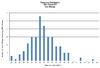
^ That's the chart - sorry, I didn't have it handy.
If you look at the range between 32-50F, it corresponds to about 670 Ohms of additional resistance per degree F drop.
In my case it was reading about 1.8kOhm too low, so I added a 1.8kOhm resistor. I think a 1/8 watt resistor is probably sufficient given that 12v/5000 Ohms is .0024 Amps. .0024A x 12v = .0288 watts power dissipation. I just used a 1/4 watt one because that's what I had sitting around.
If you look at the range between 32-50F, it corresponds to about 670 Ohms of additional resistance per degree F drop.
In my case it was reading about 1.8kOhm too low, so I added a 1.8kOhm resistor. I think a 1/8 watt resistor is probably sufficient given that 12v/5000 Ohms is .0024 Amps. .0024A x 12v = .0288 watts power dissipation. I just used a 1/4 watt one because that's what I had sitting around.
Thread Starter
|
New Member
Joined: Jun 2015
Posts: 15
From: Columbus, OH
Actually to be on the safe side, you probably want a resistor with a high enough power rating to handle a 12v drop on it's own in case the sensor were to 'fail short' (I don't know if that's even possible but let's assume it is).
In my case I'd still be within the power rating since 12v/1800 = .0067 amps and .0067 x 12v = .08 watts.
In my case I'd still be within the power rating since 12v/1800 = .0067 amps and .0067 x 12v = .08 watts.
Last edited by Jeema; Jun 8, 2017 at 11:38 AM.

Member
Joined: May 2011
Posts: 129
From: IL
Novice
I’m pretty smart but novice at doing this kind of stuff. How did you hook your resistor in? Looking at the pictures in the diagram the resistance seems to be between two ports on the plug. Not really sure how you increase the resistance.
Do you add the resistance between the plug and the module?
Do you add the resistance between the plug and the module?
Last edited by cruzn246; Aug 11, 2022 at 01:39 PM. Reason: Typos
Member
Joined: Apr 2012
Posts: 1,095
From: Hebron, In
You are posting to a 5 year old thread. You chances of getting an answer are pretty slim. He was playing with the low temperature cutoff sensor to prevent the evaporator from freezing.
A second way to accomplish this is to simply add a little R-134 to the system to increase the entire system static pressure. this pressure determines when the T-134 refrigerant evaporates what the minimum temperature can be..Keep ii above freezing and you will have no freeze ups.
Do not add very much. I suggest 1 or 2 oz.and then try it. If you can get the minimum at the vents to around 40 degrees F.. Then you will not need to rely on the low temp sensor which is really there to shut off the compressor when the refrigerant level is too low. I have never had to mod the low temp sensor on a FIT. I have done a couple on GM PU trucks.when the low temp sensor was set too high, On those the added the resistance is in parallel. To go the other way you will have to add the resistance it in series.
A second way to accomplish this is to simply add a little R-134 to the system to increase the entire system static pressure. this pressure determines when the T-134 refrigerant evaporates what the minimum temperature can be..Keep ii above freezing and you will have no freeze ups.
Do not add very much. I suggest 1 or 2 oz.and then try it. If you can get the minimum at the vents to around 40 degrees F.. Then you will not need to rely on the low temp sensor which is really there to shut off the compressor when the refrigerant level is too low. I have never had to mod the low temp sensor on a FIT. I have done a couple on GM PU trucks.when the low temp sensor was set too high, On those the added the resistance is in parallel. To go the other way you will have to add the resistance it in series.
Member
Joined: May 2011
Posts: 129
From: IL
You are posting to a 5 year old thread. You chances of getting an answer are pretty slim. He was playing with the low temperature cutoff sensor to prevent the evaporator from freezing.
A second way to accomplish this is to simply add a little R-134 to the system to increase the entire system static pressure. this pressure determines when the T-134 refrigerant evaporates what the minimum temperature can be..Keep ii above freezing and you will have no freeze ups.
Do not add very much. I suggest 1 or 2 oz.and then try it. If you can get the minimum at the vents to around 40 degrees F.. Then you will not need to rely on the low temp sensor which is really there to shut off the compressor when the refrigerant level is too low. I have never had to mod the low temp sensor on a FIT. I have done a couple on GM PU trucks.when the low temp sensor was set too high, On those the added the resistance is in parallel. To go the other way you will have to add the resistance it in series.
A second way to accomplish this is to simply add a little R-134 to the system to increase the entire system static pressure. this pressure determines when the T-134 refrigerant evaporates what the minimum temperature can be..Keep ii above freezing and you will have no freeze ups.
Do not add very much. I suggest 1 or 2 oz.and then try it. If you can get the minimum at the vents to around 40 degrees F.. Then you will not need to rely on the low temp sensor which is really there to shut off the compressor when the refrigerant level is too low. I have never had to mod the low temp sensor on a FIT. I have done a couple on GM PU trucks.when the low temp sensor was set too high, On those the added the resistance is in parallel. To go the other way you will have to add the resistance it in series.
Member
Joined: Apr 2012
Posts: 1,095
From: Hebron, In
OK, I told you the easy way to bring the evaporator minimum temp above 32 degrees f (O degrees C) and fix your icing problem. It is done all the time with multiple refrigerant types and fixed or mobile installations. . .. You can also play with the sensor and accomplish what you want. It is up to you.
You have not mentioned what minimum temp the evaporator is running at.when it ices up.
Good luck.
You have not mentioned what minimum temp the evaporator is running at.when it ices up.
Good luck.

Thread
Thread Starter
Forum
Replies
Last Post