


Generator Shed


Thread Starter
|
Member
Joined: Jul 2014
Posts: 3,284
From: Shokan, NY

Generator Shed
I realize "Generators" isn't a topic normally covered on this forum, but you asked for it.
A couple of days ago, some of you asked me to post pictures of the shed I built to cover my generator to protect it from the weather and to muffle the noise. I did a lot of online reading, but if I had it to do over again, I would have made it larger.
I used 3/4" plywood and 2 x 3's, with insulation in between the double walls. For the axle, I used a steel rod from Lowe's. I had to get a couple of different wheels till I got something large enough and strong enough. This shed is very heavy. I made a door/cover for the front, but it quickly got too hot inside, so I never use it. I have an indoor/outdoor thermometer, so I can keep track of the temperature inside the shed. If it gets too hot, I wheel the gen out a bit.
The exhaust was tricky because it gets very hot very quickly. Also, I have to start the generator before wheeling it into the shed and then attach exhaust. If I were to do it again, I would make the hole in the side of the shed larger. That flexible tube fits through the hole in the side of the shed, and then I put a rigid pipe over that, with an elbow angled down.
The large elbow in the rear is for an exhaust fan which I plug into the generator. It helps to pull out some of the hot air. The front wheels are castors, but I'll install larger ones to make it easier to maneuver.
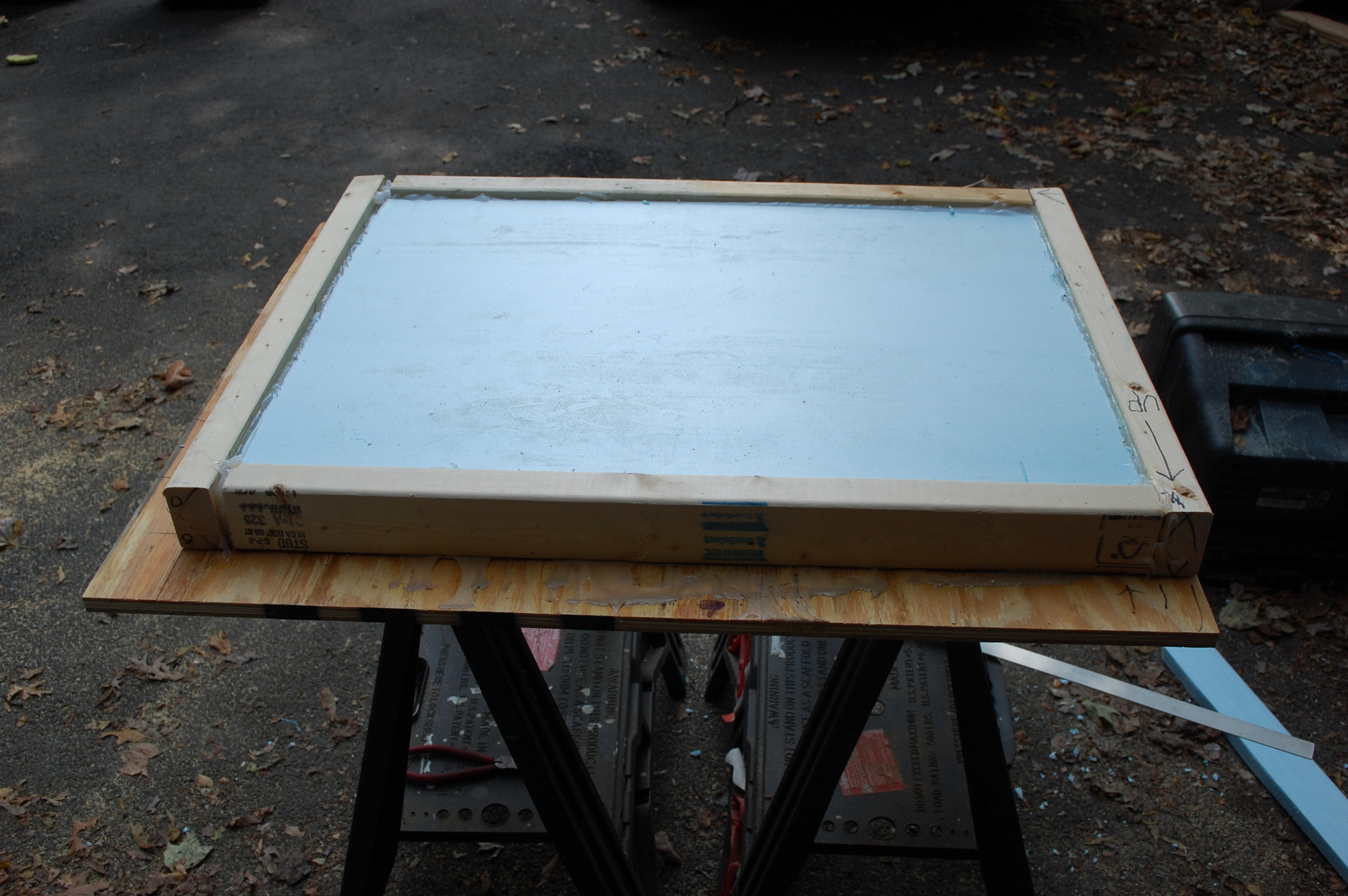

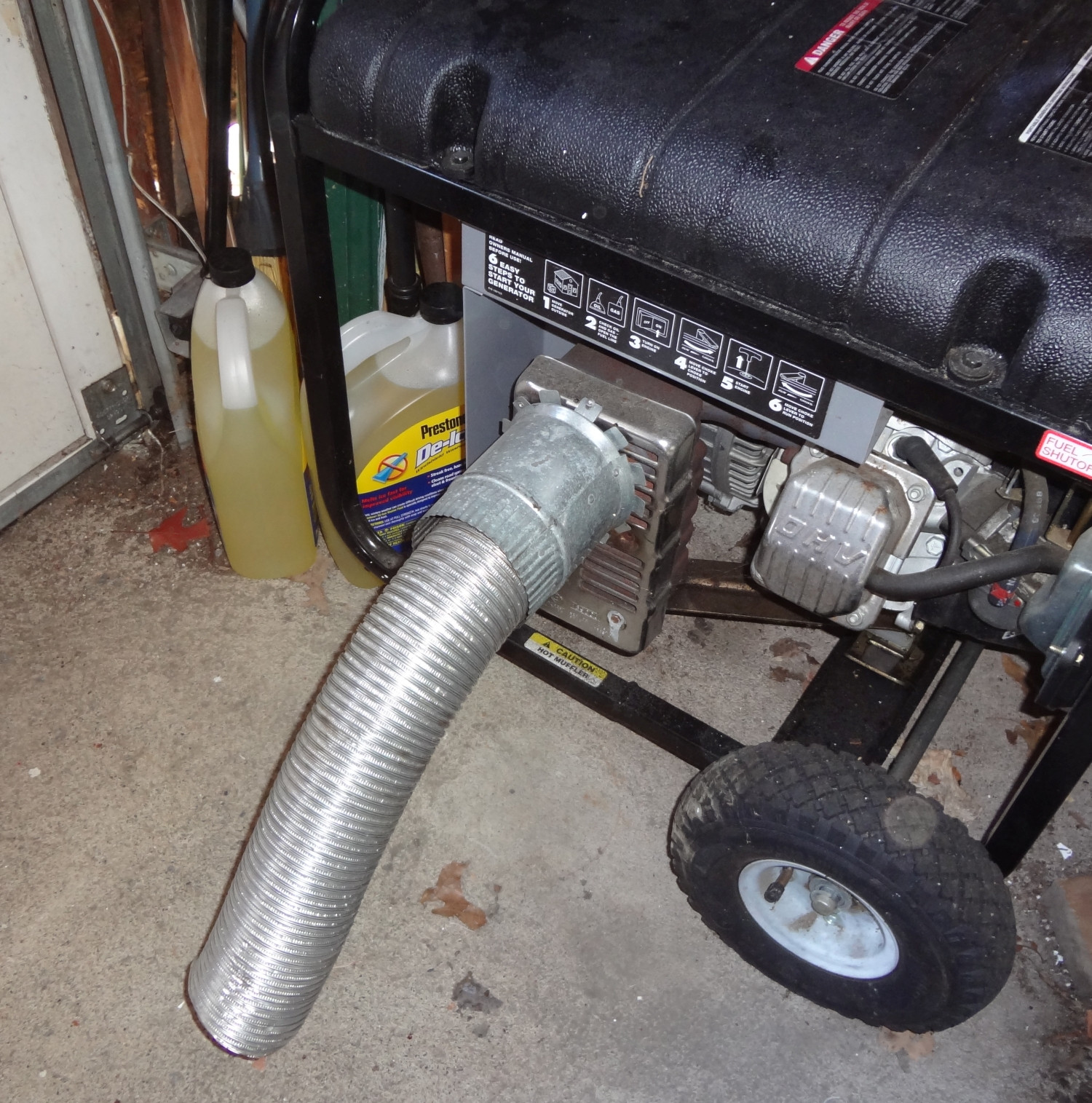
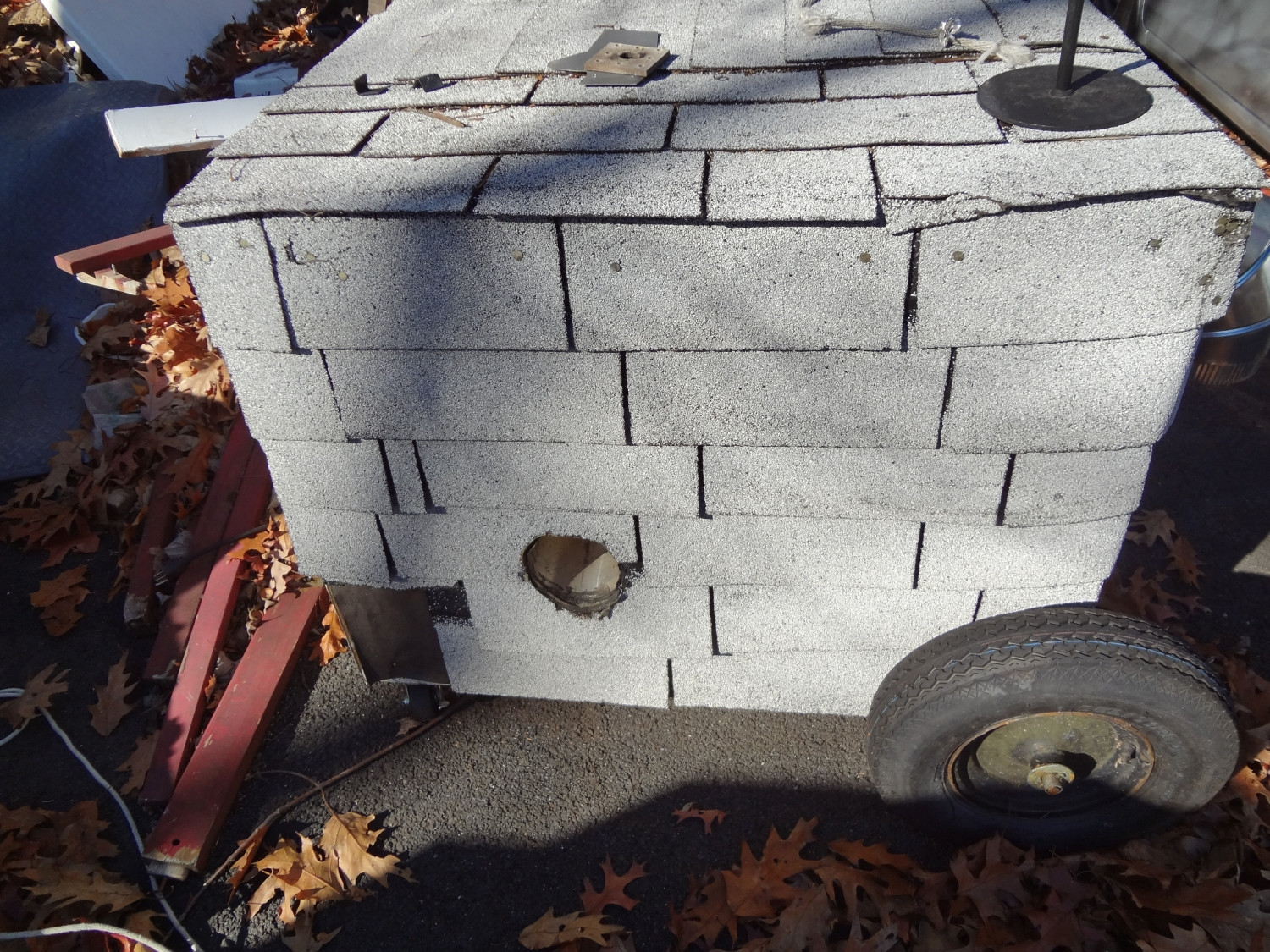

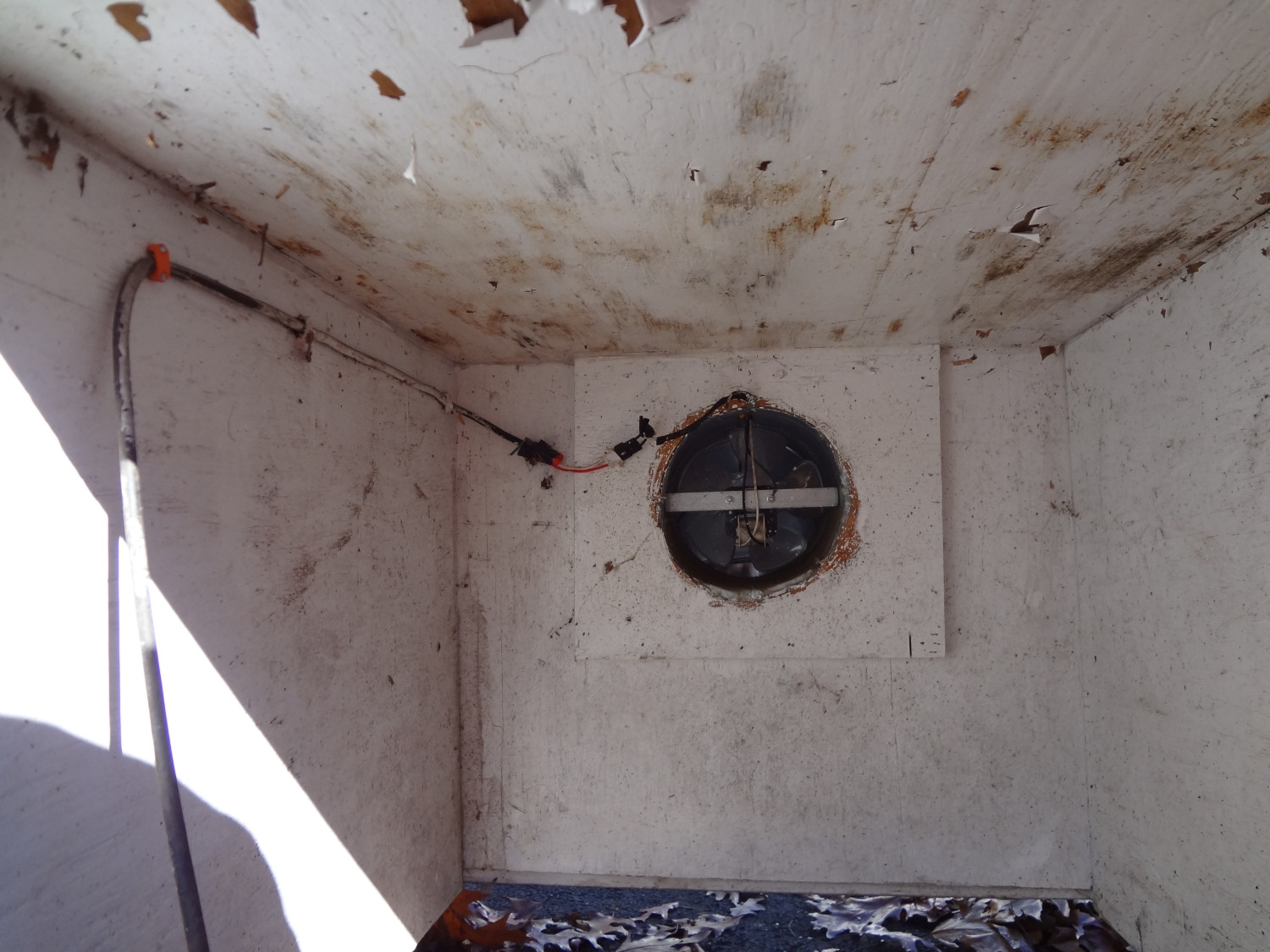
A couple of days ago, some of you asked me to post pictures of the shed I built to cover my generator to protect it from the weather and to muffle the noise. I did a lot of online reading, but if I had it to do over again, I would have made it larger.
I used 3/4" plywood and 2 x 3's, with insulation in between the double walls. For the axle, I used a steel rod from Lowe's. I had to get a couple of different wheels till I got something large enough and strong enough. This shed is very heavy. I made a door/cover for the front, but it quickly got too hot inside, so I never use it. I have an indoor/outdoor thermometer, so I can keep track of the temperature inside the shed. If it gets too hot, I wheel the gen out a bit.
The exhaust was tricky because it gets very hot very quickly. Also, I have to start the generator before wheeling it into the shed and then attach exhaust. If I were to do it again, I would make the hole in the side of the shed larger. That flexible tube fits through the hole in the side of the shed, and then I put a rigid pipe over that, with an elbow angled down.
The large elbow in the rear is for an exhaust fan which I plug into the generator. It helps to pull out some of the hot air. The front wheels are castors, but I'll install larger ones to make it easier to maneuver.


Member
Joined: Aug 2014
Posts: 1,620
From: Connecticut
Im a Generac technician, and frequent smokstak.com and zillerelectric.com. if you ever need assistance with repairs im in the know. Both portable and stationary standby units, air cooled models mostly.
You need a fan forcing outside air into the shed with an exhaust port separate from the engine exhaust. Many guys will install a thermal switch to shut down the engine when it gets too hot inside.
Hope the suggestions help. I share my big 7k generator with the neighbors run their fridges during an outage, so they look the other way because of the noise. Maybe at some point I'll make a shed like yours.
Cheers
Bass
You need a fan forcing outside air into the shed with an exhaust port separate from the engine exhaust. Many guys will install a thermal switch to shut down the engine when it gets too hot inside.
Hope the suggestions help. I share my big 7k generator with the neighbors run their fridges during an outage, so they look the other way because of the noise. Maybe at some point I'll make a shed like yours.
Cheers
Bass
Thread Starter
|
Member
Joined: Jul 2014
Posts: 3,284
From: Shokan, NY
Im a Generac technician, and frequent smokstak.com and zillerelectric.com. if you ever need assistance with repairs im in the know. Both portable and stationary standby units, air cooled models mostly.
You need a fan forcing outside air into the shed with an exhaust port separate from the engine exhaust. Many guys will install a thermal switch to shut down the engine when it gets too hot inside.
Hope the suggestions help. I share my big 7k generator with the neighbors run their fridges during an outage, so they look the other way because of the noise. Maybe at some point I'll make a shed like yours.
Cheers
Bass
You need a fan forcing outside air into the shed with an exhaust port separate from the engine exhaust. Many guys will install a thermal switch to shut down the engine when it gets too hot inside.
Hope the suggestions help. I share my big 7k generator with the neighbors run their fridges during an outage, so they look the other way because of the noise. Maybe at some point I'll make a shed like yours.
Cheers
Bass

Member
Joined: Aug 2012
Posts: 1,199
From: Vermont, USA
If you enlarge the hole in the side for the exhaust output to the size of the stovepipe, and keep the tube centered in the stovepipe, the flow of exhaust will pull some air through the larger pipe and help keep it cooler. (I think I'm reading what you did properly...if this is actually what you have set up, rather than the hole tight around the flex pipe, then obviously ignore the comment.) Also, if you direct the pipe up and add a few sections of stovepipe, above head level, a lot of the noise will be directed upwards rather than bouncing off the ground.
A commercial product for RVs that operates on this principle is sold as the gen-turi.
Overall, nice work, and plenty strong so that it's not going to collapse.
A commercial product for RVs that operates on this principle is sold as the gen-turi.
Overall, nice work, and plenty strong so that it's not going to collapse.

Member
Joined: Jun 2014
Posts: 690
From: Tennessee
One time we built a workshop on our factory floor, because the machinery was deafening to the workers sharing the space. We used pegboard over fiberglass insulation on the inside surface of the room (walls and ceiling), to help absorb the sound, which it did very well. I could see it cutting the weight down as well.
We joked in another post that it looked as though you had taken the pictures on your roof. I wonder if you could not install an active, or even powered ventilation fan on the roof of your project, in order to eliminate the heat build up.
Anyway, you have inspired me to purchase a generator, and solved the problem I had with where to locate it, so carbon dioxide did not creep into the house.
Thanks again for the pictures! They are great!
Thread Starter
|
Member
Joined: Jul 2014
Posts: 3,284
From: Shokan, NY
If you enlarge the hole in the side for the exhaust output to the size of the stovepipe, and keep the tube centered in the stovepipe, the flow of exhaust will pull some air through the larger pipe and help keep it cooler. (I think I'm reading what you did properly...if this is actually what you have set up, rather than the hole tight around the flex pipe, then obviously ignore the comment.) Also, if you direct the pipe up and add a few sections of stovepipe, above head level, a lot of the noise will be directed upwards rather than bouncing off the ground.
A commercial product for RVs that operates on this principle is sold as the gen-turi.
Overall, nice work, and plenty strong so that it's not going to collapse.
A commercial product for RVs that operates on this principle is sold as the gen-turi.
Overall, nice work, and plenty strong so that it's not going to collapse.
I like the idea of a tall, vertical pipe. It would have to be permanently attached to the shed.
Thread Starter
|
Member
Joined: Jul 2014
Posts: 3,284
From: Shokan, NY
Great concept, and great pictures. I never considered the heat issue. It looks solid. I bet it is very heavy. Is the generator a manual (pull) start, or an electric start? The insulation you used between the walls, is it fiberglass or is that blue board an insulation product?
One time we built a workshop on our factory floor, because the machinery was deafening to the workers sharing the space. We used pegboard over fiberglass insulation on the inside surface of the room (walls and ceiling), to help absorb the sound, which it did very well. I could see it cutting the weight down as well.
We joked in another post that it looked as though you had taken the pictures on your roof. I wonder if you could not install an active, or even powered ventilation fan on the roof of your project, in order to eliminate the heat build up.
Anyway, you have inspired me to purchase a generator, and solved the problem I had with where to locate it, so carbon dioxide did not creep into the house.
Thanks again for the pictures! They are great!
One time we built a workshop on our factory floor, because the machinery was deafening to the workers sharing the space. We used pegboard over fiberglass insulation on the inside surface of the room (walls and ceiling), to help absorb the sound, which it did very well. I could see it cutting the weight down as well.
We joked in another post that it looked as though you had taken the pictures on your roof. I wonder if you could not install an active, or even powered ventilation fan on the roof of your project, in order to eliminate the heat build up.
Anyway, you have inspired me to purchase a generator, and solved the problem I had with where to locate it, so carbon dioxide did not creep into the house.
Thanks again for the pictures! They are great!
I've had this generator since 2003, and it cost just $703. It included a "rebate," which was the panel that connects it to the breaker panel in the house. It's a nuisance getting it hooked up when the power goes off, but it's great to have light and water during a power failure. It uses a lot of gas, though, so if you get one, keep several 5 gal cans of gas on hand - with Sta-Bil in the gas.
Member
Joined: Jun 2014
Posts: 690
From: Tennessee
I have a reserve of 35 gallons of gas, in metal 5-gallon tanks, on hand at all times. I try and fill them when gas is trending cheap, as it is now, then use the gas when prices rise. I also keep Sta-Bil in each tank. To date, I have never had any gas go bad (knock on wood). I picked 35 gallons because that is what it would take to fill all our cars once. I guess it is the "prepper" in me.
I have my eye on a generator with electric start, and a Honda engine. Sam's is selling it now, but I am thinking of waiting until after the holidays to purchase it. I am still debating the electric start. as it add's the variable of maintaining the battery to the equation.
I will be using a variation of your shed however, and appreciate your posting that information.
I have my eye on a generator with electric start, and a Honda engine. Sam's is selling it now, but I am thinking of waiting until after the holidays to purchase it. I am still debating the electric start. as it add's the variable of maintaining the battery to the equation.
I will be using a variation of your shed however, and appreciate your posting that information.
Thread Starter
|
Member
Joined: Jul 2014
Posts: 3,284
From: Shokan, NY
I have a reserve of 35 gallons of gas, in metal 5-gallon tanks, on hand at all times. I try and fill them when gas is trending cheap, as it is now, then use the gas when prices rise. I also keep Sta-Bil in each tank. To date, I have never had any gas go bad (knock on wood). I picked 35 gallons because that is what it would take to fill all our cars once. I guess it is the "prepper" in me.
I have my eye on a generator with electric start, and a Honda engine. Sam's is selling it now, but I am thinking of waiting until after the holidays to purchase it. I am still debating the electric start. as it add's the variable of maintaining the battery to the equation.
I will be using a variation of your shed however, and appreciate your posting that information.
I have my eye on a generator with electric start, and a Honda engine. Sam's is selling it now, but I am thinking of waiting until after the holidays to purchase it. I am still debating the electric start. as it add's the variable of maintaining the battery to the equation.
I will be using a variation of your shed however, and appreciate your posting that information.

Member
Joined: May 2014
Posts: 1,545
From: SoCal, CA
For ventilation, all you need do is run a large duct to the cooling air inlet around the magneto from outside the box. This makes sure that cold air is used to cool the generator and all you need to do is vent the box on the far end for the air to get out. No need for an electric fan that way and as long as the generator is running it will get cool air.
Thread Starter
|
Member
Joined: Jul 2014
Posts: 3,284
From: Shokan, NY
For ventilation, all you need do is run a large duct to the cooling air inlet around the magneto from outside the box. This makes sure that cold air is used to cool the generator and all you need to do is vent the box on the far end for the air to get out. No need for an electric fan that way and as long as the generator is running it will get cool air.
Member
Joined: May 2014
Posts: 1,545
From: SoCal, CA
Not really my idea as the type III and IV VWs worked that way. Duct air from a remote cold source to the cooling inlet and it simplifies a lot of issues.
Thread Starter
|
Member
Joined: Jul 2014
Posts: 3,284
From: Shokan, NY
Here's an idea. Buy one of those ready-made storage sheds and get a long-enough cable to plug into your house. It would be expensive, but quiet, and you could walk right into it to start it and refill the tank.
Member
Joined: Aug 2014
Posts: 1,620
From: Connecticut
You guys should look into a tri fuel conversion kit from US carb. As you know, gasoline does not store well, but propane and natural gas do. Granted they have less BTUs but are a great alternative for storage. I have a 100 pound propane tank that I have for the grill and 7k generator.
here is my conversion. Its a loud Generac, but puts out good power for my needs. 7k on gasoline, I'd say max around 5800-6k on propane/natural gas
here is my conversion. Its a loud Generac, but puts out good power for my needs. 7k on gasoline, I'd say max around 5800-6k on propane/natural gas
Last edited by Bassguitarist1985; Nov 26, 2014 at 11:52 AM.
Thread Starter
|
Member
Joined: Jul 2014
Posts: 3,284
From: Shokan, NY
You guys should look into a tri fuel conversion kit from US carb. As you know, gasoline does not store well, but propane and natural gas do. Granted they have less BTUs but are a great alternative for storage. I have a 100 pound propane tank that I have for the grill and 7k generator.
here is my conversion. Its a loud Generac, but puts out good power for my needs. 7k on gasoline, I'd say max around 5800-6k on propane/natural gas
here is my conversion. Its a loud Generac, but puts out good power for my needs. 7k on gasoline, I'd say max around 5800-6k on propane/natural gas

Member
Joined: Oct 2014
Posts: 342
From: Modesto, CA
I have seen this type of fuel conversion before and it's great for emergencies provided you have large tanks. However, it cost more to run on propane or LP gas than regular gasoline due to lower energy output.
Honda tried with this for the NGV variation. I've seen a few of em around here but on full tank it only provides around 200 mile range. Trunk space? Forget it. Fine for daily commute and the convenience of refilling at the house.
Honda tried with this for the NGV variation. I've seen a few of em around here but on full tank it only provides around 200 mile range. Trunk space? Forget it. Fine for daily commute and the convenience of refilling at the house.
Member
Joined: Aug 2014
Posts: 1,620
From: Connecticut
My bad, here is the link. Propane and Natural Gas Generator Conversion Kits - Motor Snorkel
Member
Joined: Aug 2014
Posts: 1,620
From: Connecticut
Correct, these fuels are not meant to replace gasoline, but are an alternative when gasoline are in low supply, especially after hurricanes, storms, etc. Hurricane Irene and Sandy, gas stations were either out of gas no had no electricity to pump it. whats a prepper to do? Have an alternative fuel source until gasoline was available.
Member
Joined: Oct 2014
Posts: 342
From: Modesto, CA
Correct, these fuels are not meant to replace gasoline, but are an alternative when gasoline are in low supply, especially after hurricanes, storms, etc. Hurricane Irene and Sandy, gas stations were either out of gas no had no electricity to pump it. whats a prepper to do? Have an alternative fuel source until gasoline was available.
Let me tell you something after being whacked with three hurricanes back to back the same year (I was in West Palm Beach, Fla at the time) it transported the entire southern Florida back in time where electricity was unheard of. Imagine walking into the supermarket only to find few items on the shelves and nothing in the fridge / freezers it seriously made me feel like I was in third world country.
So yeah always prepare for the worst. Lucky I stocked up on canned foods from Costco before the hurricane season. Two weeks of clam chowder kept me in check. lol
Last edited by DArkk; Nov 27, 2014 at 03:05 AM.