


Why is Honda 0W-20 so much more expensive than 5W-20


Member
Joined: May 2010
Posts: 3,417
From: Capital Distric New York


In response to your earlier post.. There is mineral oil added to all synthetic motor oils. It has been added to curb the leaking that was common with the 100% synthetic products when they first appeared on the market.



Member
Joined: Oct 2007
Posts: 2,304
From: Illinois
I started the van today and it leaks, Have to replace the valve cover gaskets. The car has been sitting but has synthetic oil M1 High Mileage 10w30. Oil is changing just like the gasolines. Thats why prices are higher too.

Member
Joined: Apr 2009
Posts: 1,058
From: SoCal/Castaic
I suspect it's an urban legend.

Honda themselves will tell you, every manufacturer does this and any engine should be run with a high moly/zddp dino oil for break in.
Urban legend huh? Why is it with the internet at your disposal you couldn't be bothered to do some basic research and instead assert an ignorant "gut" feeling with no basis what so ever?
Here's a nice hot cup of shut the fuck up:
From your own signature: "There is no sin greater than ignorance"
Yet here we are.
Urban legend huh? Why is it with the internet at your disposal you couldn't be bothered to do some basic research and instead assert an ignorant "gut" feeling with no basis what so ever?
Here's a nice hot cup of shut the fuck up:
From your own signature: "There is no sin greater than ignorance"
Yet here we are.
Last edited by DiamondStarMonsters; Oct 31, 2012 at 01:12 AM.

Member
Joined: May 2010
Posts: 322
From: Running Springs, CA
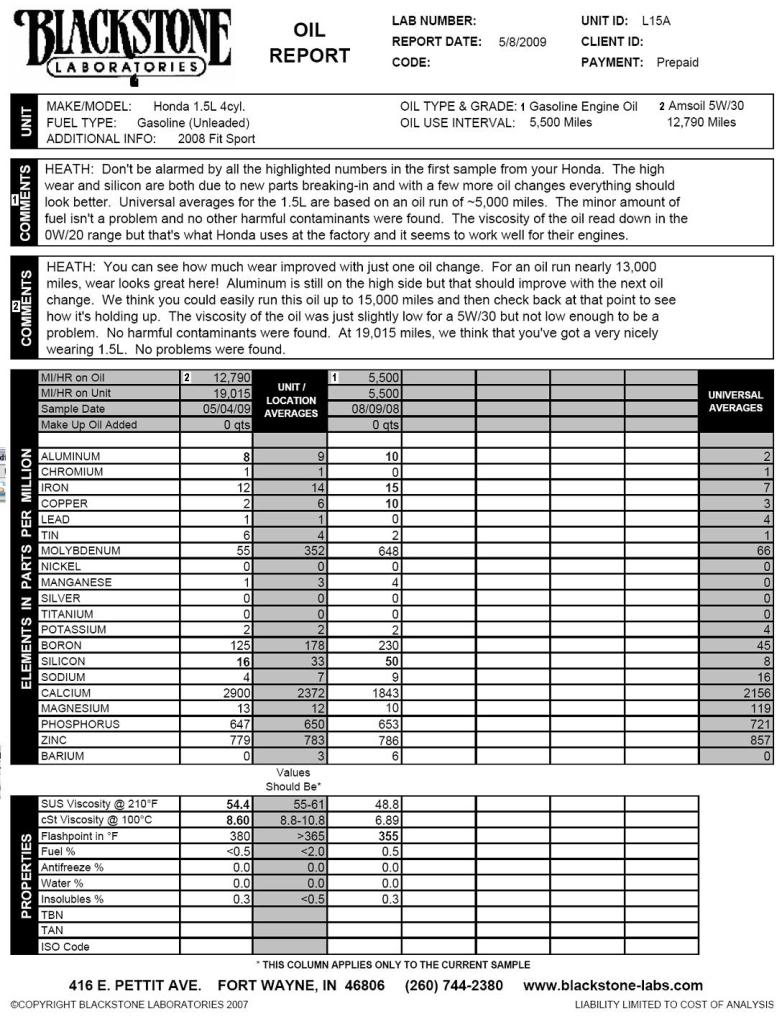
The additive is not in the factory fill oil, but the pistons are moly coated. This disperses gradually during break in. You do not want to flush it out by changing the the initial fill oil too soon. Note the high moly in the Blackstone report above. A large dose of ZDDP is not there because phosphorus degrades the cat over time, an emissions warranty issue. One of the reasons I prefer Chevron oil is moly in the Oronite additive package.
Last edited by nikita; Oct 31, 2012 at 10:47 AM.

Member
Joined: Oct 2012
Posts: 72
From: Ski country somewhere south of Buffalo, NY
Think I'll be running Toyota's 0W-20. Easy for me to access and I have read very good things about it.

Member

Joined: Jan 2008
Posts: 4,371
From: NC USA
Its the cost to make 0W-20; there are components in the recipe that are needed to get to 0W that are fairly costly but thats not the biggest reason for the high cost. They don't have the volume necessary to justify the lower cost. If you produce a thousand gallons in the same equipment you make 100,000 gallons the unit cost is considerably greater for the 1000 gallons.
Member
Joined: Jan 2008
Posts: 4,371
From: NC USA
Oils, like food recipes, are full of additives to combat wear, viscosity change, and lots of others we don't talk about.
Member
Joined: Jan 2008
Posts: 4,371
From: NC USA
Honda themselves will tell you, every manufacturer does this and any engine should be run with a high moly/zddp dino oil for break in.
Urban legend huh? Why is it with the internet at your disposal you couldn't be bothered to do some basic research and instead assert an ignorant "gut" feeling with no basis what so ever?
Here's a nice hot cup of shut the fuck up:

From your own signature: "There is no sin greater than ignorance"
Yet here we are.
Urban legend huh? Why is it with the internet at your disposal you couldn't be bothered to do some basic research and instead assert an ignorant "gut" feeling with no basis what so ever?
Here's a nice hot cup of shut the fuck up:
From your own signature: "There is no sin greater than ignorance"
Yet here we are.
Al has stabilized at about 8-10 ppm, pretty normal especially since the 3 sigma variation is about 5 ppm. Fe also, interesting that Boron is decreased but Ca in increased ! That one involves some research.
It would also be useful if the friction level was checked by determing the power loss across a known gear train. That's the real measure of lubricant worth.

Member
Joined: Mar 2010
Posts: 449
From: Bay Area CA

Do what the dealer does and throw cheap bulk oil of another viscosity in there.
Member
Joined: Oct 2012
Posts: 72
From: Ski country somewhere south of Buffalo, NY
It's all about "pour point" and most synthetics have a pour point of -40F or even colder, expecially the 0W20s.

Member
Joined: Oct 2012
Posts: 72
From: Ski country somewhere south of Buffalo, NY
And on what authority can you make this claim? When you say "full synthetic" are you talking about Group 3, or Group 4, or Group 5, or maybe Group 6?


