When you click on links to various merchants on this site and make a purchase, this can result in this site earning a commission. Affiliate programs and affiliations include, but are not limited to, the eBay Partner Network.
I’m going to try and provide a full history here. It’s a 2010 fit base model, just about to hit 80,000 miles I’ve had it since 42,000. On the drive home from from Christmas the brakes got to be metal on metal on the passenger side inner pad. The rest had about an 1/8 inch left. So I replaced pads and rotors on both sides. Now as I pull up to a parking spot or stop sign I hear this swirling grinding noise sometimes with a normal squealing brakes sound. I have taken them off and cleaned them twice and looked for any spot of contact or rubbing and I can’t see anything. I got the brake quiet gel stuff and put it on all contact pints and I pulled the extra metal shin from the old pads and put on the new ones. I have searched multiple times and find people describing the same things but they clearly don’t do their own work because they come back and say “yep it was the brakes”.... duh! But I’ve pulled these apart like 5 times and still can’t identify the problem. The only thing I can think to do now is replace calipers and I really don’t want to do that because it doesn’t guarantee the noise will go away.
Please let let me know if you’ve been here before and what you found or if you have any ideas on what to try next. Thanks in advance
If the passenger side inner pad is worn, but the outer pad isn’t...what you have is sticking caliper pins. Basically the piston in the caliper moves fine(wears out inner pad) but the pins don’t allow movement to pull the other pad against the rotor.
I like sil-glyde from Napa for the pins. With the caliper off the vehicle...iif you can’t easy slide the caliper bracket back and forth than it’s sticking too much.
Definitely check the caliper pins, but it's normal for the inside psgr to wear the quickest.
Check the splash guard on the back of the rotor. This might be slightly bent and rubbing. Check the wear indicators on the inside pads. If this was bent during shipment it might be contacting the rotor. Normally these start scraping at 1MM of material left.
Also put a light coating of brake grease between the shims (2 on inside) and their contact points on the pad and caliper/piston.
No I didn’t bed them in. I never have and I’ve done many brake jobs and never had this noise.
I dont know the pads pads are made of. They are Napa mid grade.
I did put brake grease between the shims on the back of the pads.
By clips do you mean the v shaped wire spring thing? It didn’t come with replacements but I put the old ones back in.
I have checked the dust guard multiple times and not found anything.
I dont see indicators on these brake pads like I have seen on other cars. I’ll have to investigate that further.
Ill definitely be checking the first suggestion to see if The caliper is sticky. It’s snowing right now so it’ll be a bit till I get to check it out.
Keep the ideas coming! Thanks!
two easy things. Do the braking surfaces of the new pads have beveled edges (left and right side, not top n bottom)? If not, you should be able to trim them.
brake pad composition is actually pretty important. As silly as it may sound, I stick with dealership brakes or aftermarket organics if moneys tight. When autoparts stores talk about brake quality, based on my experience, they refer to the harder material pads as being better. The truth of the matter is that it depends on the application. I lean toward soft pads, which make a lot of dust, because they wear down the rotors more slowly and more importantly, they achieve operating temperature quicker, thus making them more effective than harder pads, excluding performance/towing applications. They also make less noise. I havent inquired on the oem composition, but I already know theyre quiet. Im also aware that toyota used and likely uses organic pads on passenger vehicles and light trucks for the same reasons. Brake pads shouldnt have a long service life, they're the part thats *supposed* to wear the most.
Caliper failure is usually pretty easy to catch as its unlikely the opposite side would seize at the same time. Oh, im sure you checked this, but if your rotors have lips on em that are rubbing the sides of your pads. Well. You know.
Are you talking about a grinding noise that does not occur until after you have worn the pad down to the backing plate? Or are you talking about a noise that is always occurring? Those are 2 different situations.
The pads should wear evenly....regardless of pad compound. Organic pads have a nice initial bite but once heated up loose braking effectiveness and wear fast. Ceramic pads have a nice bite, don't fade and also have a long wear life but are harder on rotors. For the cost of rotors though...it all comes down to price and what you want to compromise on.
Just FYI, brake squeak is the noise you hear from a very high speed vibration. Basically if the hardware is loose or if something is not allowing both pads to be firmly planted against the rotor...it will cause this high speed vibration and frequency that you hear.
You can just take off the 2 bolts that bolt the caliper to the pins...than lift up your caliper a bit and slide the pin in and out with your hand to check them. Everything should move very freely. If it takes effort to move it with your hand than it's too tight. There also is a little rubber boot on the end of one of the pins and it takes up slack. Make sure it's there. Make sure the pins have plenty of sil-glyde on them. After that...check that the pads move freely also on the hardware. The hardware should hold the pads but also allow them to move freely. If the hardware are too loose...leads to that movement problem and squeak. If too tight...leads to uneven pad wear.
Thanks for the info about ceramics. Apparently they're supposed to be equally effective for regular driving, though it doesnt make much sense to me that a harder material could compete with a softer one pre-high temps, but clay is grainy. Pretty dumb that manufacturers leave out info on materials they use. Apparently some brakes *still* have asbestos!. just to ease my mind here, lift the car and shake the front wheels in every direction. Up n down play is ball joints, left n right, tie rods, all around is wheel bearings. Also check your stabilizer bar end links, inner tie rods, and your cv axel boots for grease leaking out, allowing dirt in. Hm... yeah man.. from there you can inspect rear drums n bearings, and if thats all good we'd be looking for something extra weird.. grinding noise... hmm
I always use a series of wire brushes (wide / narrow) to clean all of the "landing" surfaces on the caliper's left / right sides, so the pad will easily travel. I've noticed that gunk builds up on there, they don't release or release unevenly, and one side or other will wear out quicker than other. I also pull the pins and rubber boots off of caliper, re-grease with caliper grease (high temp), so the caliper as a unit will "center" itself on the rotor. Make sure it is all free-floating.
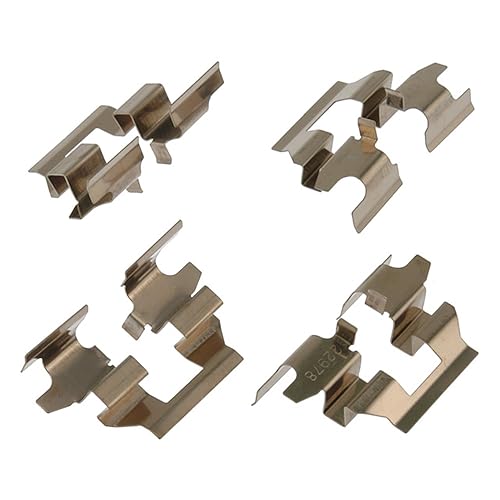
id say replace the clips and lube them and any other contact points/ pins with the already mentioned Sil-glyde...should have done them with the brake job as they are $10 bucks for Centrics (117.40051).
heres the part number and what it comes with..
ps...you also should consider doing a proper bedding procedure in the future...its meant to reduce the chance of squeals, grinds, warping, and maximize stopping power.
Alright everybody. Thanks for all the ideas and tips and for trying to help me out.
My my wife needs the car to get to work everyday so I don’t really get time to mess with it but this morning I did.
I thought maybe after a few weeks I might be able to see some wear someplace that would tell me what the issue is but no such luck.
I took the pins pins out and put plenty of sil glide on them. Both upper pins were not easy to move by hand. So I thought I’d have it figured finally but no. On my little test drive it was just as bad as it ever was.
Im going to order oem pads and clips. If that doesn’t work then I guess I buy brand new calipers??
Again. The current issue is a swirling grinding sound as I come to a stop. There is also sometimes a brake squeak sound but much more often it is this swirling grinding. I can only hear it under 15 mph but I imagine it’s anytime the brakes are on and at higher speed there is too much road noise. There is no noise what I pull the hand brake so that eliminates the rearbrakes and there is no noise when the brakes are not applied so I don’t suspect any suspension issues...
thanks for the help! I’ll keep working the problem.
cltntroxell - I haven't read every previous post but if I see that the caliper piston(s) aren't easily retracting (premature pad wear on one wheel versus all others), I'll exercise the piston(s). Without pads, I'll have someone slowly press the pedal while I watch the piston come out. I'll use a "C" clamp or a special tool (VW's twist back into the caliper but Honda isn't that fancy) push the piston all the way back in. That process has "cleaned" out whatever was making the piston hang up (I leave the rubber boots alone) on a Civic, Tundra, Dakota, VW, and on several of my dual-sport motorcycles that see dust / dirt / mud / water.
I just realized I never got back to this. Going with oem pads fixed the issue. Now a year later I have to do the brakes again. 2 hour round trip daily on a mountain road will do that I guess. Hopefully I don’t run into the same issues this time around having been through it before. Thanks for the help and ideas! Hope this helps others.
I just realized I never got back to this. Going with oem pads fixed the issue. Now a year later I have to do the brakes again. 2 hour round trip daily on a mountain road will do that I guess. Hopefully I don’t run into the same issues this time around having been through it before. Thanks for the help and ideas! Hope this helps others.
On the note of cheap vs. premium pads, I recently installed some premium carquest pads (thread). They're as good, if not better than the oem pads. No vibration on slowing like i had with the oem pads, and they're extremely smooth/quiet.
On the note of cheap vs. premium pads, I recently installed some premium carquest pads (thread). They're as good, if not better than the oem pads. No vibration on slowing like i had with the oem pads, and they're extremely smooth/quiet.
Stoked to hear that!
I always always always go with OEM pads despite price gouging. Autozone gave me trust issues lifetime warranty on brake pads. thats gotta get the gears turning.
soft pad that makes dust isnt scraping the hell out of rotors, doesnt take forever to reach/maintain operating temperature (so.. it stops good)
Didja go with ceramics? they seem to be all the rage but I'm not yet comfortable with the idea. took ceramics at community college. that sh*ts glass. dont know what witchery they must mix in the clay, but it must be somethin otherwise that'd be a racing/towing only kinda situation.
The caliper pins on these cars can wear over time. Get new ones and use the proper silicone lubricant on them. Mine seemed fine when new brake pads were installed but did not work perfectly in actual use. I got new pins and as I removed the old ones they were sticking on one side. Those pins can wear and become uneven so even when lubricated they do not slide freely. Best of luck. Clay
The caliper pins on these cars can wear over time. Get new ones and use the proper silicone lubricant on them. Mine seemed fine when new brake pads were installed but did not work perfectly in actual use. I got new pins and as I removed the old ones they were sticking on one side. Those pins can wear and become uneven so even when lubricated they do not slide freely. Best of luck. Clay
My vehicle was driven many miles with warped rotors. I know this because my sister owned the car before I acquired it. It also had a over 100,000 miles on it. Check your pins to evaluate them, there should be no real resistance when sliding the caliper back and forth. Clay




 just to ease my mind here, lift the car and shake the front wheels in every direction. Up n down play is ball joints, left n right, tie rods, all around is wheel bearings. Also check your stabilizer bar end links, inner tie rods, and your cv axel boots for grease leaking out, allowing dirt in. Hm... yeah man.. from there you can inspect rear drums n bearings, and if thats all good we'd be looking for something extra weird.. grinding noise... hmm



 lifetime warranty on brake pads. thats gotta get the gears turning.

