


Greddy E-Manage Tuning


New Member
Joined: Nov 2008
Posts: 10
From: caribbean
BTW..do you have a average on how your a/f ratio should look like say 3500-5000rpm b4 vtec and 5000-8500 after vtec? should it be like 13.0 be for vtec and closer to 12.5 at high rev?
am running a 95 integra gsr dohc with a vortech supercharger running 9psi at 280+ hp
ported b16a head ,vector x intake and a 65mm throttle body.
i dyno a while back but we needed bigger injectors because it was leaning out too much mid way through 2nd gear..so i channged from 310 to 550cc and its working ok so far..just wanted to know what a/f values i shuold be looking for with my wide band o2
thanks
am running a 95 integra gsr dohc with a vortech supercharger running 9psi at 280+ hp
ported b16a head ,vector x intake and a 65mm throttle body.
i dyno a while back but we needed bigger injectors because it was leaning out too much mid way through 2nd gear..so i channged from 310 to 550cc and its working ok so far..just wanted to know what a/f values i shuold be looking for with my wide band o2
thanks

Member
Joined: Aug 2008
Posts: 408
From: Los Banos, Ca
hey artieman i have been reading your post on this topic and i must say that i joined this forum because of you,,its always a pleasure to see tuners helping us rookies when it comes to tuning.
now about split second management i believe the greddy e-manage ultimate does the same if you use the airflow output map..ie
'by using a pressure sensor or throttle sensor signal,you can input the airflow signal which would be sent to ecu at each rpm points.this map will provide the ecu airflow meter signal it requires'
i believe this is what greddy wants us to use so that we could make proper a/f adjustments via the injectors map when the car is in closed loop and we wanna adjust our fuel.
i believe this is important for ppl like me whose running a sc where i begin to see boost at 2500-3000 rpm
now about split second management i believe the greddy e-manage ultimate does the same if you use the airflow output map..ie
'by using a pressure sensor or throttle sensor signal,you can input the airflow signal which would be sent to ecu at each rpm points.this map will provide the ecu airflow meter signal it requires'
i believe this is what greddy wants us to use so that we could make proper a/f adjustments via the injectors map when the car is in closed loop and we wanna adjust our fuel.
i believe this is important for ppl like me whose running a sc where i begin to see boost at 2500-3000 rpm
"i believe this is what greddy wants us to use so that we could make proper a/f adjustments via the injectors map when the car is in closed loop and we wanna adjust our fuel."
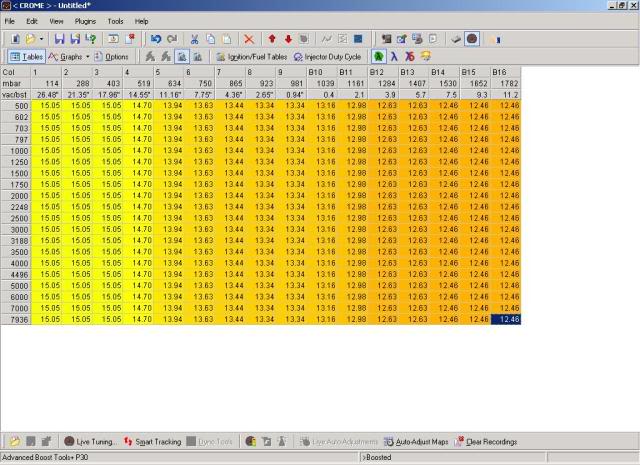
emanage wont allow closed loop correction...the ecu uses oxygen sensor voltage to determine the amount of fuel needed....when its open loop it uses the fixed fuel and timing maps and no longer does correction off the oxygen sensor...the open loop fixed timing and fuel maps is what you can modify via voltage manipulation from a piggy back system...
BTW..do you have a average on how your a/f ratio should look like say 3500-5000rpm b4 vtec and 5000-8500 after vtec? should it be like 13.0 be for vtec and closer to 12.5 at high rev?
am running a 95 integra gsr dohc with a vortech supercharger running 9psi at 280+ hp
ported b16a head ,vector x intake and a 65mm throttle body.
i dyno a while back but we needed bigger injectors because it was leaning out too much mid way through 2nd gear..so i channged from 310 to 550cc and its working ok so far..just wanted to know what a/f values i shuold be looking for with my wide band o2
thanks
am running a 95 integra gsr dohc with a vortech supercharger running 9psi at 280+ hp
ported b16a head ,vector x intake and a 65mm throttle body.
i dyno a while back but we needed bigger injectors because it was leaning out too much mid way through 2nd gear..so i channged from 310 to 550cc and its working ok so far..just wanted to know what a/f values i shuold be looking for with my wide band o2
thanks
fyi you can run the motor really lean under light load like cruising on the freeway...my friend adam who has a 96 integra gsr with fully built motor and a gt35 turbo makes well over 400whp on 91octane gas at just 17psi and we run him around 18:1 a/f light load out of boost when he is cruising around 70mph on the freeway....car gets about 32mpg doing this...
Last edited by artieman; Nov 30, 2008 at 03:30 PM.
New Member
Joined: Nov 2008
Posts: 10
From: caribbean
ok thanks for the info..
other question that i personally would like to know that i have not got the chance to experiment with is
does it makes sense using inj correction when the ecu is in closed loop like 3000rmp ? or should i just concentrate on getting the right a/f ratio when the ecu goes in open loop??
its always puzzle me as to why my tuner was trying to correct closed loop injector values while the car is idling or at low rpm when i know the ecu is working off the o2 sensor.
would it make a difference or would the ecu just change it back to what it thinks is correct..
and also about ignition timing..i see there lots of products that claims to detect knock more accurate with the use of a bosch sensor..when ever it detects a knock it supposedly lights up..whats your view of using one of these for street tuning?
or should i stick to a general rule of retarding timing 3 deg for every 1 psi.
other question that i personally would like to know that i have not got the chance to experiment with is
does it makes sense using inj correction when the ecu is in closed loop like 3000rmp ? or should i just concentrate on getting the right a/f ratio when the ecu goes in open loop??
its always puzzle me as to why my tuner was trying to correct closed loop injector values while the car is idling or at low rpm when i know the ecu is working off the o2 sensor.
would it make a difference or would the ecu just change it back to what it thinks is correct..
and also about ignition timing..i see there lots of products that claims to detect knock more accurate with the use of a bosch sensor..when ever it detects a knock it supposedly lights up..whats your view of using one of these for street tuning?
or should i stick to a general rule of retarding timing 3 deg for every 1 psi.
Member
Joined: Aug 2008
Posts: 408
From: Los Banos, Ca
ok thanks for the info..
other question that i personally would like to know that i have not got the chance to experiment with is
does it makes sense using inj correction when the ecu is in closed loop like 3000rmp ? or should i just concentrate on getting the right a/f ratio when the ecu goes in open loop??
its always puzzle me as to why my tuner was trying to correct closed loop injector values while the car is idling or at low rpm when i know the ecu is working off the o2 sensor.
would it make a difference or would the ecu just change it back to what it thinks is correct..
and also about ignition timing..i see there lots of products that claims to detect knock more accurate with the use of a bosch sensor..when ever it detects a knock it supposedly lights up..whats your view of using one of these for street tuning?
or should i stick to a general rule of retarding timing 3 deg for every 1 psi.
other question that i personally would like to know that i have not got the chance to experiment with is
does it makes sense using inj correction when the ecu is in closed loop like 3000rmp ? or should i just concentrate on getting the right a/f ratio when the ecu goes in open loop??
its always puzzle me as to why my tuner was trying to correct closed loop injector values while the car is idling or at low rpm when i know the ecu is working off the o2 sensor.
would it make a difference or would the ecu just change it back to what it thinks is correct..
and also about ignition timing..i see there lots of products that claims to detect knock more accurate with the use of a bosch sensor..when ever it detects a knock it supposedly lights up..whats your view of using one of these for street tuning?
or should i stick to a general rule of retarding timing 3 deg for every 1 psi.
and about the j&s knock system J&S Electronics SafeGuard Indivdual Cylinder Knock Control and others they only kick in after they hear knock they dont keep it from happening...its like the police they dont do any good unless you call them and then its probably already too late...also the "microphone" in the block thats hears knock is specific to certain tones....those knock sensors in the block are designed for the motor the way it came from the factory....once you make changes to how the motor runs they are no longer accurate.
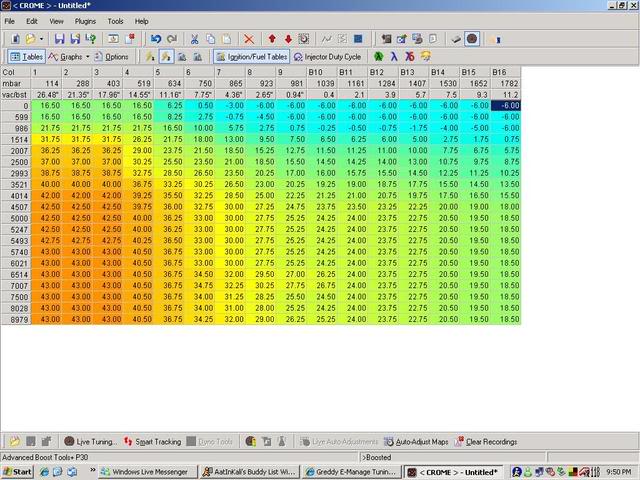
as for timing in boost...3 degrees per pound is rather extreme but safe...generally its linear on boost retard 0-3psi is about 0.1 degree retard per pound then 3-5psi is about 0.2 degree per pound 5-7psi is about 0.5 degree per pound 7-12psi is about 0.75 degrees per pound and 12-30psi is about 1 degree per pound of boost...
here is an example of a stock timing map for a b16a with those values applied...column B10 is where boosted map starts...normal honda map does not have boost columns i added these...but it will give you an idea of the timing retard needed in boost...the is what would be considered a base map for timing on a boosted b16...after tuning the timing depending on the motor design (compression, cams, piston design, bowl design, head porting etc) will either be close to that after vastly different....
Last edited by artieman; Nov 30, 2008 at 05:17 PM.
New Member
Joined: Nov 2008
Posts: 10
From: caribbean
the greddy ultimate comes with a feature where you can force the ecu into open loop via an auxiliary output.could that be used to do a proper tuning map with out the ecu reverting all my changes?
also what do you think of the a/f target map that automatically adjusts the inj duty cycle to meet the inputted air/fuel ratio?
am sorry to bombard you with all these questions but it very hard to find a tuner in this side of the Caribbean much less one who understand greddy..thats for all the help you have giving me.
also what do you think of the a/f target map that automatically adjusts the inj duty cycle to meet the inputted air/fuel ratio?
am sorry to bombard you with all these questions but it very hard to find a tuner in this side of the Caribbean much less one who understand greddy..thats for all the help you have giving me.
Member
Joined: Aug 2008
Posts: 408
From: Los Banos, Ca
the greddy ultimate comes with a feature where you can force the ecu into open loop via an auxiliary output.could that be used to do a proper tuning map with out the ecu reverting all my changes?
also what do you think of the a/f target map that automatically adjusts the inj duty cycle to meet the inputted air/fuel ratio?
am sorry to bombard you with all these questions but it very hard to find a tuner in this side of the Caribbean much less one who understand greddy..thats for all the help you have giving me.
also what do you think of the a/f target map that automatically adjusts the inj duty cycle to meet the inputted air/fuel ratio?
am sorry to bombard you with all these questions but it very hard to find a tuner in this side of the Caribbean much less one who understand greddy..thats for all the help you have giving me.
as for the a/f target map it will not work correctly untill you have a wideband oxgen sensor setup to work in place of the stock factory oxygen sensor...dont try to use the factory narrow band oxygen sensor as its basicly an on off switch for 14.7:1 a/f ratio....thats why if you watch the a/f ratio on a factory car it swings back and forth across 14.7:1 and is never steady untill it hits open loop.
Last edited by artieman; Nov 30, 2008 at 11:35 PM.
New Member
Joined: Nov 2008
Posts: 10
From: caribbean
ok thanks..maybe i would try wiring up my lm2 to the greddy and see how that works.
one last question ..i can data logg on my greddy and see my ecu retarding timing as i go up in rpm and boost..is the ecu retarding timing for max power or more for safety?
would i be putting my car in any danger if i was to retard a few degress at high rpm wher boost is at max?
just so you know my ignition is advance to it max at the distributor in the engine bay.(if i retard it the car looses alot of power.we had to that ever since we did all the head works
one last question ..i can data logg on my greddy and see my ecu retarding timing as i go up in rpm and boost..is the ecu retarding timing for max power or more for safety?
would i be putting my car in any danger if i was to retard a few degress at high rpm wher boost is at max?
just so you know my ignition is advance to it max at the distributor in the engine bay.(if i retard it the car looses alot of power.we had to that ever since we did all the head works
Last edited by crashsvg; Dec 1, 2008 at 06:20 PM.

Thread Starter
|
Member
Joined: Feb 2007
Posts: 548
From: Flint, MI
Ok, I'm back...
First of all, to artieman, I apologize for not responding yet to your PM. I will send you what you asked for when I get home from work (late tonight) or tomorrow at the latest. I have been SWAMPED driving parts for work, as well as staying late to make sure things get done. Even with the current economy I've been more than doubling my paychecks with mileage reimbursement and OT... Being a Co-Op has benefits!
Anyway, I made some (a little) headway on this closed-loop boost situation. Here's what I realized:
With the wastegate set up the way it tells you in the T1R manual, you have the wastegate line connected to your PCV line from the block. This line sees vacuum and boost, but is less than accurate for a vac reading (as seen on my vac/boost gauge, connected to the same line), as the PCV valve is OPEN and flows blow-by and PCV gasses at most vacuum levels. The PCV valve (in the block, it would seem. I was intrigued as this is very different from most cars I've seen, with the PCV valve stuck into the valve cover on the opposite side of the breather tube) is closed during boost, however, meaning you do get a reliable WG signal.
This means that no matter what throttle position you're at, the WG will be closed until you hit 6psi at the MANIFOLD (which happens very quickly and easily with this turbo being roughly the size of my left nut). This meant that (with the original BOV from the kit - a knock-off Greddy style "type-RS"), I could easily hit 6psi at ~25% TPS (as reported by ScanGauge II). Now, I never did this once I realized it was possible, as the L15 ECU seems to rely more on the TPS signal than the MAP signal for loop status and timing settings, and I really didn't want to test what that would do in a real-world situation.
This meant I would drive around very gingerly unless I wanted to boost, at wich point I would have to go from ~20% to 100% to make sure it kicked in to open loop. I could drive it this way, and if I was careful I could "ride the wave" and keep it just below 0psig at the manifold and still be able to get useable acceleration without roasting the tires. This was not true for other drivers, however, as I quickly discovered. My buddy tried to drive my car and I ended up yelling at him when he was boosting the snot out of my car at <30% throttle.
So, in an endeavor to make the car more drivable, here's what I did:
I replaced the (leaky) "Type-RS" knock-off with a Synapse Engineering Synchronic BOV. Because this is a pull-type piston-operated valve, it didn't work well at first when I used my original vacuum source (the PCV hose -- didn't know that's what it was at the time). I have since made it work rather well by using the adjustment nut, both vac. signal inputs AND the boost-only signal input on the side of the unit. This boost-only nipple is "supposed" to be used only in applications above 7 psig (which I am not), but I found that with my non-"hard" vac source it was necessary to eliminate surge.
At the same time I did this installation, I moved the signal line for the WG to the compressor signal nipple on the cold side of the housing, and tee'd off of that for the boost-only signal to the Synchronic BOV. This has resulted in 2 things that are very beneficial (I think).
First off, the car is MUCH easier to drive. I never really noticed how much throttle modulation I was doing before to control the boost (with "unlimited spool" at partial throttle), but it is now to a point where the average person can drive the car without worry.
Second, because of the way the Synchronic BOV works, I have INCREASED the MINIMUM throttle opening to achieve boost. This is because the Synchronic BOV remains OPEN to the atmosphere until ~3 in/Hg. Normally this would cause unfiltered air to enter the charge pipes, but I have discovered that because the T25 is so small, it is always supplying more air than the motor requires. That means it is always blowing OUT of the Synchronic unit, even at idle. This is especially true at highway speeds. So, because of this, until I reach about 3 in/Hg (remember, this is all off of my "soft" vac source of the PCV valve line. These numbers will change, hopefully for the better, once I re-run these lines to my brake booster hose), at which point it snaps shut and forces all of the air from the turbo to go to the TB.
With all of this combined, it means that I now no longer hit boost before (in fact it's usually after) 35% or so TPS (again, as reported by SGII). Unlike other Honda ECUs, we are still in closed loop at this point, so it's still not ideal, but it's a step in the right direction.
I am now pretty convinced that this problem stems from the aggressive throttle opening map Honda used on our DBW systems. The TPS number reported seems to be related to the pedal position (or requested throttle) as opposed to the acutal open percentage at the throttle body. This, combined with the ECU's stubborn refusal to find open loop before ~70% throttle (as reported at the pedal, not the TB, as far as I can tell).
Seems we could benefit from a throttle controller such as the Blitz unit, but one with a slower-than-stock response curve.
Another thought - I currently have my E-Manage set up with the boost limiter cut setting letting the ECU see 14.9 psia, or roughly .2 above sea-level atmospheric pressure. This does not throw a code, but I'm wondering just how far I can let that go before it does, and if it would help to throw the ECU in to open loop earlier. Anyone have input? I'll probably do some experimenting as soon as I have time.
First of all, to artieman, I apologize for not responding yet to your PM. I will send you what you asked for when I get home from work (late tonight) or tomorrow at the latest. I have been SWAMPED driving parts for work, as well as staying late to make sure things get done. Even with the current economy I've been more than doubling my paychecks with mileage reimbursement and OT... Being a Co-Op has benefits!
Anyway, I made some (a little) headway on this closed-loop boost situation. Here's what I realized:
With the wastegate set up the way it tells you in the T1R manual, you have the wastegate line connected to your PCV line from the block. This line sees vacuum and boost, but is less than accurate for a vac reading (as seen on my vac/boost gauge, connected to the same line), as the PCV valve is OPEN and flows blow-by and PCV gasses at most vacuum levels. The PCV valve (in the block, it would seem. I was intrigued as this is very different from most cars I've seen, with the PCV valve stuck into the valve cover on the opposite side of the breather tube) is closed during boost, however, meaning you do get a reliable WG signal.
This means that no matter what throttle position you're at, the WG will be closed until you hit 6psi at the MANIFOLD (which happens very quickly and easily with this turbo being roughly the size of my left nut). This meant that (with the original BOV from the kit - a knock-off Greddy style "type-RS"), I could easily hit 6psi at ~25% TPS (as reported by ScanGauge II). Now, I never did this once I realized it was possible, as the L15 ECU seems to rely more on the TPS signal than the MAP signal for loop status and timing settings, and I really didn't want to test what that would do in a real-world situation.
This meant I would drive around very gingerly unless I wanted to boost, at wich point I would have to go from ~20% to 100% to make sure it kicked in to open loop. I could drive it this way, and if I was careful I could "ride the wave" and keep it just below 0psig at the manifold and still be able to get useable acceleration without roasting the tires. This was not true for other drivers, however, as I quickly discovered. My buddy tried to drive my car and I ended up yelling at him when he was boosting the snot out of my car at <30% throttle.
So, in an endeavor to make the car more drivable, here's what I did:
I replaced the (leaky) "Type-RS" knock-off with a Synapse Engineering Synchronic BOV. Because this is a pull-type piston-operated valve, it didn't work well at first when I used my original vacuum source (the PCV hose -- didn't know that's what it was at the time). I have since made it work rather well by using the adjustment nut, both vac. signal inputs AND the boost-only signal input on the side of the unit. This boost-only nipple is "supposed" to be used only in applications above 7 psig (which I am not), but I found that with my non-"hard" vac source it was necessary to eliminate surge.
At the same time I did this installation, I moved the signal line for the WG to the compressor signal nipple on the cold side of the housing, and tee'd off of that for the boost-only signal to the Synchronic BOV. This has resulted in 2 things that are very beneficial (I think).
First off, the car is MUCH easier to drive. I never really noticed how much throttle modulation I was doing before to control the boost (with "unlimited spool" at partial throttle), but it is now to a point where the average person can drive the car without worry.
Second, because of the way the Synchronic BOV works, I have INCREASED the MINIMUM throttle opening to achieve boost. This is because the Synchronic BOV remains OPEN to the atmosphere until ~3 in/Hg. Normally this would cause unfiltered air to enter the charge pipes, but I have discovered that because the T25 is so small, it is always supplying more air than the motor requires. That means it is always blowing OUT of the Synchronic unit, even at idle. This is especially true at highway speeds. So, because of this, until I reach about 3 in/Hg (remember, this is all off of my "soft" vac source of the PCV valve line. These numbers will change, hopefully for the better, once I re-run these lines to my brake booster hose), at which point it snaps shut and forces all of the air from the turbo to go to the TB.
With all of this combined, it means that I now no longer hit boost before (in fact it's usually after) 35% or so TPS (again, as reported by SGII). Unlike other Honda ECUs, we are still in closed loop at this point, so it's still not ideal, but it's a step in the right direction.
I am now pretty convinced that this problem stems from the aggressive throttle opening map Honda used on our DBW systems. The TPS number reported seems to be related to the pedal position (or requested throttle) as opposed to the acutal open percentage at the throttle body. This, combined with the ECU's stubborn refusal to find open loop before ~70% throttle (as reported at the pedal, not the TB, as far as I can tell).
Seems we could benefit from a throttle controller such as the Blitz unit, but one with a slower-than-stock response curve.
Another thought - I currently have my E-Manage set up with the boost limiter cut setting letting the ECU see 14.9 psia, or roughly .2 above sea-level atmospheric pressure. This does not throw a code, but I'm wondering just how far I can let that go before it does, and if it would help to throw the ECU in to open loop earlier. Anyone have input? I'll probably do some experimenting as soon as I have time.
Thread Starter
|
Member
Joined: Feb 2007
Posts: 548
From: Flint, MI
ok thanks..maybe i would try wiring up my lm2 to the greddy and see how that works.
one last question ..i can data logg on my greddy and see my ecu retarding timing as i go up in rpm and boost..is the ecu retarding timing for max power or more for safety?
would i be putting my car in any danger if i was to retard a few degress at high rpm wher boost is at max?
just so you know my ignition is advance to it max at the distributor in the engine bay.(if i retard it the car looses alot of power.we had to that ever since we did all the head works
one last question ..i can data logg on my greddy and see my ecu retarding timing as i go up in rpm and boost..is the ecu retarding timing for max power or more for safety?
would i be putting my car in any danger if i was to retard a few degress at high rpm wher boost is at max?
just so you know my ignition is advance to it max at the distributor in the engine bay.(if i retard it the car looses alot of power.we had to that ever since we did all the head works
Sounds like your cam timing is off, if you have to advance the distributor ALL THE WAY. If your cam timing was in, putting the dizzy all the way advanced would a grenade quickly make.
Absolute timing (in *BTDC, or degrees Before Top Dead Center) is related to the speed at which the combustion charge burns, which is in turn related to manifold pressure (more pressure = more fuel = higher cylinder pressures and a faster burn), throttle position (ECU uses this for load calculations), RPM (for an identical burn speed, you need MORE timing with more RPM, as the fuel/air mixture will burn at the same speed, but the piston will be moving faster. Since the piston is moving faster, you have less time for the mixture to burn when at higher RPMs with timing being identical).
That said, you should see timing being pulled as boost (manifold pressure) increases. When you increase manifold pressure over atmospheric in a motor originally designed to be naturally aspirated, the combustion pressures increase pretty rapidly. This means that the timing you would be adding with increased RPM is less than what you need to pull for the increased cylinder pressures. This results in a net DECREASE in ignition timing as you go up in boost and RPM.
Pulling more timing usually won't hurt, to a point. All it will do is reduce power (assuming you start from the optimal, or Minimum Best Timing), unless you reduce it waay TOO much. If you pull way too much timing, you will end up with the combustion mixture not having time to burn completely before the exhaust stroke begins, and you will end up with 4 little flamethrowers for exhaust ports. This makes for very high exhaust gas temperatures and a shortened lifespan for exhaust valves, turbines (if you've got one, this doesn't apply to your vortech), and sensors (EGT sensors, if you've got em, and particularly O2 sensors).
NOTE:
Most of what I know I learned from artieman. The rest is from hours of reading articles and forums on the internet. I am by no means an expert, but artieman is. He has completed the efi101 training, and really knows his stuff.
Member
Joined: Aug 2008
Posts: 408
From: Los Banos, Ca
Yup sounds like his cam is off a tooth or two...nice to hear you are getting the bugs worked out of your turbo setup explosivpotato...this is why im building a custom turbo kit...prebuilt kits are generally good but are also put together as quickly as possible to get them to market to make $$$ and will have a few small things overlooked as you have found.
More basic question about Emanage
So, I have the T1R turbo kit w/Emanage Ultimate.
The car runs good, but the only issue I have with my emanage is the software, well not really the software, but the user interface.
When I open up a map window in the program on my laptop it pops up a window about 1/6 the size of the screen, the data is there, but if I try to click and drag to make the window bigger the data doesn't actually show up in the larger window.. it just stays the same size and I can' scroll down to see the other values! This is really annoying..
Does anyone else suffer from this problem?
The car runs good, but the only issue I have with my emanage is the software, well not really the software, but the user interface.
When I open up a map window in the program on my laptop it pops up a window about 1/6 the size of the screen, the data is there, but if I try to click and drag to make the window bigger the data doesn't actually show up in the larger window.. it just stays the same size and I can' scroll down to see the other values! This is really annoying..
Does anyone else suffer from this problem?
Thread Starter
|
Member
Joined: Feb 2007
Posts: 548
From: Flint, MI
So, I have the T1R turbo kit w/Emanage Ultimate.
The car runs good, but the only issue I have with my emanage is the software, well not really the software, but the user interface.
When I open up a map window in the program on my laptop it pops up a window about 1/6 the size of the screen, the data is there, but if I try to click and drag to make the window bigger the data doesn't actually show up in the larger window.. it just stays the same size and I can' scroll down to see the other values! This is really annoying..
Does anyone else suffer from this problem?
The car runs good, but the only issue I have with my emanage is the software, well not really the software, but the user interface.
When I open up a map window in the program on my laptop it pops up a window about 1/6 the size of the screen, the data is there, but if I try to click and drag to make the window bigger the data doesn't actually show up in the larger window.. it just stays the same size and I can' scroll down to see the other values! This is really annoying..
Does anyone else suffer from this problem?
When I open the E-manager software, all the map windows are contained within the application window. When I can't see enough of the map, I maximize the application window and then I can drag the map window larger.
If it doesn't work that way for you, maybe you could try reinstalling the software? That's all I can think of that might help. It could be that part of the software didn't install correctly.
New Member
Joined: Nov 2008
Posts: 10
From: caribbean
artieman is it possible for you to give me a brief description as to how intake air temp affects timing and a/f ratio settings and what should take in to factor before if i wanted to advance or retard timing a little for a 9psi ,10:5 compression ratio setup
I don't think I have that problem, as I'm still trying to visualize what's happening here.
When I open the E-manager software, all the map windows are contained within the application window. When I can't see enough of the map, I maximize the application window and then I can drag the map window larger.
If it doesn't work that way for you, maybe you could try reinstalling the software? That's all I can think of that might help. It could be that part of the software didn't install correctly.
When I open the E-manager software, all the map windows are contained within the application window. When I can't see enough of the map, I maximize the application window and then I can drag the map window larger.
If it doesn't work that way for you, maybe you could try reinstalling the software? That's all I can think of that might help. It could be that part of the software didn't install correctly.

Thread Starter
|
Member
Joined: Feb 2007
Posts: 548
From: Flint, MI
Huh, that's really weird. It almost seems like your computer is putting the scroll bars on the bottom and covering up the last row of cells, but it also seems like there should be way more cells....
I'm really not sure about this one. Mine looks nothing like that, the map windows have their own border that you can stretch & resize individually...
Maybe it's a setting that's screwed up somewhere in the emanage software? I'm just shooting in the dark here.
Maybe you should call Greddy tech support?
on a side note, I'm about 2 inches from ordering a split second ESC1 to solve the closed-loop boost problem, after I caught myself @ 4psi and half throttle on the way home, and my afr was hovering around 14.2-14.5..
 eep!
eep!
I just wish the thing wasn't 200$.
I'm really not sure about this one. Mine looks nothing like that, the map windows have their own border that you can stretch & resize individually...
Maybe it's a setting that's screwed up somewhere in the emanage software? I'm just shooting in the dark here.
Maybe you should call Greddy tech support?
on a side note, I'm about 2 inches from ordering a split second ESC1 to solve the closed-loop boost problem, after I caught myself @ 4psi and half throttle on the way home, and my afr was hovering around 14.2-14.5..
eep! I just wish the thing wasn't 200$.


Member
Joined: Aug 2008
Posts: 408
From: Los Banos, Ca
Huh, that's really weird. It almost seems like your computer is putting the scroll bars on the bottom and covering up the last row of cells, but it also seems like there should be way more cells....
I'm really not sure about this one. Mine looks nothing like that, the map windows have their own border that you can stretch & resize individually...
Maybe it's a setting that's screwed up somewhere in the emanage software? I'm just shooting in the dark here.
Maybe you should call Greddy tech support?
on a side note, I'm about 2 inches from ordering a split second ESC1 to solve the closed-loop boost problem, after I caught myself @ 4psi and half throttle on the way home, and my afr was hovering around 14.2-14.5..
eep!
I just wish the thing wasn't 200$.
I'm really not sure about this one. Mine looks nothing like that, the map windows have their own border that you can stretch & resize individually...
Maybe it's a setting that's screwed up somewhere in the emanage software? I'm just shooting in the dark here.
Maybe you should call Greddy tech support?
on a side note, I'm about 2 inches from ordering a split second ESC1 to solve the closed-loop boost problem, after I caught myself @ 4psi and half throttle on the way home, and my afr was hovering around 14.2-14.5..
eep! I just wish the thing wasn't 200$.

