


GE8 Intake Questions & Answers Mega-Thread


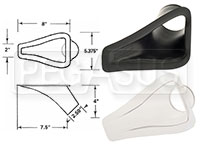
Would a scoop or inlet in the left side fender be beneficial for a SRI?
I've been thinking about this for a while. My idea is to buy a junk driver's side fender and either a) fashion a small scoop and cutout or b) make a cut out and inlet.
I would think the b option would be more beneficial because of drag and maybe less of a bend. The scoop could possibly help induct the air, though.
Would this be beneficial to those of us with a SRI that sits just behind the battery? (In my case the PRM intake) This in combination with a raked hood might be even more beneficial. I would think it might by bringing in cooler air directly to the intake, but I am by no means sure. Maybe those with a more advanced understanding could lend some advice.
I would think the b option would be more beneficial because of drag and maybe less of a bend. The scoop could possibly help induct the air, though.
Would this be beneficial to those of us with a SRI that sits just behind the battery? (In my case the PRM intake) This in combination with a raked hood might be even more beneficial. I would think it might by bringing in cooler air directly to the intake, but I am by no means sure. Maybe those with a more advanced understanding could lend some advice.

Probably not. Google "Bernoulli's Principle"
If the inlet is in an area with high lateral wind velocity you might actually start sucking air out of the engine bay.
If you use a scoop you might get the effect you're seeking but at what cost to your car's overall coefficient of drag? You would only get the benefit of increased cool air at higher speeds, which is where you'll also get the greatest negative impact to aerodynamics.
In my opinion, you might even out the positive/negative effects if you completely seal the intake tract after the inlet, making a ramjet style system with nowhere for the incoming air to go but to the engine.
Of course all of this is theory and you'd have to do scientific testing to see if it works. Testing horsepower gains from engine modifications is hard enough as it is. Throw in potential negative consequences from changing aerodynamics and you've got quite a project on your hands. I'm not even sure how you could do such a thing except maybe with a dyno located inside a wind tunnel.
If the inlet is in an area with high lateral wind velocity you might actually start sucking air out of the engine bay.
If you use a scoop you might get the effect you're seeking but at what cost to your car's overall coefficient of drag? You would only get the benefit of increased cool air at higher speeds, which is where you'll also get the greatest negative impact to aerodynamics.
In my opinion, you might even out the positive/negative effects if you completely seal the intake tract after the inlet, making a ramjet style system with nowhere for the incoming air to go but to the engine.
Of course all of this is theory and you'd have to do scientific testing to see if it works. Testing horsepower gains from engine modifications is hard enough as it is. Throw in potential negative consequences from changing aerodynamics and you've got quite a project on your hands. I'm not even sure how you could do such a thing except maybe with a dyno located inside a wind tunnel.



Probably not. Google "Bernoulli's Principle"
If the inlet is in an area with high lateral wind velocity you might actually start sucking air out of the engine bay.
If you use a scoop you might get the effect you're seeking but at what cost to your car's overall coefficient of drag? You would only get the benefit of increased cool air at higher speeds, which is where you'll also get the greatest negative impact to aerodynamics.
In my opinion, you might even out the positive/negative effects if you completely seal the intake tract after the inlet, making a ramjet style system with nowhere for the incoming air to go but to the engine.
Of course all of this is theory and you'd have to do scientific testing to see if it works. Testing horsepower gains from engine modifications is hard enough as it is. Throw in potential negative consequences from changing aerodynamics and you've got quite a project on your hands. I'm not even sure how you could do such a thing except maybe with a dyno located inside a wind tunnel.
If the inlet is in an area with high lateral wind velocity you might actually start sucking air out of the engine bay.
If you use a scoop you might get the effect you're seeking but at what cost to your car's overall coefficient of drag? You would only get the benefit of increased cool air at higher speeds, which is where you'll also get the greatest negative impact to aerodynamics.
In my opinion, you might even out the positive/negative effects if you completely seal the intake tract after the inlet, making a ramjet style system with nowhere for the incoming air to go but to the engine.
Of course all of this is theory and you'd have to do scientific testing to see if it works. Testing horsepower gains from engine modifications is hard enough as it is. Throw in potential negative consequences from changing aerodynamics and you've got quite a project on your hands. I'm not even sure how you could do such a thing except maybe with a dyno located inside a wind tunnel.
I think an inlet funneled into the intake would be the best bet as you mentioned. The PRM NA probe has something like this if I remember correctly, and they claim that it is the fastest NA probe on the planet. It's also where I got this idea from. If there were to just be an inlet, and the intake tract were to be sealed off, would there be a problem pulling in air that is moving front to back along the skin of the car?

You would want to install the duct in a surface that is as close to a 90 degree angle with the direction of travel as possible. ----> |
The arrow is the direction of travel of the air. The pipe is close to the ideal surface for mounting a ramjet type of intake.

Excuse the child-like illustration, but this is what you mean right? Without something stopping the air (like a scoop), the air will just fly right by?
Would the intake (if properly sealed off) act like a vacuum disturbing the air enough to bring all that cold air goodness in, thus eliminating the need for a scoop?


Member
Joined: Oct 2009
Posts: 4,295
From: Wandering around.

Um... I'm just gonna take a few stabs at this (since I know nothing about ramjetting a car, sri, etc.)
If you have the stock upper grille... drill extra holes into that honeycomb, especially on the driver's side. then, add a piece of really stiff plastic or metal to force the air to turn upwards into those openings in the grille cover (or glue a duct into it!). Better yet, widen those covers a bit too... at least to the size of the opening of the underhood duct.
The way I see it now, the air that goes into that duct is only "left over" air that turned 90 degrees after hitting the A/C condenser.
meh... just a guess.
If you have the stock upper grille... drill extra holes into that honeycomb, especially on the driver's side. then, add a piece of really stiff plastic or metal to force the air to turn upwards into those openings in the grille cover (or glue a duct into it!). Better yet, widen those covers a bit too... at least to the size of the opening of the underhood duct.
The way I see it now, the air that goes into that duct is only "left over" air that turned 90 degrees after hitting the A/C condenser.
meh... just a guess.

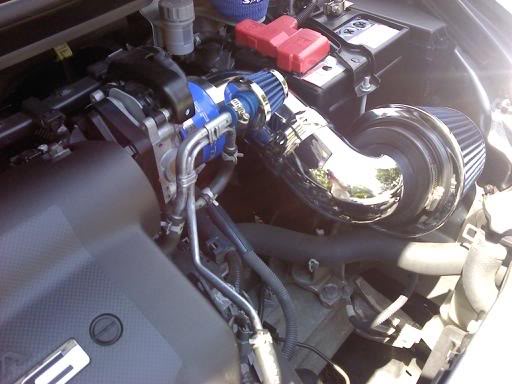
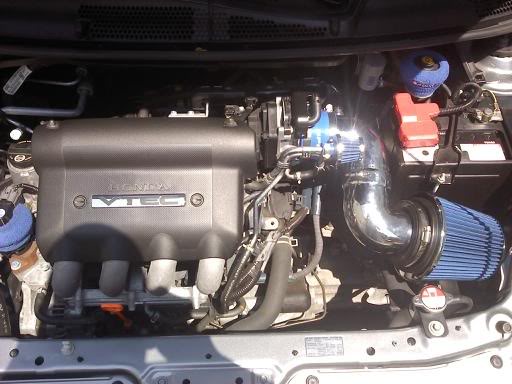


oh 1 quick note Tekeda also makes an intake for the GE.

What difference other than being louder? Nice DIY by the way.



Member

Joined: Jul 2009
Posts: 837
From: Atlanta, GA
If the goal is really to produce a CAI, why not just insulate the duct that runs from the front of the hood to the air box? Space blanket comes to mind.

I've always been concerned about hydro-locking with most of the CAI designs.
Hydro-lock = ruined engine in many cases.
I've always been concerned about hydro-locking with most of the CAI designs.
Hydro-lock = ruined engine in many cases.
Last edited by Selden; Aug 4, 2010 at 05:40 PM.