My mileage story


Member
Joined: Oct 2007
Posts: 2,304
From: Illinois

My fuel mileage has taken a dive since my last oil change using 10w30 and a few ounces of Lucas oil stabilizer...Using the lower viscosity synthetic oil made a huge positive difference, changing to what I am now using has done the opposite... My problem with blow by seems to have subsided at a cost of roughly 4 MPG based on calculations from 1 fill up... There may be other issues that have popped up related to emissions control that also play into the loss of mileage as well that needs to be diagnosed and dealt with.

Member
Joined: May 2010
Posts: 3,417
From: Capital Distric New York
Fuel trims haven't changed, still in the +7 to +11 range. Lyon indicated that they are what he saw when he ran stock.
It's been my experience that oil selection and MPG are difficult to correlate.
Some seem to think it should make a difference, but in reality, from all I've discovered, internal engine friction plays a very small part - if any - in the MPG's calculated by the numbers.
Quality oil does improve engine life, though I've seen little proof that additives make a difference either.
Synthetics have greatly improved lubricating properties and oil life.
Honda does coat the piston skirts in the new Fits w/ moly and it's a reason why they recommend keeping the factory oil [plain old dino] in the crank till the first oil change.
They feel the moly will improve engine break-in. After the first oil change it's done it's job and it's out of the engine by the next change. That's where I'm at and will go over to syn.
Hate to say it, but it's mostly snake oil in a can... but this stretches the topic, so I'll accept being the heretic_
It's been my experience that oil selection and MPG are difficult to correlate.
Some seem to think it should make a difference, but in reality, from all I've discovered, internal engine friction plays a very small part - if any - in the MPG's calculated by the numbers.
Quality oil does improve engine life, though I've seen little proof that additives make a difference either.
Synthetics have greatly improved lubricating properties and oil life.
Honda does coat the piston skirts in the new Fits w/ moly and it's a reason why they recommend keeping the factory oil [plain old dino] in the crank till the first oil change.
They feel the moly will improve engine break-in. After the first oil change it's done it's job and it's out of the engine by the next change. That's where I'm at and will go over to syn.
Hate to say it, but it's mostly snake oil in a can... but this stretches the topic, so I'll accept being the heretic_
Last edited by Krimson_Cardnal; Feb 26, 2011 at 04:15 PM.
Member
Joined: Oct 2007
Posts: 2,304
From: Illinois
Fuel trims haven't changed, still in the +7 to +11 range. Lyon indicated that they are what he saw when he ran stock.
It's been my experience that oil selection and MPG are difficult to correlate.
Some seem to think it should make a difference, but in reality, from all I've discovered, internal engine friction plays a very small part - if any - in the MPG's calculated by the numbers.
Quality oil does improve engine life, though I've seen little proof that additives make a difference either.
Synthetics have greatly improved lubricating properties and oil life.
Honda does coat the piston skirts in the new Fits w/ moly and it's a reason why they recommend keeping the factory oil [plain old dino] in the crank till the first oil change.
They feel it will improve engine break-in. After the first oil change it's done it's job and it's out of the engine by the next change. That's where I'm at and will go over to syn.
Hate to say it, but it's mostly snake oil in a can... but this stretches the topic, so I'll accept being the heretic_
It's been my experience that oil selection and MPG are difficult to correlate.
Some seem to think it should make a difference, but in reality, from all I've discovered, internal engine friction plays a very small part - if any - in the MPG's calculated by the numbers.
Quality oil does improve engine life, though I've seen little proof that additives make a difference either.
Synthetics have greatly improved lubricating properties and oil life.
Honda does coat the piston skirts in the new Fits w/ moly and it's a reason why they recommend keeping the factory oil [plain old dino] in the crank till the first oil change.
They feel it will improve engine break-in. After the first oil change it's done it's job and it's out of the engine by the next change. That's where I'm at and will go over to syn.
Hate to say it, but it's mostly snake oil in a can... but this stretches the topic, so I'll accept being the heretic_
The reason turbos need synthetic is high temps, but my diesel truck uses semi-synthetic oil and is change ever 25000 miles which is 5000 gallons of fuel was burned. Those motors last 500000,1000000 miles before overhaul.
Member
Joined: May 2010
Posts: 3,417
From: Capital Distric New York
Honda seems to have its own ideas on oil, worth watching.
Curious, what's the sump capacity on the truck? the biggest car I had [DeVille] was 8gal and the smallest cat I had [Riley Elf] was 6, but that included the transmission as well as the crankcase. Yup, every time you changed the oil you changed the tranny fluid.
Can't remember the VW...
Curious, what's the sump capacity on the truck? the biggest car I had [DeVille] was 8gal and the smallest cat I had [Riley Elf] was 6, but that included the transmission as well as the crankcase. Yup, every time you changed the oil you changed the tranny fluid.
Can't remember the VW...
Member
Joined: Oct 2007
Posts: 2,304
From: Illinois
Honda seems to have its own ideas on oil, worth watching.
Curious, what's the sump capacity on the truck? the biggest car I had [DeVille] was 8gal and the smallest cat I had [Riley Elf] was 6, but that included the transmission as well as the crankcase. Yup, every time you changed the oil you changed the tranny fluid.
Can't remember the VW...
Curious, what's the sump capacity on the truck? the biggest car I had [DeVille] was 8gal and the smallest cat I had [Riley Elf] was 6, but that included the transmission as well as the crankcase. Yup, every time you changed the oil you changed the tranny fluid.
Can't remember the VW...
Changing just the oil and both the trans and oil are change is a good idea. Just think how much oil would be saved.
Last edited by SilverBullet; Feb 26, 2011 at 08:12 PM.
Going from a 0w20 to a chemically similar 0w30 will not likely yield much in the way of better fuel economy, by the numbers it should though. In practice this can be hard to gauge. Keeping the engine spinning slower is the biggest thing you can do to decrease internal parasitic losses when consider the area of the piston sides and the contact patch on the bores.
Here is something to consider, this applies to a 4G63 with a significantly higher Brake Mean Effective Pressure (BMEP) but the numbers are pretty close for our motors as well.
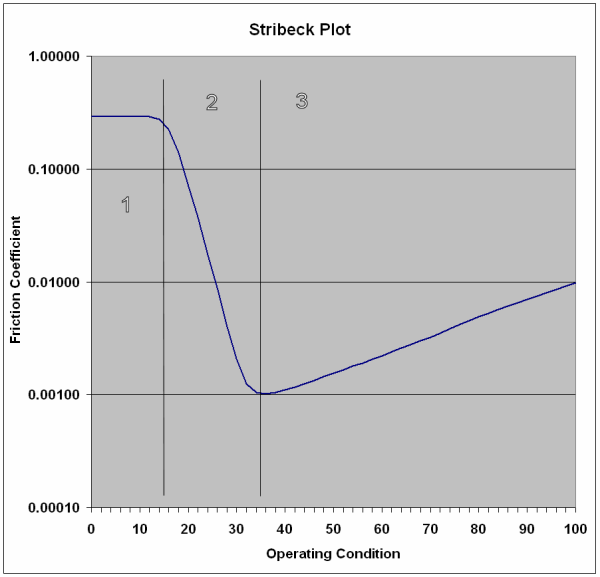
There is something called Bearing Operating Condition(BOC) which can be one of 3 states, but you really only want it operating in the 3rd state, fully developed hydrodynamic lubrication. Which correlates to a BOC of 35+. The formula to find BOC is as follows:
BOC = Viscosity x RPM x Diameter x K / Unit Load
Viscosity is in units of absolute viscosity. "K" is a value to convert RPM and Diameter into surface speed. Unit Load is the applied force divided by the projected area of the bearing (the insert width times the journal diameter).
First, viscosity. I can't find absolute/dynamic viscosity numbers for motor oil, so I took the Kinematic Viscosity of motor oil at 100*C and multiplied it by it's specific gravity.
As I understand it this should give me the Dynamic Viscosity.
Second is the value "K". To find surface speed you multiply circumference by RPM. So Diameter x Pi x RPM = Surface speed, so K = Pi
Third, unit load. I used 12,000 lbs of force, this force if relative to Formula1 type engines, not boosted 4cyls. I know my engines see a BMEP nearly twice that of a formula 1 car, but I don't know how this translates into bearing force, perhaps someone can provide some input here....
I just put a caliper on the main cap and eyeballed it. I came up with an area of 1.425, so a load value of 8421.
Put it all together, 8.4 x 9500 x 2.245 x 3.1415 / 8421 = 66
The optimal range is between 35 and 50 so we are well out of that range.
From here we can use the Stribeck Curve to find our friction coefficient, which I found to be .0057
So with an applied load of 12,000lbs, that gives us a friction load of 68.4 lbs. The diameter of the journal used is 2.245, so 1.1225 x 68.4 = 76.7 in/lbs or 6.39 lb/ft.
At 9500 this equates to 11.56 hp per main bearing!
I have my redline set to 9250rpm at the moment, so it is pretty close.
Now remember those are just the frictional losses on ONE main bearing, this doesn't even account for the friction generated by the cam journals, rockers, valve guides, rod bearings, wrist pins, accesories, etc.
So there are certainly gains to be had going to a thinner oil, as long as that oil is still up to the job.
The thinnest oil I can get away with at the moment (for cold start protection) that still can handle the stresses of the turbos center section (journal bearing, 360*) is a 5w40 synthetic. Originally I used a 20w50 year round, till I read up on Dr. Haas and talked to a few chemical engineers about it.
Here is something to consider, this applies to a 4G63 with a significantly higher Brake Mean Effective Pressure (BMEP) but the numbers are pretty close for our motors as well.
There is something called Bearing Operating Condition(BOC) which can be one of 3 states, but you really only want it operating in the 3rd state, fully developed hydrodynamic lubrication. Which correlates to a BOC of 35+. The formula to find BOC is as follows:
BOC = Viscosity x RPM x Diameter x K / Unit Load
Viscosity is in units of absolute viscosity. "K" is a value to convert RPM and Diameter into surface speed. Unit Load is the applied force divided by the projected area of the bearing (the insert width times the journal diameter).
First, viscosity. I can't find absolute/dynamic viscosity numbers for motor oil, so I took the Kinematic Viscosity of motor oil at 100*C and multiplied it by it's specific gravity.
As I understand it this should give me the Dynamic Viscosity.
Second is the value "K". To find surface speed you multiply circumference by RPM. So Diameter x Pi x RPM = Surface speed, so K = Pi
Third, unit load. I used 12,000 lbs of force, this force if relative to Formula1 type engines, not boosted 4cyls. I know my engines see a BMEP nearly twice that of a formula 1 car, but I don't know how this translates into bearing force, perhaps someone can provide some input here....
I just put a caliper on the main cap and eyeballed it.
I came up with an area of 1.425, so a load value of 8421.Put it all together, 8.4 x 9500 x 2.245 x 3.1415 / 8421 = 66
The optimal range is between 35 and 50 so we are well out of that range.
From here we can use the Stribeck Curve to find our friction coefficient, which I found to be .0057
So with an applied load of 12,000lbs, that gives us a friction load of 68.4 lbs. The diameter of the journal used is 2.245, so 1.1225 x 68.4 = 76.7 in/lbs or 6.39 lb/ft.
At 9500 this equates to 11.56 hp per main bearing!
I have my redline set to 9250rpm at the moment, so it is pretty close.
Now remember those are just the frictional losses on ONE main bearing, this doesn't even account for the friction generated by the cam journals, rockers, valve guides, rod bearings, wrist pins, accesories, etc.
So there are certainly gains to be had going to a thinner oil, as long as that oil is still up to the job.
The thinnest oil I can get away with at the moment (for cold start protection) that still can handle the stresses of the turbos center section (journal bearing, 360*) is a 5w40 synthetic. Originally I used a 20w50 year round, till I read up on Dr. Haas and talked to a few chemical engineers about it.
Last edited by DiamondStarMonsters; Feb 27, 2011 at 12:27 AM.
Member
Joined: Oct 2007
Posts: 2,304
From: Illinois
I just got back and my mpg with 89 is 33.7 down from 34.5 with premium/mid grade mix in tank. My fuel trims are -5.6 LT and ST are -4.7. I noticed the shifting is better and I can coast longer to. Tomorrow when I hit the Intestate is the big test. At almost 4 dollars a gallon I hope to hit 36 average. In the Summer I expect over 40 and gonna change to synthetic 0w20.
Lol nobody has any input on the energy lost to bearing friction?
Sounds like the Mid-grade is treating you pretty well SB! This is a BP 89?
I wouldn't worry so much about your FT's they are going to swing daily even if nothing but the atmospheric conditions change. Altitude density is the main culprit, humidity is a key player as well!
Sounds like the Mid-grade is treating you pretty well SB! This is a BP 89?
I wouldn't worry so much about your FT's they are going to swing daily even if nothing but the atmospheric conditions change. Altitude density is the main culprit, humidity is a key player as well!
Member
Joined: Oct 2007
Posts: 2,304
From: Illinois
Lol nobody has any input on the energy lost to bearing friction?
Sounds like the Mid-grade is treating you pretty well SB! This is a BP 89?
I wouldn't worry so much about your FT's they are going to swing daily even if nothing but the atmospheric conditions change. Altitude density is the main culprit, humidity is a key player as well!
Sounds like the Mid-grade is treating you pretty well SB! This is a BP 89?
I wouldn't worry so much about your FT's they are going to swing daily even if nothing but the atmospheric conditions change. Altitude density is the main culprit, humidity is a key player as well!
Heres a quote about oil treatments from Honda.
Made a powerful film lubrication within the engine, reducing wear and improving fuel efficiency and durability. Oil treatment, by adding engine oil, and serves to enhance the capabilities of the engine oil. Engine parts, in heavy rotation and reciprocating motion, is repeated abrasion of the metal. Organic molybdenum compound is absorbed quickly into the friction surface. Made a direct 触Re合Wanai lubricating film between the metal as to prevent abrasion to smooth sliding with minimal loss of power by a smooth engine operation and improved fuel economy. It also reduces engine noise and improves the durability of the engine.
Fuel treatment from Honda website
Cleaning up inside the engine combustion chamber and intake system, engine performance restoration. Gasorintoritomento not only added to gasoline, carbon deposits adhering to the engine intake system and combustion chamber (dirt) down, to restore the engine performance is a gasoline additive effective cleaning. With less contamination by the new addition, some preventive effect on engine performance degradation. Also, since they burn with the gasoline in the combustion process will not leave residue.
The addition of a tank of gasoline, premium (high-octane) of gasoline - up 20 times the concentration cleaning component 30, 3,000 ~ 5,000 km once every high-mileage car is recommended to use two consecutive Masu.
Last edited by SilverBullet; Feb 27, 2011 at 09:24 PM.
Member
Joined: Oct 2007
Posts: 2,304
From: Illinois
I have to read more but this is what your talking about right? Hydrodynamic Bearings, by EPI Inc.
That is exactly what I was discussing!
Here are the three stages of BOC show on the stribeck curve from the graph in the link you provided!
Member
Joined: Oct 2007
Posts: 2,304
From: Illinois
After years of searching and learning, its easy to know what to look for.
Basically what all that above was to show that there can be an appreciable difference in power "freed" up and increases in efficiency from a mere change of oil grades!
Member
Joined: Oct 2007
Posts: 2,304
From: Illinois
Thats a good point, So it doesn't matter how thin or thick the oil is the boundary layer forms the same way. Then the viscosity is just how much heat is taken off the parts and how fast.
http://www.epi-eng.com/mechanical_en...t_bearings.htm
http://www.epi-eng.com/mechanical_en...t_bearings.htm
Last edited by SilverBullet; Feb 27, 2011 at 10:24 PM.


This may seem like a stupid question but why wouldn't you want a 0w instead of 5w at start up? Anything that flows to the moving parts faster is the best way to go IMO and is why I'm always sticking with 0w20 from now on. I will see soon enough what the combo of the correct warm oil weight (0w20 vs. the 0w30 I WAS running) and monthes of running BP 93 (some 89's in there "just to see") will really net me.
The warm weather is coming, finally
BTW, DSM, your info combined with SB's really make this thread useful, don't mind what that guy said on the other thread about the recall thread and feel free to put up a random "bouncing pair" into this thread at any time, we'll figure a way to work in here and have it make sense
The warm weather is coming, finally
BTW, DSM, your info combined with SB's really make this thread useful, don't mind what that guy said on the other thread about the recall thread and feel free to put up a random "bouncing pair" into this thread at any time, we'll figure a way to work in here and have it make sense
Member
Joined: May 2010
Posts: 3,417
From: Capital Distric New York
Among other things, Ive been reading through and trying to digest the two articles these guys have presented and I've boiled it down to this:
It tells me that the manufacturers design grade on the oil should be followed and the oil change cycle needs to be followed.
I agree with your point on using 0W20 Klasse. It only makes sense.
I think I came to that conclusion during on of last summers oil debate threads. It was news to me, or at least I never put it together before.
You are right in switching to 20weight. I'll be interested in seeing you numbers.
I'm soon to go over to synthetic. Some think it will boost the MPG's but I'm not thinking I'll be able to see it.
Ideally a bearing material should offer low friction properties, but given that in fully-hydrodynamic operation, the bearing surface is separated from the surface of the journal by a thin film of oil, it is clearly the lubricant rather than the respective surface materials that dominates the friction generated under normal running conditions.
Most rolling element bearing manufacturers publish detailed life-load analysis procedures. The bearing life calculations which the manufacturers publish take into account factors including:
- the combined effect of applied radial and thrust loads,
- RPM,
- pitchline velocity,
- lubricant viscosity,
- contamination,
- bearing load ratings, and
- desired probability of survival (failure rate).
I agree with your point on using 0W20 Klasse. It only makes sense.
I think I came to that conclusion during on of last summers oil debate threads. It was news to me, or at least I never put it together before.
You are right in switching to 20weight. I'll be interested in seeing you numbers.
I'm soon to go over to synthetic. Some think it will boost the MPG's but I'm not thinking I'll be able to see it.
I need to order the Blackstone oil testing kit soon. I saved my last oil change which was done back on February 19th. It was Mobil 1 0w30 (used 30 instead of 20 by accident) and it had 9,088 miles on it over a 5 month period of time. I must say that the mileage has gone up right away since switching over to the correct weight but the temp have gone up slightly too. The true test will be when the weather finally breaks and spring is here officially with low's in the upper 30's to 40's and higher. I remember what my car got last year on the trips back home to Detroit, so I'm looking forward to seeing what the combo of correct warm oil weight and monthes of using 93 BP and giving the ECU time to adjust things will make. I'm shooting for 45 mpg on the way back to Chicago, previous record is 43 mpg and while 2 mpg isn't a huge increase and its not exactly scientific due to not knowing the exact wind speed, I know this, the route and cruize speed will be the same, that's always the same
Does anyone know why an OEM wouldn't want someone to run 0w instead of 5w
Does anyone know why an OEM wouldn't want someone to run 0w instead of 5w